Sunday, July 24, 2011

Parc nationale des îles-de-Boucherville (Sunday July 24)

Although Parc nationale des Îles-de-Boucherville has year-round auto-access (by tunnel and autoroute, no less), getting there by public transit is more challenging. Last year I missed the 3-or-so month season of the navettes (ferries) to and from the park. This year I was determined to make it over at least once. A couple of weeks ago, I'd looked at the temperature and wilted. This weekend, newly hardened by our "heat dome", I didn't look; I made my plans, packed my bag, and set out.
ParcBoucherville
The navette from the Montreal side leaves from Parc Bellerive on the east island. With Sunday bus service, I figured I was going to miss the first ferry at 10 am, but it was still there when I trotted up to the dock about 5 minutes past. I paid my $8.00, clambered aboard. Brisk zip with a certain bounce along the St Laurence to the dock on Île Charron (that's the incoming dotted line to the upper left of the island-mass on the map), past a formidable looking radar monitoring station and into a rectangular bay of calm stale water, with a slight whiff of anaerobic mud.
This did not put me into the Parc proper; rather disconcertingly, I climbed up the short path from the dock and I found myself plunk beside a roaring highway, rising up from underground. However, a dozen or so yards away, a cinder track turned off to the left and I left it all behind. All the other ferry passengers had bicycles, so I shortly found myself alone, tramping across Ile Charron; the map said 3.5 km to the Centre de Locations, about half way down the channel between Île Sainte-Marguerite and Île Saint-Jean. I'll compress the land-bits, save that the temperature was already heading for the high-whatever and I was feeling the lack of shade because of the well-cleared zone around the path, I gave one of the local lifeforms a flying fright, catching only a glimpse of reddish flank and a great thrashing wave retreating through the tall grasses (I was put in mind of Sheri Tepper's Grass, though obviously it was not a foxen). I crossed over a road-access, and walked by two parking lots, something that seemed mildly surprising and ever so slightly indecent. At the entrance I paused to puzzle over whether or not I needed to put a bit of my ticket in the self-pay envelope to establish I had paid the entrance fee - which I knew was included in the ferry fare - but decided I probably needed it with me. As it turned out, I was right.
Once in sight of the rental shack, I had a gazpacho-break in the broad picnic area, and then went and snagged myself a boat ($35 for 3 hours). I did not (remiss of me) take a note of the name, save that it had 6 letters, and was Inuit. The kayak was bright red, hard glossy plastic, with a rudder, probably a 14'. Very comfortable seat with good back support. Foot-pedals on a strap, sparing me the usual contortions adjusting them as I floated offshore, having cleared the busy beach. I need to bring my sandals next time - paddling barefoot is too hard on the heels, but walking 7 km in those sandals is too hard on the feet. On the deck, waving like a tongue, was a laminated Parc map about 9 inches long, secured at one end. The man at the booth assured me the circuit on the map was doable in 3 hours, and that I should start by heading south.
However, in not looking at the temperature, I also missed taking note of the wind. I have no photos of the initial paddle down Chenal Grande Riviere. The paddle I had was fixed, not feathered, and felt shorter than I was used to, and I needed to hold my course between the reeds and various pleasure-boats, against the wind. Later I read it was 15 kph N with gusts up to 30 kph, per environment Canada, but even by Montréal's idiosyncratic definition of directions, that wasn't a north wind. I hugged the reeds along the right shore until the debouchment into the Fleuve Saint-Laurent, checked for oncomings, and slogged across the choppy water to start along the south shore of Île de la Commune. There are no photos of this section, either, because I still had the headwind, and in addition, had wakes kicked up by the assorted pleasures boats' more energetic cousins, all the way to the turn-in to Chenal la Passe. I also had company, a couple in a red rented double, a family of three in a canoe who could not all paddle in the direction at the same time, and a couple probably in their own boats, bold enough to swing out clear of the shallows and the worst of the chop. I think they all had more ambitious plans than I, because when I turned into the Chenal la Passe, none of them followed me.
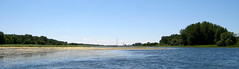
Something else did. I was admiring the wooden bridge which carries the foot/bike path over the Chenal, when I heard a clatter of outboard behind me. It refused to be willed away, and further asserted itself with a puff of diesel flatulence, before parking in the middle of the channel. I can haz torpedoz, I darkly muttered, and scooted past before the fishhooks came out. I met the breeze again coming down, making that five points of the compass it covered, though it was much lessened. And when I got to the top of the Chenal and turned west, putting the wind more or less at my back, and hitched myself around (flexibility exercises! must do!) and discovered that although I had not checked that the rudder was unhooked, it was unhooked, and I could flip it down - suddenly my Sunday workout became a Sunday cruise. On both sides I had reeds and what seemed a thin line of low trees. Straight ahead, I could just see civilization in the form of a pylon. The omnipresent city hum was almost inaudible. On the way up the Chenal, I caught sight of a kingfisher, glimpse of blue and pale, dashing past, a little mustard-coloured finch-like bird, dotting from leaf to leaf, the ubiquitous red-winged blackbird, and the hovering black-winged seagulls. Though the map suggested one hugged the shore, I needed to steer wide around mats of frothy spew of yellow-green weed (the only way to describe it). In amongst the reeds, I could see water-lilies. There was the occasional white one, open, and faintly luminous, with the peppering of tiny insects in the base of the cup, but more of the closed fist-like yellow ones, pushing above the waters on their stems.
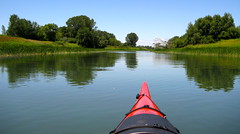
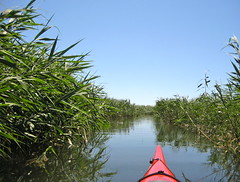
Parc de Boucherville, Chenal la Passe from the kayakParc de Boucherville, Chenal du Courant from the kayakAmong the reeds. Parc de Boucherville, Chenal du Courant.
Then the reeds closed in. Shiny, green, about 3 feet high, with the wind hissing through in a mean-girls whispering; they narrowed the passage down to a single navigable channel. The movie clip captures the motion and something of the sound, though coarsely through the little microphone. I think that sudden flight of birds is of red-winged blackbirds, and the creaking is the sound of my plying the rudder, steering. Just after I had put the camera down, two double kayaks, as red as mine, appeared before me, and we were occupied in trying not to run into each other as we maneuvered past. I heard the occasional grunt and mutter of a heron, but only saw one, when it launched to my left and floated parallel to my course for several impossibly slow wingbeats, before it settled out of sight again. It was one of those long suspended moments that are still far too short to go for a camera. Something behind me started shrieking and crying in piteous alarm, though I have no idea whether I was the provocation, or what it was. Once out of the reeds, I paused to drink yoghurt turned liquid the warmth and finish my Jamaican pastry. Then I carried on down the channel past assorted route markers and the occasional cryptic sign, thinking about the unmistakable high summer blue-green of the foliage, just before it starts to look tired.
Chenal la Passe turned into Chenal Grande Riviere, and I was very shortly back among the pleasure-boats, with the bronzed and bodacious disporting themselves. A large shaggy golden retriever on the deck of one gave the peasant in her kayak the stern retainer's eye. The circuit had taken me 2:15 hours, and though I was tempted to turn back amongst the reeds, I was tired and my eyes were dry and scratchy. So I beached, off-loaded, and, the attendants being occupied, discovered that using the trick of lifting the boat onto my thighs before shouldering it, I could heft a plastic kayak pushing 50 lb. Though I would not have wanted to load it onto a roof-rack solo, and maneuvering with only a 90 degree field of view and 7 feet of kayak sweeping fore and aft is not something I like to do with as many people around - so in future I will wait. But I returned it to its rack without injury to myself or anyone else, and my return was timely, because the line at the rental shed was getting ever longer and the supply of visible boats, dwindling.
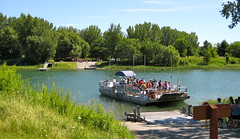
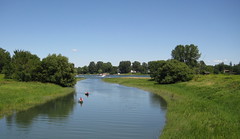
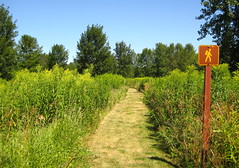
Parc de Boucherville, cable ferryParc de Boucherville, Chenal la Passe from the bridgeParc de Boucherville, path on île de la commune
Back on land, I'd the choice of walking back to Île Charron and taking the navette back to Bellerive, or continuing on to the other dock, walking along the shore I'd just paddled beside, crossing over Chenal la Passe and getting a shuttle over to Boucherville itself. The distance, walking, was about the same, and I wanted to scout out the second route, which seemed to me the most feasible way of bringing the Dragonfly over. So I got to see a quite different aspect of the island, because although from the water it looked wildish, inland, it had been cleared and put to the plough and looked not unlike parts of central Saanich. I crossed the Chenal Grande Riviere on the cable-ferry, and the Chenal la Passe on the bridge I had admired. On foot, ducking down the grassed footpath which ran parallel to the track, I was in a minority, most everyone else being on bicycles. This time I knew I'd miss the ferry, which according to the schedule left on the half hour, but I was pleasantly surprised to discover that, whatever the schedule said, the ferry was only pausing to off- and on-load passengers. My ticket turned out to be a return, and I hopped aboard, bound for Boucherville. The young man at the helm took off with brio, including some wide swishing turns that kicked up white spray and were - fun. Yes, indeed, maybe I can understand the appeal of going really fast over the water. (But I didn't squeal.) My luck held at the other side, because after a short, pleasant wait, the hourly bus (81) hove into view, and I had even had the foresight not to spend all my change. The one downside of the southern route is the Boucherville bus is a separate fare from the Montreal one; on the other hand the ferry is cheaper. And so to the Metro station and back into town.
Here's the first selection of photos; there may be more.
Parc de Boucherville, Chenal la Passe from the kayakParc de Boucherville, Chenal du Courant from the kayakAmong the reeds. Parc de Boucherville, Chenal du Courant.Parc de Boucherville, Turning into Chenal Grande RiviereParc de Boucherville, cable ferryParc de Boucherville, Chenal la Passe from the bridgeParc de Boucherville, , Chenal la Passe from the bridgeParc de Boucherville, thistlesParc de Boucherville, path on île de la communeParc de Boucherville, BridgeParc de Boucherville, meadow on île de la CommuneParc de Boucherville, navette departing Boucherville

Wednesday, July 20, 2011

Rowed Trip

Adventurers Colin and Julie Angus decided early in their marriage to explore the roots of their respective families -- Colin's from Scotland, and Julie's from Syria and Germany. Since Colin had previously circled the earth under human power, joined on part of his journey by Julie, another human-powered expedition seemed to be in order. They choose to row and bicycle from Scotland to Syria, travelling the canals and rivers of Europe in a pair of specially designed row boats whenever possible, or towing them behind their bikes on trailers when rowing was impractical.
The resultant trip is documented in their book Rowed Trip. From the north of Scotland, peddle and paddle their way down through England, out the Thames, across the English Channel, through France and Germany, then down the Danube to the Black Sea to Syria, this fun and exciting read recounts the Angus's encounters, from with snotty lock-masters along the canals of England and border bureaucracy in Europe, to the seemingly endless supplies of hospitality and assistance offered up by total strangers. In fact, if there is one theme that runs through this and the Angus' previous adventures, it is that almost every stranger they encounter willingly offers kindness and good cheer, if not food and lodging.
This is another in the Angus' growing library of well-told expedition stories.

Tuesday, July 19, 2011

Fuel Spill Update

Remember that fuel slick we saw in Tod Inlet last week, Sunday July 12? I wrote a note to Columbia Fuels asking if it could possibly be lingering fuel from the spill in Goldstream River back in April. There's been a reply from Shawn Samborsky, Environmental Manager of Parkland Fuel Corporation.
It's a pretty helpful note. I won't quote it here, but it basically says that Tod Inlet is several kilometres along Saanich Inlet from the Goldstream River estuary. Most of the spilled fuel from the April spill seems to have either evaporated or dissolved within a few hundred metres of the estuary right away, so it probably never reached Tod Inlet. It's not at all likely that the fuel would still be floating months later, even on the surface of a quiet, sheltered inlet.
Shawn Samborsky also passed on word about the Tod Inlet slick to the Department of Fisheries and the Ministry of the Environment. It's good that attention is being paid to this smaller fuel spill.
As small boat users, we kayakers have the opportunity to notice environmental problems such as this fuel spill. Sometimes we're the first to see a problem. It's important for small boat users to add to our safety preparations -- not just by wearing a PFD and carrying a rope and taking a first aid course, but by learning the local phone numbers for reporting environmental problems. I feel better prepared now, knowing these phone numbers.

Sunday, July 17, 2011

Floored

So apparently oppressive heat is blanketing the much of the country this weekend. Sure, whatever. Here on the we(s)t coast, The Summer That Never Arrived continues to, well, not arrive. Louise and I had the last week off and we were presented with cool, cloudy days, topped with showers and breezes. Of course -- we were on vacation!
So given the iffy weather we planned a little home reno job for Sunday instead of kayaking, and naturally Sunday turned into one of the better kayaking days of the week. Cloudy but 19 degrees, calm winds, and the forecast rain held off. At least our luck is consistent.
So with the help of Paula and Bernie, we ripped off the old living room carpet....
IMGP1060-1
...and found this.
IMGP1062-1
We knew the original hardwood flooring was under there, we just had no idea that it was in such good shape. And look at that dark oak inlay -- awesome!
A few hours later, the living room looked this, only not quite so blurry and out of focus.
IMGP1067-1
The foreman was very pleased with the result.
IMGP1069-1

Friday, July 15, 2011

About Fuel Spills

Well, so far there has been no response to any of my e-mails to BC Parks or Columbia Fuels about the fuel slick we found in Tod Inlet on Sunday, July 10. But I did discover that there is an official provincial emergency number to call to report hazardous materials and oil spills! And thank you to our reader Jo, who also put that information in our comments.

Here in British Columbia, call the 24-hour Spill Line toll-free at 1-800-663-3456 to report when you see a spill of gasoline, oil, or any other kind of hazardous material. The Spill Line is just one part of the Provincial Emergency Program. This particular office responds to reports of emergencies on land but will take calls about spills on water and forward the case to the appropriate federal agency. This same toll-free number can be called any time of day or night to report any kind of emergency including flooding, boaters in distress, or wildfire. Here's their Weekly Incident Report from last week. Busy people!
Anywhere in California, Oregon, Washington, and British Columbia, call the International Marine Oil Spill Reporting line toll-free at 1-800-OILS-911 to report when you see a spill of any kind of fuel on the water.

Those are good phone number for kayakers to know. I now keep them on the cell phone that I carry while on the water, as well as the number for the DFO’s Observe, Record and Report 24-hour hotline at 1-800-465-4336. That number is toll-free. Call to report any sightings of marine mammals in distress. Or if you happen to see any sea turtle, healthy or in distress, call the DFO!


There are other citizens concerned about fuel spills, who are working to promote public awareness and to encourage corporations to behave responsibly. Check out the report at the Dogwood Initiative about one local kid's group and their activities!

Thursday, July 14, 2011

Baby Whales!

As sea kayakers, it's nice to keep in touch with what the neighbours are doing. Even if we're the "light" version of sea kayakers. Because the neighbours are whales.
Yup, killer whales, actually. Orcinus orca. The largest of the dolphin family, they are longer than our kayaks and very big and strong.There are three local pods of resident killer whales: J, K, and L pods, adding up to fewer than a hundred orcas. We've been lucky enough to see them from small boats, when Bernie & I were out in Straitwatch's zodiac, and John & Louise were out whale-watching. Haven't seen them so far from our kayaks. If you're thinking of looking for whales, be sure to check out the laws for viewing whales and other large marine animals.
Still, it's nice to know things are going well enough for the local whales this summer that two babies have been born! Cara Lachmuth from Straitwatch reports: "We've been quite busy on the water and it's been really exciting with two new southern resident calves. On July 6th a first time mom in K pod had a baby (K44), and L pod had a new calf (L118) on June 17th. Both pods have been around the past few days so we've enjoyed seeing the little ones."
Scroll down here on Kayak Yak and look for the earlier blog post that John wrote about when he and Louise went whale-watching this month! One of his photos shows a little baby whale. Odds are, that's one of these two new orcas. Wonderful!

Monday, July 11, 2011

Fuel Spill in Tod Inlet

Yesterday, while kayaking in Tod Inlet, we came across a fuel spill. It's awful to see such a mess in such a lovely place. When kayaking, the fresh air smells so good coming off a lake or sea water, but this breeze smelled awful. The hulls of our boats were scummed when we came back to shore.

Tod Inlet is only a few minutes away from the dock at the Brentwood Bay/Mill Bay ferry, but when you're in the inlet, you can't see any of the houses that are only half a mile away. Even Butchart Gardens is invisible, behind a curtain of trees. This is a photo of the ferry we have to watch out for when we're paddling in Brentwood Bay, from the BC Ferries website.In winter, the inlet is empty of all but a few live-aboard boats near the opening to Brentwood Bay, and kayakers feel like we're paddling in an isolated fjord up the coast somewhere. In summer, the inlet has dozens of small sailboats and motorboats moored along the shore of Gowlland Tod Provincial Park. Every time we go there in our kayaks, we see a different assortment of sea life. Sometimes we see seals, and on the shore are raccoons. We've found smacks of jellyfish, and groups of purple sea stars. There are eagles overhead, herons fishing, and dragonflies humming past our heads. This time, we noticed several small fish leaping in the water, breaking the surface alone or in groups.

So, what does a responsible kayaker do on finding an oily slick on a place like this, inside a provincial park? We're not sure. But we're finding out.

First place I've contacted is BC Parks, through the feedback page on their website. I also sent them an e-mail note at their @ddress ParkInfo@Victoria1.gov.bc.ca. Then I sent a note to Columbia Fuels, the company that owns the truck that crashed on the Malahat Highway on April 15, sending 40,000 litres of fuel into the Goldstream River. Columbia Fuels has been working as part of the team cleaning up what can be done in Goldstream, and they have an e-mail @ddress for queries about this fuel spill -- malahat@columbiafuels.com . I've also contacted a couple of reporters for the Times-Colonist newspaper, who reported on the fuel spill in Goldstream. Much of that fuel spill apparently went into Saanich Inlet, and Tod Inlet is connected to Saanich Inlet. We'll let you know if anyone has any news about what's going on with this oily slick in Tod Inlet.

Sunday, July 10, 2011

It's a Gas

Project1
Louise and I met Paula at Brentwood Bay for a quick paddle.

Paula was in her inflatable today, so we thought we'd stick close to shore and meander down into Tod Inlet. From our put-in beside the ferry terminal we turned to the south and crossed towards the Inlet.
2011-07-10 Tod Inlet_0060
Someone followed us for a while.
2011-07-10 Tod Inlet_0062 copy

As we entered Tod Inlet, and Gowlland Tod Provincial Park, Paula put ashore for some adjustments to her boat....
2011-07-10 Tod Inlet_0064
...while this heron enjoyed a little breakfast.
2011-07-10 Tod Inlet_0030 copy

As we paddled down the inlet, we saw many sail boats and cabin cruisers that had moored for the night.
2011-07-10 Tod Inlet_0069

But as we paddled by this eagle....
2011-07-10 Tod Inlet_0036
...we realized that we were paddling through a slick of oil or gas on the surface on the water.
2011-07-10 Tod Inlet_0073
It wasn't very thick, nothing more than a thin skin on the surface, but it was everywhere. The whole southern end was covered in it, and occasionally Paula and Louise would gag when the wind shifted and they inhaled a lungful of fumes.
We initially assumed that one or more of the boats moored in the inlet had had a fuel spill, but then we recalled that there had been a major fuel spill into Goldstream River a couple of months ago. Goldstream River does not connect directly with Tod Inlet but it does with nearby Saanich Inlet. Could tidal action have pushed the fuel out of Saanich Inlet into Tod Inlet where there it sits, slowly evaporating?
It was a depressing thought that the fuel in the water that was spoiling the inlet was not being attended to, no matter how it got there. The only upside was that the animals did seem to be avoiding the area.

We turned around and headed back...
2011-07-10 Tod Inlet_0078 copy
....and watched a heron cruise in for a landing.
2011-07-10 Tod Inlet_0039 copy
He got into a staring contest with us.
2011-07-10 Tod Inlet_0046
I think he won.

Louise checked out some sea stars...
2011-07-10 Tod Inlet_0084 copy
...and then it was time to head back.
2011-07-10 Tod Inlet_0070

Trip Length: 6.08 km
YTD: 137.01 km
More pictures are here.
2011-07-10 Tod Inlet

Saturday, July 09, 2011

Kayak Review -- the MiniTripper

The newest kayak to join the Kayak Yak fleet is a kayak designed especially for small people -- specifically, kids.


No, I didn't save up my pop bottles and buy yet another kayak. I bought a raffle ticket at Paddlefest in Ladysmith. Bernie and I returned to the Beach House that Sunday May 15, only to get a phone call saying that we had won the raffle prize of a kayak.

The next weekend we went up to Sealegs Kayaking on Transit Beach to pick up our prize. It turned out to be a MiniTripper -- a new design from Jackson Kayaks. It's a recreational boat, a smaller and lighter version of their DayTripper. It's something like a cross between a canoe and a kayak with its wide-open cockpit. Here's a photo of a kid in the MiniTripper from the Jackson Kayaks website, with what appears to be his dad in a DayTripper behind him.


A couple of times this summer, I've taken the MiniTripper out in the sheltered waters of Cadboro Bay. These short test runs have worked very well, though I'm heavier than the recommended maximum weight for this model. At five foot one, I'm not really taller than the kids expected to paddle the MiniTripper. Until I can get our friends Sophie and Mark, or Jeffrey and Thomas, or Erican and John, to try it out, I'll be our test paddler.

The MiniTripper is a convenient size at a bit over 9 feet long and 23 inches wide. It's a very portable 27 pounds, even with a reinforcing bar in the keel. I have no trouble carrying it a few hundred yards. Two kids could carry it to the beach easily, by the handles at bow and stern, or one kid dragging it along the ground. Parents, be aware of this portable quality: it's possible for an un-supervised child to get this boat to water without assistance!

Once on the water, I find the MiniTripper is a nice, simple ride. It's quiet enough that I was able to surprise a river otter today. It's fast enough that I paddled three kilometres in less than an hour, without breaking sweat or getting tired.

I find it less stable than the Lagoon from AdvancedElements (which is 34 inches wide), but with a bit more glide. I'd recommend doing some deliberate tipping over sideways in safe conditions, to get used to how the MiniTripper responds to the paddler leaning. You can even edge this boat a little! But you can't edge it up on its side like Bernie can a Pamlico 100, which is ten feet long and 30 inches wide. That's because the MiniTripper is a very shallow boat. There's not a lot of height above water here! It's a terrific experience to paddle a kayak with a cockpit rim that's lower than my elbows and knees. But then, this boat is designed for small people.

I like the open cockpit for the easy-in, easy-out feel. The open cockpit means a lot of water can drip off the paddle blades onto the paddler's legs and feet. There's plenty of room for two small people to ride, with a dog or some watertoys behind the paddler. I could easily imagine this boat being used by two or three swimming kids climbing in and out, rolling it over, and having noisy fun at a shallow beach. There's minimal flotation in the MiniTripper. Two blocks of closed-cell foam in the bow and stern are it, with no bulkheads.

My verdict: the MiniTripper feels like a fun boat for paddling flat water in sheltered places. A paddler around five feet tall can handle it easily. The Jackson Kayaks website claims that a three-year-old weighing forty pounds can paddle this boat. Having seen what Erica and John could do at age seven and five, I can believe that's possible.

Friday, July 08, 2011

Ganges!

No, not the holy river in India. The town on SaltSpring Island. In a masterpiece of coordinating weather and transportation, technology and nature, I was able to enjoy kayaking in Ganges Harbour. The weather report called for sunny skies in the afternoon, and a wind warning, but I left the house just after 7:00am planning to have a good day even if weather didn't let me get on the water. The clouds were enough to keep the day from getting hot, but not enough to rain. Score!


It's been months since I was last able to visit SaltSpring, and then I was only able to putter around Fulford Harbour. Nice, but I'd done it before. This time, I was able to hop on the little community bus and catch a ride to Ganges. Some 14 km from Fulford, the trip to town is too far to walk while trundling the Expedition, a 43-pound kayak, bagged up with a PFD, two paddles, a big air pump and a small emergency pump, a water pump & throw bag, and a small dunk bag. I had no trouble getting the gear onto the regular transit buses in Victoria (especially when a fella helped me lift it onto the #70) or onto the ferry at Swartz Bay. But since I was the last person onto the ferry, my kayak on its luggage roller got trapped at the stern behind some tightly-parked cars. When the other foot passengers walked off and got on the community bus, I was stuck until the cars had cleared. The bus was gone by then, but no problem. It was nice to poke around in Fulford for a while.


Waiting for the bus gave me time to go into Rock Salt (lovely little bistro) and eat some of their excellent chocolate mousse. This isn't the only cafe or restaurant in the village, but it's the one I like best. And they'll fill your water bottle without charging you an arm & a leg! And around the corner, past the post office, is the best place to find sundresses and scarves.


After shopping a little and walking around, I read a local magazine till the bus came. The kayak case was almost too big to wrestle onto the bus, but with a little help I got it onto the front seat where it rode in splendour, stared at by all the bus passengers. The bus driver Don was very helpful, and even suggested that I use the boat ramp next to Centennial Park in Ganges' small "downtown" area. The ramp was perfect for my purposes. I hustled onto the water, not wanting to linger on the ramp. Wet tracks showed that this ramp was in use already that morning.


Just outside the breakwater is Grace Island, with a shell beach that's exposed at low tide. So neat to look at the tons of crumbling shell and realize that people have been eating clams and oysters here since before the Pyramids were built in Egypt!


There's a lot of traffic in Ganges Harbour... cormorants, seals, and ravens as well as the kind of traffic that treats kayaks like speedbumps. I'm used to sailboats and motorboats of various kinds, but the Harbour Air floatplane certainly had the right-of-way as far as I was concerned. I got out of the heavy traffic channel quickly, and popped over to Goat Island.


Here my cell phone came in good use. Nice to be able to let Bernie know that I did get to SaltSpring like I'd hoped, and that I planned to be on the 3:40 ferry back from Fulford Harbour. Plus, I took a photo of the lacey sandstone rock, weathered by the waves. All through this conversation and drifting, a great blue heron kept on fishing from a rock on the other edge of a tiny cove. Go heron!


Here's a link that my SPOT device sent out with an OK message, when I pushed the button at the other end of Goat Island, the south end, at exactly 48.8483 latitude, -123.47523 longitude. The message is supposed to be reassuring to friends & family that I am OK on the water. But it also seems to serve as a bit of crowing with delight, "I'm on the water! And letting you know about it, even if you're at work or home with a cold!"

I looked across a channel at Deadman Island, knowing there was just time to nip across and back before beginning a leisurely return along Goat Island back towards the shore. But then, a seal popped up and stared at me. I paused to send the OK message on my SPOT. The seal popped up again and stared even harder. Y'know, this was really the seal's place. I didn't have to go past it to see that other island for a moment. I'll go see it some other time. Better to head back early when I'm paddling alone. It was nice to take my time looking at the wave-worn shore and the arbutus trees, and another float plane roaring past.


My cell phone rang at Grace Island, on my way back to shore. Bernie checked in, and made sure that I knew about the wind warning. The gusts had just hit at Victoria, and he knew it wouldn't be long till the weather front made it north to Ganges Harbour. I reassured him that I was ten minutes from the boat ramp. Technology is our friend at moments like this! And for sure, half an hour later while I was onshore packing up the Expedition in a leisurely way, the wind started to pick up.

With everything packed, I trundled the roller along to the Visitors Info Centre where the buses all stop. Got out my knitting and did a few more rows on the latest project. Wrestled onto the bus, rolled onto the ferry, and enjoyed a day that had turned sunny & bright when the wind came howling in. Cruise ships don't come any better than this, lounging on the upper deck with people getting windburned brown and seals below surfing in the waves. What a day!

Thursday, July 07, 2011

Crowded

It's summer! It's finally felt like summer for more than one day at a time inbetween cool days that are more like early spring or late autumn. And how do we know it's summer? Is it by the number of paddlers bringing their kayaks to the beach to enjoy Cadboro Bay?
Nope. Though there are, indeed, a plethora of paddlers. Anytime there's ten cars or trucks in the parking lot at Gyro Park with kayak racks on the roof, yep, that does feel like good weather. No, the cardinal sign of summer in Cadboro Bay is a crowd of PEOPLE.
Yes, they're out in small boats of various kinds. But hundreds more are on shore. They're all over the beach. They're setting up volleyball nets in the field. Every picnic table is in use. The concrete animals (giant fish, giant octopus, Cadborosaurus and a sunken ship) are covered in young people climbing up & down. The benches have little socks and shoes displayed on the seats and backs. It's easy to get home wearing one sock, but one sandal? You'd think even a five-year-old would notice...
By commenting on the crowds on summer days, I'm not saying that the park is empty the rest of the time. Summer nights have a steady stream of people progressing along the beach or through the park. There's people here every hour of the day or night, year-round. It takes a wet snowstorm on a winter's night for the only people in the park to be Bernie and me, walking our landlady's dogs (yep, we're nuts) or on a winter's day for us to be salvaging an abandoned kayak that went adrift in a storm.
But in summer, the parking lot is full and some drivers park on the field. There's a steady rumble of wheels from li'l wagons full of kids and coolers full of beer being rolled along as neighbours walk to the park and visitors walk from the #11 bus stops. But those little rumbly wheels don't bug me like cars do! If everyone in that crowded park walked in from their homes or the bus, I wouldn't be half so crowded by the crowds. It's the car traffic in and out of Gyro Park that gets on my nerves. I swear, one morning all the parking places in the lot are going to be painted with "Handicapped Parking Only", "Boat Loading Only", and "Bus Only" -- on that day, do NOT ask me why there's paint spattered all over my paddling clothes.
It's not that I don't want to share this wonderful park with everyone who comes here. Well, maybe it is. Maybe after walking and kayaking at this beach year-round, and trying to disturb the seals, otters and herons as little as possible, I resent coming to the shore and seeing humans stacked like driftwood everywhere. The other day, the only wild creature I saw was a bald eagle hovering very high over the beach on an updraft. Even at that height, I could tell he was scowling.
But, I shall try to accept the crowds. After all, they're only here in bright summer weather. And they do pick up nearly all of their trash. And on the outside of the trash bins, the racks for pop bottles are full, so that when the scruffy guys come through the park collecting bottles it's easy to find 'em. And maybe this year most of the able-bodied people without boats will learn to hike or take the bus to the park.
But darn it... it's a lot harder to get my little inflatable kayak or the new Mini-Tripper to the beach without thwacking into someone in the crowd. And my wet suit has a mend on the bottom. *sigh* Vanity is a sin, anyway.

Wednesday, July 06, 2011

Post #1000

Almost six years ago, I took up kayaking as a hobby, and started this blog. And here we are at Post #1000. Until six years ago I had never been in a kayak in my life -- it never even occurred to me that kayaking would be something I'd even want to do. But Paula and Bernie picked up a used playboat from a rental place late in the season, and I thought I'd give it a try.
I sat in the seat of their little red Pamlico, barely longer than I am tall, and pushed off into Elk Lake. "Oh. This is nice. Oh. Oooooooooooooh."
Well, I was hooked.
The blog was originally meant just to be a record of our paddles. I brought my camera with me almost from the very first paddle (except for the infamous time that I forgot all of my cameras at home - d'oh!), and keeping an online visual record of our meagre adventures seemed only natural. However, over time we've expanded a bit to include local and not so local paddling news and features. Just whatever strikes our fancy.
Here's some things about the blog that you may not know:

Most Popular Page
Is the most popular post on the blog a scintillating write-up on a local paddling issue? Or a post featuring terrific nature photography? Or a paddle report report from a wonderful day on the water?
No. It's these guys ambushing the Google Maps car in Norway:
But among our top ten most popular pages are a book review, a commando kayaking report from Toronto, a kayak review, and another kayak review. And, of course, William Shatner.

Top Search Terms
Surprisingly, the most popular search term people use to get to this site is "fireball whisky." This is not entirely off-the-wall as this post featured a picture of a bottle of Dr. Magillicuddy Brand Fireball Whisky Shooter that I had fished out of The Gorge.

The second most popular search term was "kayak," and the explanation of that seems fairly self-evident. Next was "google maps fail" (see the Norwegians in wetsuits above), "golden spruce", and the always popular "jet powered kayak."

Top Ten Visitor Countries
Almost 40% of the blog's readers come from the US, with Canada second at just under 32%. The top ten are rounded out by the UK, Austalia, Germany, France, Sweden, Spain, Italy and the Netherlands. In all, the blog has been visited by readers from 156 different countries, which isn't a bad percentage considering the UN currently recognizes 203 countries.

Top Ten Pictures
What are the blog's most popular pictures, I hear you ask? (Yes, my ears are that powerful.) According to my flickr stats, the most popular picture we've posted is this one...
2008-07-03 Esquimalt 403
...of the Fisgard Lighthouse, part of the Fort Rodd Hill National Historic Site, taken from my kayak in Esquimalt Harbour looking back at the Olympic Mountains in Washington State. And if I can be somewhat immodest, it's a great pic. We put in at Esquimalt Lagoon and paddled into the Harbour, and as we passed by the lighthouse, I looked back and saw that it framed perfectly by the snowy peaks. I knew that when we paddled back I would be stopping for a few minutes to take a few pictures. And I did -- until the MPs zoomed up in their Zodiac and told us to move on. (The original post is here.)
The next most popular photo is this one...
IMGP1015
...followed by this one...
IMGP1102_edited-1
...then this one...
IMGP0986
...well, you get the idea. 10 of my top 11 most popular pictures are of Advanced Elements blow-up kayaks. Somewhere along the way, these pictures were linked to in an Advanced Elements discussion group and they still generate a few hits a week.
Popular pic #12 is my left shoulder and all the hardware it contains.
Why I'm Not Kayaking Very Much These Days
And you can read all about that here.
Next up in popularity is this one...
Deer Coming Out of the Water 2
..and this one.
The Olympic Mountains from Victoria
And yes, it's the same group of peaks as in the lighthouse photo above. When you've got props as good as these, you might as well keep using them. And thus endeth the picture portion of the post, as the next five photos are more of those Advanced Elements pictures.

Thanks for reading. See you in another 1,000 posts!

Colin Angus Rows Around Vancouver Island

Colin Angus has completed his circumnavigation of Vancouver Island in a row boat. He did it in a time of about 15 days 12 hours, breaking the record for fastest human-powered circumnavigation of the island set by Joe O'Blenis. (Joe still holds the record for a kayak: 16 days, 12 hours and nine minutes.) Colin battled severe tendonitis in his legs and wrists, but still managed to complete his trek. Check out the details on his blog, including more photos from his adventure like this one.

Tuesday, July 05, 2011

Teenaged Kayaker Lost off Hornby Island

A sad time for the local kayaking community. Last Wednesday, a 16 year-old boy pushed his recently purchased kayak into the waters off Sandpiper Beach on Hornby Island in the early afternoon. He has not been seen since. He was reported missing in the evening, and a couple of hours later his flooded kayak was found.
His paddle, shoes and hoodie were found in the kayak; he was wearing a PFD and was considered to be an experienced paddler.
A vigil was held last night.