Showing posts with label Dear Kayak Yak. Show all posts

Wednesday, March 02, 2011

Dear Kayak Yak: Tides Everywhere?

Dear Kayak Yak:
There's high tide twice a day here in Victoria, and the difference between low tide and high tide is easy to see on local beaches. The difference between high and low tide is even more in the Bay of Fundy and along the shores of Ungava in Northern Quebec. What I'm wondering is -- is there anywhere in the world that there's no real difference between high tide and low tide? Would those be nice calm places for a quiet recreational paddle outing?
signed
Looking For a Constant Sea Level

Dear Looking:
There are indeed several places around the world where there's little if no difference between high tide and low tide! And no, these aren't places on land. Ha ha.
A place where the tidal range is almost zero is called an amphidromic point. You can read an interesting article about these places on Wikipedia. The nearest one is half-way between Hawaii and Mexico.
At these amphidromic points, there's almost no difference in tidal height, even though the tidal current may be whipping along at a good clip. So an amphidromic point wouldn't be really be a calm place for a quiet time on the water.
That page also has this image made by NASA, showing the amphidromic points around the world. We're able to use the image here, because it like most NASA material is not copyrighted. Thank you, NASA experts!

Wednesday, April 01, 2009

Dear Kayak Yak - Signals

Dear Kayak Yak
As kayakers, we should paddle the ocean with the ability to communicate with others and so we carry radios, cell phones and even whistles. But we have a hearing-impaired paddler in our group and I was wondering if there are any recognized visual signals used in kayaking.
Yours,
Toasted in Tofino

Dear Toasted,
There are many signals that can be used to communicate between paddlers to increase safety during your paddle. Here are some of the most common ones. (Remember that not everyone may use the same signals, so talk them over with your fellow paddlers ahead of time!)


This signal means "GO, proceed in the direction previously discussed." (It can also be done by raising one arm straight into the air).


Holding your horizontally paddle over head is indicating to your fellow paddlers that they should "STOP and hold their position." (This signal can also be done by holding your arms outstretched.)


Holding your horizontally paddle over head and alternately moving each end of the paddle up and down indicates to your fellow paddlers that they should "move BACKWARDS."


Pointing your paddle to one side or the other indicates the direction that you wish to travel. Here, our model is pointing his paddle to his right, indicating that he wishes to travel to the right.
If our model was holding his paddle in a similar fashion but waving it over his head, this would indicate "EMERGENCY." (Waving your arm over your head also means Emergency.)


This signal means that "my tandem paddle partner is very annoying and if he doesn't shut up soon I'm going to stab him through the chest with his own paddle."


This signal is seldom used on the water, but can sometimes be seen when expeditions have made camp for the night. It means that "this moron forgot to pack the food for our five-day trip."
Groups displaying this signal should be avoided whenever possible. They will be grouchy and annoyed and could possibly resort to cannibalism.


This signal means "you heard right, ladies: carbon shaft."


This signal is often used by Canadian paddlers and means "two minutes for hooking."

Tuesday, April 01, 2008

Dear Kayak Yak - Paddles

Dear Kayak Yak

I'm new to kayaking and I get confused by all the different kinds of paddles and blades. Can you offer a short paddle primer?

Yours,
Baffled in Banff

Dear Baffled
One paddle primer coming up!


This is what a conventional paddle looks like. While there is some variation in the blade shape, most paddles look like this. Some expedition paddlers prefer longer and thinner blades, while some whitewater paddlers like shorter and wider blades.
There can be even more variation, like this wing paddle...


...but most conventional paddles have the same basic look.

Then there's the more traditional Greenland paddle.


This paddle is usually made from wood and features a long but very thin blade. Generally shorter than a conventional paddle, it is surprisingly efficient. Many Greenland paddlers swear by them and would never go back to a conventional paddle.

Then there's the Canadian paddle.


This paddle is similar to the Greenland paddle in that it is made from wood (although new versions made from graphite are now on the market). The hook of the blade allows for more efficient paddling, and should allow for a harder shot from the point and more goal scoring.


Happy paddling!

Sunday, April 01, 2007

Dear Kayak Yak - Transporting Your Kayak

Dear Kayak Yak,
I've seen lots of kayaks on vehicles, but with the rainy July we've had, I've been wondering if there is a way of transporting kayaks that prevents the seats from getting wet if it rains. I know you can get neoprene cockpit covers that are similar to hatch covers, but new kayaking gear can get pretty expensive. (I already had to sell my dog and one kidney to afford a new paddle!) Is there a cheaper alternative?
Yours,
Wet in Whistler

Dear Wet
Yes, new gear is very expensive, but recently Alison came up with a cheap transporting idea to save herself from a wet seat on a rainy day.


Dear Kayak Yak Yak
Normally, I only carry one kayak on my roof rack, but recently I also carried an additional kayak belonging to a friend. It was a tight fit and the two kayaks were rubbing together. Is there any way to help prevent the kayaks from being damaged further if I have to carry another kayak again?
Sincerely,
Hosed in Hope

Dear Hosed,
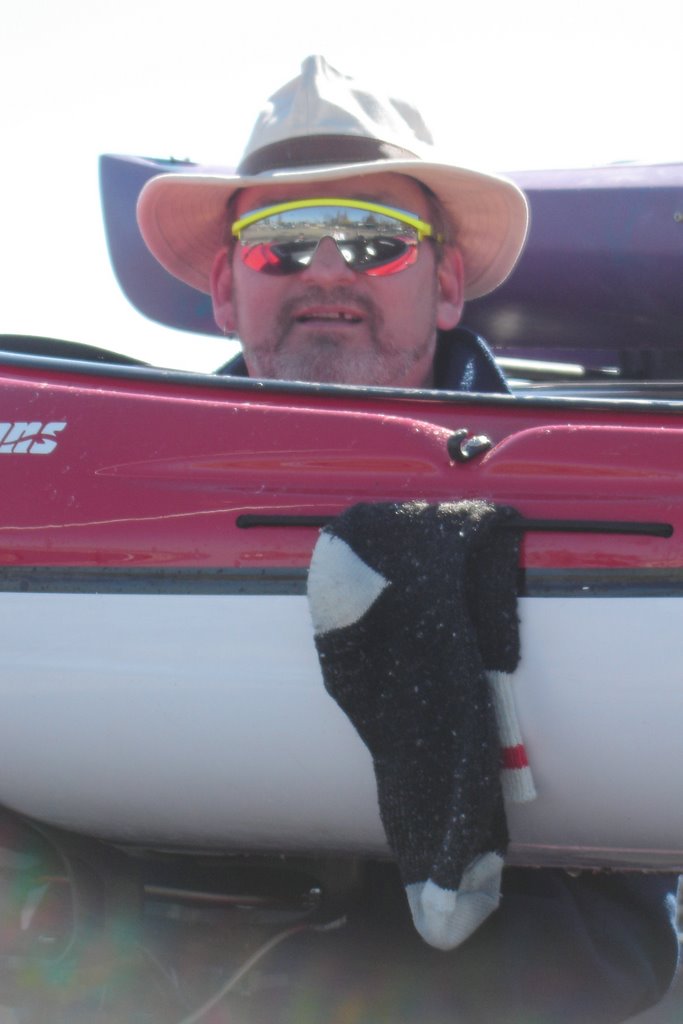
Socks.
Yes, socks. You may not believe it, but socks could be the most important thing you carry in your kayak. First, they keep your feet warm. They can also be used in a first aid situation as a towel or bandage. You can use them to check wind speed and direction. Finally, they can even be used as food during an emergency (mind you, they do require a lot of cooking).
But to answer your question, socks are also very important when loading your kayaks and can prevent them from rubbing together if you follow these simple directions.

First, you steal a sock from Bernie. Then, once you've loaded one kayak, you attach the sock as you can see in the photo below.


Thus when you load the second kayak, the sock prevents the two kayaks from rubbing together!

And there you have it! Two kayaks on a small car! One sock made all the difference!


Dear Kayak Yak Yak,
There's been a lot of lightning storms around this year. Is it safe to go kayaking during a thunderstorm?
Yours,
Vexed in Vanderhoof

Dear Vexed,
Lightning can be very dangerous and NOAA recommends that "if you are boating or swimming, get to land and find shelter immediately!"
Our own Bernie tried kayaking during a recent lightning storm. Fortunately the lightning did not strike him until he was on shore, otherwise a great paddle could have been ruined!