Want to turn your kayak around in a hurry? In the clip embedded below, Leon Sommé of Boat Body Blade demonstrates a high speed 180-degree kayak turn called The Deep Diggity Dig. Check out the clip:

Showing posts with label paddling tips. Show all posts
Showing posts with label paddling tips. Show all posts
Tuesday, April 28, 2015

Friday, March 20, 2015
Re-enter and Roll
Tying to master your re-enter and roll? Here's a couple of videos that may help you master this rescue technique.
In this first video, Dympna Hayes from the Ontario Sea Kayak Centre shares the starightforward tips to perfroming this roll:
In the second clip, Gordon Brown demonstrates two versions of the re-enter and roll, including one using a paddlefloat.
In this first video, Dympna Hayes from the Ontario Sea Kayak Centre shares the starightforward tips to perfroming this roll:
In the second clip, Gordon Brown demonstrates two versions of the re-enter and roll, including one using a paddlefloat.
Tuesday, August 28, 2012
River Access
Something important about river access became very clear to me this summer while I was paddling the Red Deer River. I'd like to address everyone who owns a business that has water access, whether that be access to a river, lake, or saltwater. Campground owners and park managers, listen up! If there's a sign at the road leading to your operation, put up a sign at the water access as well. Every person operating a business that promotes itself as having water access should feel that I'm addressing each of them in particular. Picture me frowning seriously as I insist: Put up a sign at your water access!
The sign doesn't have to be huge. Nail it to a tree or a dock, so you don't have to fuss with sinking a post into the ground. The sign doesn't have to be professionally-made... though professionals do a good job of designing a sign that can be read and is appropriately sized and located. It doesn't have to say a lot. The name of your business is a good start. Or it could say "Private Property" if you don't want strange picnickers coming onto your land from the water.
This absence of signs doesn't trouble me too much here in Victoria BC on the Inner Harbour (few places to land) or the Upper Harbour (working harbour with a number of signs and few places to land) or the Gorge (mostly private property). It would be nice to see in this general area a few more signs visible from the water, like the ones we've seen at Gowland/Tod Park and Discovery Island Marine Park. Parks and campgrounds have no excuses: put up a sign at the water access!
The need for signs became very apparent to me when kayaking down the Red Deer river between the city of Red Deer and Drumheller. By all reports, this is the most-used stretch of river in Alberta. It's very quiet water, well-suited to novice paddlers in kayaks, canoes, and rafts, and in some places inner tubes for floating. On the most popular river in Alberta for novice paddling, during the August long weekend, I passed a dozen campgrounds and parks with official river access that was marked on the Middle Red Deer River map (sold through MEC) and on websites for the parks and campgrounds. Eleven had no signs at their river access! There was only ONE campground that had ANY sign at all at its river access. I'll tell you which one that was a little later.
 |
| This campground above Content Bridge, and its neighbour below the bridge, have NO SIGNS on the river! |
 |
| Two years ago, John took this photo in Saanich Inlet, showing a practical sign. |
 |
| Bernie took this photo in 2008 of my first time passing the big sign for Discovery Island Marine Park. |
In the meantime, I'll address a related rant to the managers of campgrounds and parks. If you have a website for your park or campground, with photos of the location, include a photo of the road access and the water access. This isn't rocket science. If your website has the bandwidth to support showing three photos of the location, it can include a photo of the entrance. It's great to see a photo of the playground or the tall trees or the amazing geology of your location... but if visitors can't tell when they're approaching the access, they'll miss the turn or the landing and go merrily along the road or shore. Sometimes for miles. Sometimes they can't turn around and get there after all. Of course you'll have a sign (after what I said earlier). Give your visitors a chance to recognise your access points when approaching your location by road or by water.
And while you're at it, put a geocache at your road access and river access, and tag them online so people can find them in their GPS devices. Even geocaching isn't rocket science these days.
I swear, on this trip to the Red Deer river, I'd read the maps and been to Google Maps, and my ground crew and I STILL drove right past the turn for the Content Bridge Campground. And on the river, at all but one of a dozen campgrounds and parks, I Stared Right At the river access and wondered out loud if this was where I was supposed to come ashore.
I had to wonder for two reasons -- no signs, and for many of these river access points, no obvious landing. Here beginneth the third rant. Attention, managers of campgrounds and parks with water access! Clear a path to the water access, and make a nice landing! I'll start by showing a photo of a good river access point with a good landing. Here you can see that at Content Bridge Campground, there is a clearing onshore and a shallow place suitable for wading or bringing a boat ashore.

What doesn't show in this photo is that the boat launch had no sharp rocks or gumbo mud. The boat launch or wading access was over twenty feet of shore. The launch included a simple unpaved road access and foot access as well. There was no steep bank to lift a boat by hand, just a nice level approach.
It was amazing to learn that only five of the dozen recommended campgrounds and parks along the most-used stretch of the Red Deer river have anything like a good landing point at their river access. But with no signs, there was no way to know these were campgrounds instead of a ranch or other private land.
Six of these commercial campground businesses had river access that was no better than a cattle path where grazing cows have pushed their way through willows down to the water. If that. Frankly, for three of these six, cattle would have done a better job!
I'm talking NO path, barely bruised bushes, no sloping shore to pull up a boat, and lots of gumbo mud, black mud, scattered rocks as big as your head.
So this time, I'm going to address the family members of someone who owns a campground with water access. Once a year, go to your relative's campground. Spend a morning there. Cut brush to clear a path down to the water, using a machete or a weedwhacker. At the landing point, wade out from shore and roll aside any rocks bigger than your fist to make a nice boat launch. The launch can be only five or ten feet wide if that's all the shoreline available. The campground owner should feel responsible for giving these volunteer workers a beer or burgers or the cultural equivalent.
And while I'm addressing the relatives -- a nice present to give the owner of a campground is the delivery of a yard or two of gravel dumped onto this boat launch. The gravel can be raked into a smooth landing. After a few years, the water will eventually deposit enough silt to cover the gravel, but at least the boat launch won't be gumbo mud dotted with sharp rocks the size of your head.
Hmph.
As for the only campground between the city of Red Deer and Drumheller that had a good river access, that place was Dinosaur RV Park. This privately-owned campground has road and river access, with signs at both points. Good signs for the river access, that could be read whether one approached from upstream or downstream. There was a shallow place to wade ashore, with a small clearing along the shore and access to the rest of the campground for people on foot or bicycles. I'm guessing a car could get pretty close to the boat launch in a dry season. Clearly, this place caters to river users as well as cars and campers!
The ranting is over. Thanks for listening. Things like this go through the mind during a long trip of river camping.
And while you're at it, put a geocache at your road access and river access, and tag them online so people can find them in their GPS devices. Even geocaching isn't rocket science these days.
I swear, on this trip to the Red Deer river, I'd read the maps and been to Google Maps, and my ground crew and I STILL drove right past the turn for the Content Bridge Campground. And on the river, at all but one of a dozen campgrounds and parks, I Stared Right At the river access and wondered out loud if this was where I was supposed to come ashore.
I had to wonder for two reasons -- no signs, and for many of these river access points, no obvious landing. Here beginneth the third rant. Attention, managers of campgrounds and parks with water access! Clear a path to the water access, and make a nice landing! I'll start by showing a photo of a good river access point with a good landing. Here you can see that at Content Bridge Campground, there is a clearing onshore and a shallow place suitable for wading or bringing a boat ashore.

What doesn't show in this photo is that the boat launch had no sharp rocks or gumbo mud. The boat launch or wading access was over twenty feet of shore. The launch included a simple unpaved road access and foot access as well. There was no steep bank to lift a boat by hand, just a nice level approach.
It was amazing to learn that only five of the dozen recommended campgrounds and parks along the most-used stretch of the Red Deer river have anything like a good landing point at their river access. But with no signs, there was no way to know these were campgrounds instead of a ranch or other private land.
Six of these commercial campground businesses had river access that was no better than a cattle path where grazing cows have pushed their way through willows down to the water. If that. Frankly, for three of these six, cattle would have done a better job!
I'm talking NO path, barely bruised bushes, no sloping shore to pull up a boat, and lots of gumbo mud, black mud, scattered rocks as big as your head.
So this time, I'm going to address the family members of someone who owns a campground with water access. Once a year, go to your relative's campground. Spend a morning there. Cut brush to clear a path down to the water, using a machete or a weedwhacker. At the landing point, wade out from shore and roll aside any rocks bigger than your fist to make a nice boat launch. The launch can be only five or ten feet wide if that's all the shoreline available. The campground owner should feel responsible for giving these volunteer workers a beer or burgers or the cultural equivalent.
And while I'm addressing the relatives -- a nice present to give the owner of a campground is the delivery of a yard or two of gravel dumped onto this boat launch. The gravel can be raked into a smooth landing. After a few years, the water will eventually deposit enough silt to cover the gravel, but at least the boat launch won't be gumbo mud dotted with sharp rocks the size of your head.
Hmph.
 |
| This photo is from the website for Dinosaur RV Park. |
As for the only campground between the city of Red Deer and Drumheller that had a good river access, that place was Dinosaur RV Park. This privately-owned campground has road and river access, with signs at both points. Good signs for the river access, that could be read whether one approached from upstream or downstream. There was a shallow place to wade ashore, with a small clearing along the shore and access to the rest of the campground for people on foot or bicycles. I'm guessing a car could get pretty close to the boat launch in a dry season. Clearly, this place caters to river users as well as cars and campers!
The ranting is over. Thanks for listening. Things like this go through the mind during a long trip of river camping.
Sunday, July 01, 2012
Paddling the Ice Kap
No, I didn't get up North or to Antarctica, to paddle either of the actual ice caps. Instead I got to try out a kayak model called the Ice Kap, from Sterling Kayaks.
At the MEC Paddlefest on Willows Beach, there was a terrific assortment of several models from Sterling Kayaks. Each is a custom job, with the foot pedals set to accommodate the paddler's own leg length, for example. While Marlena went off in the Discovery Island Shuttle that was giving free rides, I got to sit in an Illusion, but even with the footpedals run as far forward as possible, my feet still couldn't reach. That would be no problem if I bought one of their kayaks, explained the designer, Sterling Donaldson. He would put the footpedals closer to the seat for someone as short as me.
What a great experience, to meet the kayak designer and builder! He's got fibreglass under his fingernails and epoxy all over his hands, he complained at one point. But there's no substitute for the hands-on approach when customizing a kayak for someone who wants a day hatch sealed off from the big rear compartment behind the bulkhead.
The foam seats (Joe Greenley Custom seats) are a terrific support... lifting the knees a little and fitting around the butt. I'm guessing that my partner Bernie would find THIS style of seat causes way less pressure on his back and sciatic nerve. The seat back is good support for the pelvis, but low enough to encourage good rolling posture. On each side of the seats is a glassed-in support for foam padding, to customize the fit to the paddler's thighs.
But enough about the Illusion, which I never took on the water, as without footpedals I'd just be like a toddler wearing her daddy's shoes. I got into the Ice Kap! This is the boat that Dubside uses, when he's not commando kayaking with a folding kayak.

The Ice Kap is designed for smaller paddlers. The coaming is low. Low, low, low. As in approaching the waterline. As in half-way up my thighs when I'm seated in the kayak with feet on the pegs. No more rubbing my elbows on the coaming with each stroke! That happens in most kayaks for me, perpetuating the toddler-in-her-daddy's-shoes feeling. As the designer Donaldson pointed out, most shorter people are not only short in the leg, but have short backs as well. It's hard to roll a kayak when the coaming is up at your waist.
John took a photo of me on the water in the Ice Kap. It's pretty clear in the photo that this boat has a lot of rocker. I'm used to the rocker in my rotomolded Necky Eliza, which brings the keel up in the bow and stern and makes for a lot of fun in waves. The Ice Kap has more rocker, enough to bring the bow and stern up much higher out of the water than the Eliza. I expressed some concern about the front deck being so high out of the water, and the stern so high -- wouldn't they catch wind and weathercock? "None of our boats weathercocks," Donaldson insisted.
The Illusion has a similar hull to the Ice Kap, but the coaming rises a little higher at the paddler's thighs and sides. John didn't even consider trying either model. At 6'4", he went for their Grand Illusion that fits the 6'3" designer, but the model on the beach had been padded to fit a thinner paddler. No dice.
Louise tried the Ice Kap as well, just to add another model to her research for her new boat. We compared notes afterward. She's 5'4, I'm 5'1, and in our opinions:
-The Ice Kap is a sporty, responsive kayak that turns on a dime.
-It's well suited to people up to about 5'6 (I've met Dubside, and he's about the size of my son who is a lean 5'8".)
-Very small adults from 4'10" to 5'2" should definitely give this model a try, as it is suited to a paddler with short legs AND a short back.
-Very light adults should also try this model, as it's recommended for paddlers up to 165 pounds. I'm at the top of the weight class, and definitely felt BIG and MEATY in the Ice Kap.
-Though I have little or no sense of balance, that was not a problem as the Ice Kap fits the paddler like a fine shoe. The responsive feel was terrific, and allowed me to control the boat with confidence.

Afterwards, John and Louise changed out of their paddling gear while I just wandered around evaporating. One of the pleasures of commando kayaking is that my paddle clothes evaporate dry quickly. Should also give a shout out to John Kimantas, who said hello while promoting his magazine, and Mike Jackson who was there to roll and show his terrific Greenland paddles. The Discovery Island Shuttle came back, and Marlena teetered down the ramp, grabbed her coffee mug in both hands and drank half in a gulp. We piled into the Kiwanis tea house and waited a while for fries etc.
Our verdict: if you're a thin, short man or woman who is wanting an exciting kayak instead of a barge to noodle around in, get down to Ocean River Kayaks and try the Ice Kap in their rental fleet for a kayak suited to riding waves or rolling. If you're not thin, try the Illusion as the coaming is just a little higher instead of pressing on the sides of your thighs.
And if you're a differently-able kayaker (like every member of our paddling group, and plenty members of SISKA and VCKC and the entire crew of the Breaststokers Dragon Boat team), talk to Sterling Kayaks about how to customize a kayak to meet your needs. This designer understands. Other designers talk the talk, and come through as well as they can. Sterling Donaldson not only talks the talk, he walks the walk with one leg and crutches on the beach among his demonstrator models.
At the MEC Paddlefest on Willows Beach, there was a terrific assortment of several models from Sterling Kayaks. Each is a custom job, with the foot pedals set to accommodate the paddler's own leg length, for example. While Marlena went off in the Discovery Island Shuttle that was giving free rides, I got to sit in an Illusion, but even with the footpedals run as far forward as possible, my feet still couldn't reach. That would be no problem if I bought one of their kayaks, explained the designer, Sterling Donaldson. He would put the footpedals closer to the seat for someone as short as me.
What a great experience, to meet the kayak designer and builder! He's got fibreglass under his fingernails and epoxy all over his hands, he complained at one point. But there's no substitute for the hands-on approach when customizing a kayak for someone who wants a day hatch sealed off from the big rear compartment behind the bulkhead.
The foam seats (Joe Greenley Custom seats) are a terrific support... lifting the knees a little and fitting around the butt. I'm guessing that my partner Bernie would find THIS style of seat causes way less pressure on his back and sciatic nerve. The seat back is good support for the pelvis, but low enough to encourage good rolling posture. On each side of the seats is a glassed-in support for foam padding, to customize the fit to the paddler's thighs.
But enough about the Illusion, which I never took on the water, as without footpedals I'd just be like a toddler wearing her daddy's shoes. I got into the Ice Kap! This is the boat that Dubside uses, when he's not commando kayaking with a folding kayak.

The Ice Kap is designed for smaller paddlers. The coaming is low. Low, low, low. As in approaching the waterline. As in half-way up my thighs when I'm seated in the kayak with feet on the pegs. No more rubbing my elbows on the coaming with each stroke! That happens in most kayaks for me, perpetuating the toddler-in-her-daddy's-shoes feeling. As the designer Donaldson pointed out, most shorter people are not only short in the leg, but have short backs as well. It's hard to roll a kayak when the coaming is up at your waist.
John took a photo of me on the water in the Ice Kap. It's pretty clear in the photo that this boat has a lot of rocker. I'm used to the rocker in my rotomolded Necky Eliza, which brings the keel up in the bow and stern and makes for a lot of fun in waves. The Ice Kap has more rocker, enough to bring the bow and stern up much higher out of the water than the Eliza. I expressed some concern about the front deck being so high out of the water, and the stern so high -- wouldn't they catch wind and weathercock? "None of our boats weathercocks," Donaldson insisted.
The Illusion has a similar hull to the Ice Kap, but the coaming rises a little higher at the paddler's thighs and sides. John didn't even consider trying either model. At 6'4", he went for their Grand Illusion that fits the 6'3" designer, but the model on the beach had been padded to fit a thinner paddler. No dice.
Louise tried the Ice Kap as well, just to add another model to her research for her new boat. We compared notes afterward. She's 5'4, I'm 5'1, and in our opinions:
-The Ice Kap is a sporty, responsive kayak that turns on a dime.
-It's well suited to people up to about 5'6 (I've met Dubside, and he's about the size of my son who is a lean 5'8".)
-Very small adults from 4'10" to 5'2" should definitely give this model a try, as it is suited to a paddler with short legs AND a short back.
-Very light adults should also try this model, as it's recommended for paddlers up to 165 pounds. I'm at the top of the weight class, and definitely felt BIG and MEATY in the Ice Kap.
-Though I have little or no sense of balance, that was not a problem as the Ice Kap fits the paddler like a fine shoe. The responsive feel was terrific, and allowed me to control the boat with confidence.
Afterwards, John and Louise changed out of their paddling gear while I just wandered around evaporating. One of the pleasures of commando kayaking is that my paddle clothes evaporate dry quickly. Should also give a shout out to John Kimantas, who said hello while promoting his magazine, and Mike Jackson who was there to roll and show his terrific Greenland paddles. The Discovery Island Shuttle came back, and Marlena teetered down the ramp, grabbed her coffee mug in both hands and drank half in a gulp. We piled into the Kiwanis tea house and waited a while for fries etc.
Our verdict: if you're a thin, short man or woman who is wanting an exciting kayak instead of a barge to noodle around in, get down to Ocean River Kayaks and try the Ice Kap in their rental fleet for a kayak suited to riding waves or rolling. If you're not thin, try the Illusion as the coaming is just a little higher instead of pressing on the sides of your thighs.
And if you're a differently-able kayaker (like every member of our paddling group, and plenty members of SISKA and VCKC and the entire crew of the Breaststokers Dragon Boat team), talk to Sterling Kayaks about how to customize a kayak to meet your needs. This designer understands. Other designers talk the talk, and come through as well as they can. Sterling Donaldson not only talks the talk, he walks the walk with one leg and crutches on the beach among his demonstrator models.
Monday, August 29, 2011
Testing Stuff!
Stuff arrived by courier this week. It was a package sent by Icebreaker, with a pair of their Legless merino wool leggings for me to test and write about. Yay!
These Legless tights are the Pace version, meant for runners to wear alone or under light trousers. Other versions of Legless tights are winter underwear meant to leave shins & ankles free from excessive layering with socks & trousers. They're capri length, to about mid-calf on the model on their website. (Full disclosure: I am NOT the model on the Icebreaker.com website. I do not look even remotely like the model wearing the Legless tights, Pace version. I have the finely-honed body of a freelance writer.)
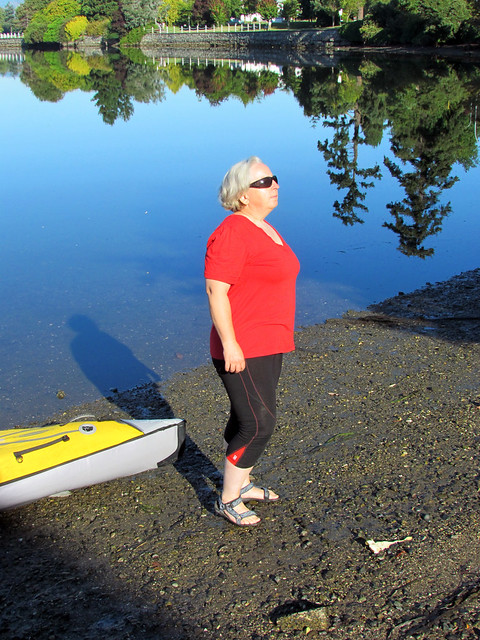
One of my theories about clothing for kayakers is that "dress for immersion" doesn't always have to mean "wear a wetsuit" or "wear a dry suit." It can also mean "wear something I can swim in" where swimming is safe. On hot summer days when we're practising our wet exits at a sheltered lake, I wear a bathing suit or shorts and a t-shirt. But most days, I'm not planning to swim. When I'm kayaking in sheltered, familiar waters and staying close to shore, dressing for immersion means I wear a light merino wool shirt and leggings. In the cold ocean water, I'd be able to swim a few yards to shore.
But my old leggings wore out. And when I wrote to Icebreaker praising the many-mended leggings and shirts that I wear while paddling, they sent me a new pair of leggings to try.
Lemme say, the Legless are pretty much exactly what I'm looking for in paddling pants. They're short enough that I can wade and get into my boat. They dry quickly when splashed. They're warm when wet, something that polyester tights and bike shorts are NOT.
Another factor that works for me is that these tights look like summery, sporty clothes. When commando kayaking I like to be able to wear my paddling clothes on the bus without causing panic and a general exodus via the back door. I wore these tights with a long t-shirt and a long sweater on campus and at the library. (Don't panic. I have permission from my fashionistas Lila, Ben and Marlene, provided that the shirt is long enough to cover the rump.) The verdict from several consultants was that the look was "slimming." Nice thought.
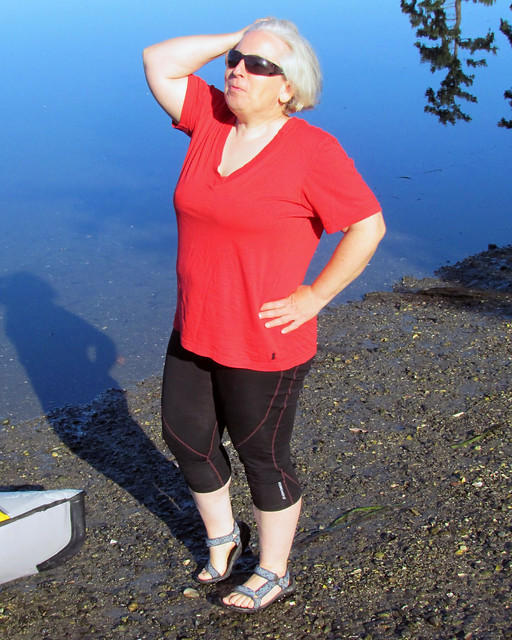
We've been in a bit of a heat wave, and I wore these tights not only while kayaking, but while gardening and walking over a mile on pavement in the baking hot sunshine. In spite of being made of black wool, these tights were cooler than a similar pair of polyester tights.
For people unfamiliar with wearing wool as anything other than a bulky sweater, I can confirm that like other light merino wool garments, Legless tights can be thrown in the washing machine. (Cold water wash, and any other clothes in the load should not be "shedding" lots of fluff.) For drying, hang 'em up. They dry pretty quickly.
The only problem for me is that the promotional ad photos Icebreaker puts on its website are a little weird. Not the photos showing the garments worn by models... those are ok though all the models are young and trim. (Would it be so wrong to have a plump model staying healthy and active in sports gear?) No, it's the flashy promotional photos on Icebreaker's website that are kinda weird. A dark man with a ram's head. A woman riding him. I'm up for images of strength and vigor, but some of these photos look heterosexist and creepy. Not creepy enough to keep me from wearing these merino wool tights and my mended shirts!
The only problem for me is that the promotional ad photos Icebreaker puts on its website are a little weird. Not the photos showing the garments worn by models... those are ok though all the models are young and trim. (Would it be so wrong to have a plump model staying healthy and active in sports gear?) No, it's the flashy promotional photos on Icebreaker's website that are kinda weird. A dark man with a ram's head. A woman riding him. I'm up for images of strength and vigor, but some of these photos look heterosexist and creepy. Not creepy enough to keep me from wearing these merino wool tights and my mended shirts!
Saturday, November 13, 2010
Virtual Edging
Over at the Canoe and Kayak website, Shawna Franklin and Leon Sommé of Body Boat Blade star in a series of quick instructional videos on edging kayaks produced by Bryan Smith of Pacific Horizons fame. Check them out below:
Tuesday, July 13, 2010
Drowning Doesn't Look Like Drowning
*fweeeeet!*
Time for another safety check among all us kayakers and general seashore and boating enthusiasts. Who knows how to swim? That's a good start.
Who has taken a water safety course and has some idea how to rescue a drowning person? Aha. Thought so. And if ya took a course, how long ago was it?
How about we take a moment and read the article that gave this blog post the thought-provoking title Drowning Doesn't Look Like Drowning, written by Mario Vittone.
That article sure made me think. I took Red Cross swimming lessons for years. I started lifeguard training, though I didn't get a certificate. But when I pulled my five-year-old son back up to the surface of a lake without dropping his twin sister, it became really clear to me that keeping people safe around water is not a piece of cake.
Water Safety Is Hard, Dammitt!
Kids fall into the water without any warning and often not even a splash or shout.
People who are drowning are often quiet and struggle a lot less than you'd think. Well, they might not look like they're struggling till they get a grip on a rescuer and climb up him or her to stand on the rescuer's head.
And just in case you need some motivation, it's a grim fact that most people who drown are within a few yards of a dock or beach. Most children who drown are within a few yards of adults. Most of the people who drown while out in a small boat have a life jacket or PFD, but it's stuffed behind the seat instead of being worn.
It's not enough to be the smart kayaker who wears a PFD and knows how to swim. If you're ever the one who DOES see someone drowning, let's hope you know enough not to come alongside and grab the person's hand. Panic makes drowning people strong and desperate.
I hope that I'd be a calm enough rescuer to remember that there's a paddle float on my kayak's back deck. And there's a rope in a throw bag on the front deck.
A paddle float could make a good flotation device! It has almost as much lift as a PFD, and loops on both ends to grip. During safety practice in Thetis Lake, I've floated around holding onto my paddle float from North Water. We figured then that if we ever had to tow a swimmer to shore with a rope, it would be a good idea to clip two paddle floats together and let the swimmer use this float. We know that the cold water where we paddle makes a swimmer numb in minutes, so usually the best idea is to get a kayaker out of the water and back into his or her boat. We're just noticing how we react when we dunk ourselves. It's fun to feel smart and in practise. And maybe we'll be ready if an emergency happens.
Time for another safety check among all us kayakers and general seashore and boating enthusiasts. Who knows how to swim? That's a good start.
Who has taken a water safety course and has some idea how to rescue a drowning person? Aha. Thought so. And if ya took a course, how long ago was it?
How about we take a moment and read the article that gave this blog post the thought-provoking title Drowning Doesn't Look Like Drowning, written by Mario Vittone.
That article sure made me think. I took Red Cross swimming lessons for years. I started lifeguard training, though I didn't get a certificate. But when I pulled my five-year-old son back up to the surface of a lake without dropping his twin sister, it became really clear to me that keeping people safe around water is not a piece of cake.
Water Safety Is Hard, Dammitt!
Kids fall into the water without any warning and often not even a splash or shout.
People who are drowning are often quiet and struggle a lot less than you'd think. Well, they might not look like they're struggling till they get a grip on a rescuer and climb up him or her to stand on the rescuer's head.
And just in case you need some motivation, it's a grim fact that most people who drown are within a few yards of a dock or beach. Most children who drown are within a few yards of adults. Most of the people who drown while out in a small boat have a life jacket or PFD, but it's stuffed behind the seat instead of being worn.
It's not enough to be the smart kayaker who wears a PFD and knows how to swim. If you're ever the one who DOES see someone drowning, let's hope you know enough not to come alongside and grab the person's hand. Panic makes drowning people strong and desperate.
I hope that I'd be a calm enough rescuer to remember that there's a paddle float on my kayak's back deck. And there's a rope in a throw bag on the front deck.
A paddle float could make a good flotation device! It has almost as much lift as a PFD, and loops on both ends to grip. During safety practice in Thetis Lake, I've floated around holding onto my paddle float from North Water. We figured then that if we ever had to tow a swimmer to shore with a rope, it would be a good idea to clip two paddle floats together and let the swimmer use this float. We know that the cold water where we paddle makes a swimmer numb in minutes, so usually the best idea is to get a kayaker out of the water and back into his or her boat. We're just noticing how we react when we dunk ourselves. It's fun to feel smart and in practise. And maybe we'll be ready if an emergency happens.
Saturday, January 30, 2010
New Words!
I was just re-reading Fatal Tide, the book by local writer David Leach on circumstances surrounding a kayaker's death in a sporting event. There's a striking moment in the book, where Leach describes a distress that is sometimes felt by Greenland kayakers when they are alone and out of sight of land. Sensory deprivation may be a factor in a sudden, awful feeling of doom. The person in the kayak may panic, flail, or wail, and it is possible that many people may have drowned at moments like this. when paddling alone. The panic and disorientation of this distress usually fades on seeing another paddler or shore, but it may return.
This upsetting event has been named kayakangst by Danish paddlers. The Inuit call this distress nangiarnaq -- to be afraid in dangerous places. It's clearly a feeling that can be related to panic attacks and anxiety disorders, or to some kinds of Meniere's syndrome and other conditions that affect the sense of balance. The closest I've come to this feeling has been over quickly: the spins and drop attacks that come from time to time since my hearing loss. Not something I'd wish on anybody!
This upsetting event has been named kayakangst by Danish paddlers. The Inuit call this distress nangiarnaq -- to be afraid in dangerous places. It's clearly a feeling that can be related to panic attacks and anxiety disorders, or to some kinds of Meniere's syndrome and other conditions that affect the sense of balance. The closest I've come to this feeling has been over quickly: the spins and drop attacks that come from time to time since my hearing loss. Not something I'd wish on anybody!
Sunday, January 24, 2010
Rich, you dip
It was great when you called at the last minute for a paddle in Cadboro Bay on Saturday morning, Rich -- bright, warm weather with about 5 klicks of breeze made the day feel more like April than January. I was glad to have some time to practise my figure 8s when I got to the Gyro Park beach first. Thanks for putting my roller in your van, so I didn't have to take it apart and strap the frame onto the back deck of my Eliza. But next time, I'm going to put the wheels in my hatch and the frame on my deck because I ended up hanging around for over an hour and a half waiting for you to come back from wherever the current carried you!
We found that ebb current flowing mild but steady from Cadboro Point. It was a good day to head over there, look at Baynes Channel and decide instead to go to Jemmy Jones Island, where the current carried us at no more than about one klick. And when we came round Jemmy through the kelp bed, it was okay when you found the current and headed off with it while I headed back towards Flower Island and the shore.
Really, it was okay. I could see you riding down-current, you could see me, and the conditions were so good that either of us would have to have been hit by a meteor to be at any risk. And when I got to Flower, I watched your tiny figure disappear behind the light at Carolina Reef (where the current always picks up speed) and realized that you weren't coming back any time soon. Still, I hung around for half an hour before going back to the beach and landing.
The only time I didn't really feel okay about you heading off on the current was when I had to carry my kayak over the gravel... but I dragged it on the grass the rest of the way to the Beach House and got there just as Bernie was coming out to look for us on the shore. And I had plenty of time during another hour of putting my boat away, cleaning up and walking back to the shore twice, to remind myself that the weather conditions were great and you were probably okay just like the other times you've zipped off for half an hour or so.
I also had plenty of time to decide not to take your van engine's distributor cap off for a little trip to the coffee shop. In fact, I had just decided to go to Olive Olio's when I found Bernie at the shore during HIS second time of checking for you, and he said you were back & would meet us for coffee.
So my plan for future kayak outings is to carry my own damned roller even if it does stick up on my back deck, and not to call the Marine Rescue unless you are -- ooooh, about two hours overdue from your last sighting or message. And in the unhappy event that you ever do end up flipping in Enterprise Channel (something that I know you feel is very unlikely), let me express the earnest wish that you would, of course, survive in chilly good health after swimming to Harling Point or Foul Bay, but that your kayak would drift away to become a beach toy for the young elephant seals on Race Rocks.
Addendum on Feb 1st: Rich writes about his part of paddling on this bright winter day, at his own blog.
We found that ebb current flowing mild but steady from Cadboro Point. It was a good day to head over there, look at Baynes Channel and decide instead to go to Jemmy Jones Island, where the current carried us at no more than about one klick. And when we came round Jemmy through the kelp bed, it was okay when you found the current and headed off with it while I headed back towards Flower Island and the shore.
Really, it was okay. I could see you riding down-current, you could see me, and the conditions were so good that either of us would have to have been hit by a meteor to be at any risk. And when I got to Flower, I watched your tiny figure disappear behind the light at Carolina Reef (where the current always picks up speed) and realized that you weren't coming back any time soon. Still, I hung around for half an hour before going back to the beach and landing.
The only time I didn't really feel okay about you heading off on the current was when I had to carry my kayak over the gravel... but I dragged it on the grass the rest of the way to the Beach House and got there just as Bernie was coming out to look for us on the shore. And I had plenty of time during another hour of putting my boat away, cleaning up and walking back to the shore twice, to remind myself that the weather conditions were great and you were probably okay just like the other times you've zipped off for half an hour or so.
I also had plenty of time to decide not to take your van engine's distributor cap off for a little trip to the coffee shop. In fact, I had just decided to go to Olive Olio's when I found Bernie at the shore during HIS second time of checking for you, and he said you were back & would meet us for coffee.
So my plan for future kayak outings is to carry my own damned roller even if it does stick up on my back deck, and not to call the Marine Rescue unless you are -- ooooh, about two hours overdue from your last sighting or message. And in the unhappy event that you ever do end up flipping in Enterprise Channel (something that I know you feel is very unlikely), let me express the earnest wish that you would, of course, survive in chilly good health after swimming to Harling Point or Foul Bay, but that your kayak would drift away to become a beach toy for the young elephant seals on Race Rocks.
Addendum on Feb 1st: Rich writes about his part of paddling on this bright winter day, at his own blog.
Friday, January 22, 2010
New paddle friends
It's always great getting out on the water on odd days. I may not go out to as many daring places as some people, but I do get a boat in the water some mornings or afternoons that aren't on the weekends! It's terrific and feels a bit wicked to be out in the wide world while so many people are stuck at responsibilities like jobs and so on. Well, I have a responsibility, too -- if I don't haul my kayak down to the water and paddle it around the bay, I'll end up too fat to fit in it and not fit enough to have any fun paddling.
Ran into Mike Jackson and his friend Dennis when they were launching, a hundred yards down the beach from the boat launch at Gyro Park. Ever so nice to cruise on along the shore and out past Flower Island to the point with some new company! The guys went on to cross Baynes Channel and go round the Chathams, while I turned back into the bay and went back to the beach.
Landing was a more crowded event than launching had been -- the new members of the University of Victoria Sailing Association were there. It was apparently time for a sailing lesson. Four of them were trundling out their zodiac and others were getting their small sailboats. As they rolled down the sandy launch ramp, the young fellows discovered that last night's storm had piled some small logs across their path. And now I was coming ashore.
"No problem," I said. "I'll be out of your way in a minute. Maybe one of you could help me carry my kayak up onto the grass, out of your way?"
And of course, one of the young men DID help me. He took the bow end, and started walking. But it seemed like a lot of strong people willing to help out, he didn't know what was going on behind him. Namely me, struggling over the driftwood.
"Hold on!" I called. "First lesson of carrying a boat with two people: the guy in front walks slowly, especially on uneven ground."
"Yeah," he said. "All this stuff is in our way for our rollers. Do the waves wash this stuff in every night?"
"Sometimes. Especially when there's a storm."
"It's hard for us to roll the boats over the logs!"
"Try it with a kayak on your shoulder!"
He laughed, and joined his friends clearing the small logs to make a path on the sandy slope. The waves will move the logs again and again in the future, and the sailors will have to learn how to move the logs without hurting themselves or tearing up the beach. But clearly, there's a willingness to learn here, which is good to see.
Ran into Mike Jackson and his friend Dennis when they were launching, a hundred yards down the beach from the boat launch at Gyro Park. Ever so nice to cruise on along the shore and out past Flower Island to the point with some new company! The guys went on to cross Baynes Channel and go round the Chathams, while I turned back into the bay and went back to the beach.
Landing was a more crowded event than launching had been -- the new members of the University of Victoria Sailing Association were there. It was apparently time for a sailing lesson. Four of them were trundling out their zodiac and others were getting their small sailboats. As they rolled down the sandy launch ramp, the young fellows discovered that last night's storm had piled some small logs across their path. And now I was coming ashore.
"No problem," I said. "I'll be out of your way in a minute. Maybe one of you could help me carry my kayak up onto the grass, out of your way?"
And of course, one of the young men DID help me. He took the bow end, and started walking. But it seemed like a lot of strong people willing to help out, he didn't know what was going on behind him. Namely me, struggling over the driftwood.
"Hold on!" I called. "First lesson of carrying a boat with two people: the guy in front walks slowly, especially on uneven ground."
"Yeah," he said. "All this stuff is in our way for our rollers. Do the waves wash this stuff in every night?"
"Sometimes. Especially when there's a storm."
"It's hard for us to roll the boats over the logs!"
"Try it with a kayak on your shoulder!"
He laughed, and joined his friends clearing the small logs to make a path on the sandy slope. The waves will move the logs again and again in the future, and the sailors will have to learn how to move the logs without hurting themselves or tearing up the beach. But clearly, there's a willingness to learn here, which is good to see.
Sunday, October 18, 2009
Spawning!
We had an awesomely terrific paddle today, in good weather made even better by contrast with the last week. And we learned something important that we really should have figured out before stumbling into someplace where we shouldn't have been paddling. It's salmon spawning season, people!
There's been days of rain that have the Beach House surrounded by an informal moat, here in the low land by Cadboro Bay. But this morning dawned bright as I hopped onto the bus to meet John and Louise and Richard for paddling on the Gorge.
There are plenty of pictures from this outing that John will probably post later. What may or may not show in the photos is how full of rainwater the creeks and rivers are around here, after days of rain. We paddled into Portage Inlet, and then up Colquitz Creek, a little river that comes across the Panama Flats after it drains Beaver and Elk Lakes. We were able to get quite far upstream into Cuthbert Holmes Park, behind the parking lot for Tillicum Mall, Silver City movie house, and Pearkes Arena.
It was a great day to be out, and we saw more wildlife than expected. First was a buck on the Gorge shoreline, then many Canada geese and mallard ducks on the way to Colquitz Creek. The water moved from time to time, but we couldn't see what was moving in the cloudy water of the stream.
John realized that as it was near high tide, and the creeks were running with rainwater, that we'd probably be able to go up Craigflower Creek all the way under the highway. We crossed Portage Inlet, and he was right! This creek too was swollen with rain and cloudy with silt in the water. We were able to go easily under the Helmecken Road bridge, and snuck around a fallen log to get towards the tunnel under the highway. Even surprising something under the water wasn't enough to cue me to what we'd been seeing in the creeks. I was looking around to see if a muskrat was swimming nearby, when Richard called out what he was seeing at the rocks that barred our passage further upstream.
Salmon.
Craigflower Creek is a salmon spawning stream! And apparently, so is Colquitz Creek.
Augh! And we were paddling among salmon that were resting in this pool before struggling upstream to the rocky area where they could spawn. We got out of there quickly. And on our way back through the Inlet and the Gorge, we saw at least four seals, one of whom seemed to be hunting salmon with a great deal of splashing.
I hadn't thought that either of these creeks had spawning salmon in them... little creek fish like sculpins, sure, but salmon coming up to spawn? These streams have muddy bottoms where we paddle near the estuaries, and salmon need gravel for spawning. I'd thought any local salmon runs had been wiped out by pollution when this area was being farmed and then subdivided into small lots for housing. But thinking about it, I should have known better and kept us out of the streams in autumn. There are salmon enhancement and conservation programs going on all over the south end of Vancouver Island. People are cleaning local streams. The local newspapers made a big deal out of salmon returning to Douglas Creek in Mount Douglas Park after decades of pollution keeping them out.
So, we've learned our lesson. We'll go exploring up streams in late winter, when the rain fills the streams, not in autumn.
Memo to all kayakers in their own home waters in this part of the world: Stay out of any creeks and streams and little rivers from half-past September through to the end of October! That's spawning season. And in May and June, keep away from baby seals on islands and shorelines in the ocean!
There's been days of rain that have the Beach House surrounded by an informal moat, here in the low land by Cadboro Bay. But this morning dawned bright as I hopped onto the bus to meet John and Louise and Richard for paddling on the Gorge.
There are plenty of pictures from this outing that John will probably post later. What may or may not show in the photos is how full of rainwater the creeks and rivers are around here, after days of rain. We paddled into Portage Inlet, and then up Colquitz Creek, a little river that comes across the Panama Flats after it drains Beaver and Elk Lakes. We were able to get quite far upstream into Cuthbert Holmes Park, behind the parking lot for Tillicum Mall, Silver City movie house, and Pearkes Arena.
It was a great day to be out, and we saw more wildlife than expected. First was a buck on the Gorge shoreline, then many Canada geese and mallard ducks on the way to Colquitz Creek. The water moved from time to time, but we couldn't see what was moving in the cloudy water of the stream.
John realized that as it was near high tide, and the creeks were running with rainwater, that we'd probably be able to go up Craigflower Creek all the way under the highway. We crossed Portage Inlet, and he was right! This creek too was swollen with rain and cloudy with silt in the water. We were able to go easily under the Helmecken Road bridge, and snuck around a fallen log to get towards the tunnel under the highway. Even surprising something under the water wasn't enough to cue me to what we'd been seeing in the creeks. I was looking around to see if a muskrat was swimming nearby, when Richard called out what he was seeing at the rocks that barred our passage further upstream.
Salmon.
Craigflower Creek is a salmon spawning stream! And apparently, so is Colquitz Creek.
Augh! And we were paddling among salmon that were resting in this pool before struggling upstream to the rocky area where they could spawn. We got out of there quickly. And on our way back through the Inlet and the Gorge, we saw at least four seals, one of whom seemed to be hunting salmon with a great deal of splashing.
I hadn't thought that either of these creeks had spawning salmon in them... little creek fish like sculpins, sure, but salmon coming up to spawn? These streams have muddy bottoms where we paddle near the estuaries, and salmon need gravel for spawning. I'd thought any local salmon runs had been wiped out by pollution when this area was being farmed and then subdivided into small lots for housing. But thinking about it, I should have known better and kept us out of the streams in autumn. There are salmon enhancement and conservation programs going on all over the south end of Vancouver Island. People are cleaning local streams. The local newspapers made a big deal out of salmon returning to Douglas Creek in Mount Douglas Park after decades of pollution keeping them out.
So, we've learned our lesson. We'll go exploring up streams in late winter, when the rain fills the streams, not in autumn.
Memo to all kayakers in their own home waters in this part of the world: Stay out of any creeks and streams and little rivers from half-past September through to the end of October! That's spawning season. And in May and June, keep away from baby seals on islands and shorelines in the ocean!
Friday, October 02, 2009
How to Report a Sea Animal Sighting or Incident
Have you been lucky enough to see one of the large marine mammals or sea turtles in Canadian waters? It’s a good idea to learn more about these animals and what to do if you see them.
The short answer is: Don't Get Close!
Here is the website for the department of Fisheries and Oceans Canada: http://www.pac.dfo-mpo.gc.ca/fm-gp/species-especes/mammals-mammiferes/index-eng.htm There’s a French version of the website.
On both sides of the page’s centre column are lists of useful links. Top right is the link to report a sighting or an incident http://www.pac.dfo-mpo.gc.ca/fm-gp/species-especes/mammals-mammiferes/report-signaler-eng.htm This is a terrifically useful link! Go here to find the three links where you can report an incident of a marine animal in distress, or seeing a leatherback turtle, or seeing any whales, dolphins or porpoises. It’s worth taking a minute to scroll down and read all the details, so you’ll have an idea what to do.
The page's comments on reporting an incident of an animal in distress are important enough to be worth quoting here:
Report an incident
Incidents involving marine mammals and sea turtles along our coastline are an unfortunate reality. At DFO, we do our best to monitor marine areas and respond to a range of incidents, but we also rely on information provided by the public.
An incident is a situation involving an animal in which some form of response may be required to assist in rescue and rehabilitation, collection of scientific sampling and data, or enforcement concerns. Incidents may involve marine mammals or turtles that are found alive, injured or dead. Some common examples of incidents include:
· An animal being harassed or injured
· An injured or sick animal exhibiting highly unusual behaviour
· A live whale, dolphin or porpoise stranded on land
· A collision between an animal and a vessel, or an animal that appears to have been struck by a vessel
· An animal that has become entangled in a net or other debris
· A dead marine mammal or sea turtle
· An animal that is tagged or branded
· A marine mammal or sea turtle seen in an unusual location or a species not commonly seen in BC (see below to report a sighting)
If you observe, encounter or even just hear about an incident, please call DFO’s Observe, Record and Report 24-hour hotline at 1-800-465-4336. Response time can be crucial and is greatly assisted by detailed observations, so your reports are very important. Prompt reporting ensures that a rapid and effective rescue action can be initiated, resulting in a greater chance for survival for live animals or determination of cause of death in dead animals.
When reporting an incident, you may be asked to provide:
· Date and time you found the animal or witnessed the incident
· Specific location, including latitude and longitude (if available) or driving directions (if accessible by land)
· Species or type of animal, including a description of the size, colour, features
· Condition of the animal – alive, sick or injured, freshly dead, badly rotting away
· Number of animals involved
· Your contact information, including name and phone number
Caution: Please do not touch or move an animal yourself. Marine mammals can carry diseases transmissible to humans, or you may inadvertently do more harm to the animal. DFO coordinates a network of government and non-government experts in disentanglement, strandings, animal illness, and behavioural assessment.
While not every incident warrants a field response or further investigation, all reports are recorded and contribute to a better understanding of these species and the threats they face.
Your assistance in supporting this important conservation and research program is sincerely appreciated.
And although the DFO's website doesn't have any mention here of sea monsters, unicorns or Cadborosaurus, I've always found it charming that British Columbia and Canada have laws intended to protect such animals just in case they do exist. If a Sasquatch or a Cadborosaurus ever turns up, it is protected under the same laws that protect endangered animals. That's not just humour in action: there have been new species of deer found in Vietnam recently, so large animals are still being discovered in various places around the world.
Considering how elephant seals have made surprising appearances here on Vancouver Island this year, I'm keeping my eye open for them and other large sea animals!
The short answer is: Don't Get Close!
Here is the website for the department of Fisheries and Oceans Canada: http://www.pac.dfo-mpo.gc.ca/fm-gp/species-especes/mammals-mammiferes/index-eng.htm There’s a French version of the website.
On both sides of the page’s centre column are lists of useful links. Top right is the link to report a sighting or an incident http://www.pac.dfo-mpo.gc.ca/fm-gp/species-especes/mammals-mammiferes/report-signaler-eng.htm This is a terrifically useful link! Go here to find the three links where you can report an incident of a marine animal in distress, or seeing a leatherback turtle, or seeing any whales, dolphins or porpoises. It’s worth taking a minute to scroll down and read all the details, so you’ll have an idea what to do.
The page's comments on reporting an incident of an animal in distress are important enough to be worth quoting here:
Report an incident
Incidents involving marine mammals and sea turtles along our coastline are an unfortunate reality. At DFO, we do our best to monitor marine areas and respond to a range of incidents, but we also rely on information provided by the public.
An incident is a situation involving an animal in which some form of response may be required to assist in rescue and rehabilitation, collection of scientific sampling and data, or enforcement concerns. Incidents may involve marine mammals or turtles that are found alive, injured or dead. Some common examples of incidents include:
· An animal being harassed or injured
· An injured or sick animal exhibiting highly unusual behaviour
· A live whale, dolphin or porpoise stranded on land
· A collision between an animal and a vessel, or an animal that appears to have been struck by a vessel
· An animal that has become entangled in a net or other debris
· A dead marine mammal or sea turtle
· An animal that is tagged or branded
· A marine mammal or sea turtle seen in an unusual location or a species not commonly seen in BC (see below to report a sighting)
If you observe, encounter or even just hear about an incident, please call DFO’s Observe, Record and Report 24-hour hotline at 1-800-465-4336. Response time can be crucial and is greatly assisted by detailed observations, so your reports are very important. Prompt reporting ensures that a rapid and effective rescue action can be initiated, resulting in a greater chance for survival for live animals or determination of cause of death in dead animals.
When reporting an incident, you may be asked to provide:
· Date and time you found the animal or witnessed the incident
· Specific location, including latitude and longitude (if available) or driving directions (if accessible by land)
· Species or type of animal, including a description of the size, colour, features
· Condition of the animal – alive, sick or injured, freshly dead, badly rotting away
· Number of animals involved
· Your contact information, including name and phone number
Caution: Please do not touch or move an animal yourself. Marine mammals can carry diseases transmissible to humans, or you may inadvertently do more harm to the animal. DFO coordinates a network of government and non-government experts in disentanglement, strandings, animal illness, and behavioural assessment.
While not every incident warrants a field response or further investigation, all reports are recorded and contribute to a better understanding of these species and the threats they face.
Your assistance in supporting this important conservation and research program is sincerely appreciated.
And although the DFO's website doesn't have any mention here of sea monsters, unicorns or Cadborosaurus, I've always found it charming that British Columbia and Canada have laws intended to protect such animals just in case they do exist. If a Sasquatch or a Cadborosaurus ever turns up, it is protected under the same laws that protect endangered animals. That's not just humour in action: there have been new species of deer found in Vietnam recently, so large animals are still being discovered in various places around the world.
Considering how elephant seals have made surprising appearances here on Vancouver Island this year, I'm keeping my eye open for them and other large sea animals!
Wednesday, April 01, 2009
Dear Kayak Yak - Signals
Dear Kayak Yak
As kayakers, we should paddle the ocean with the ability to communicate with others and so we carry radios, cell phones and even whistles. But we have a hearing-impaired paddler in our group and I was wondering if there are any recognized visual signals used in kayaking.
Yours,
Toasted in Tofino
Dear Toasted,
There are many signals that can be used to communicate between paddlers to increase safety during your paddle. Here are some of the most common ones. (Remember that not everyone may use the same signals, so talk them over with your fellow paddlers ahead of time!)

This signal means "GO, proceed in the direction previously discussed." (It can also be done by raising one arm straight into the air).

Holding your horizontally paddle over head is indicating to your fellow paddlers that they should "STOP and hold their position." (This signal can also be done by holding your arms outstretched.)
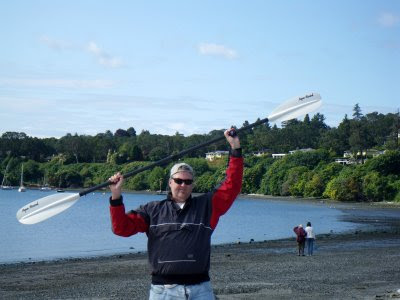
Holding your horizontally paddle over head and alternately moving each end of the paddle up and down indicates to your fellow paddlers that they should "move BACKWARDS."
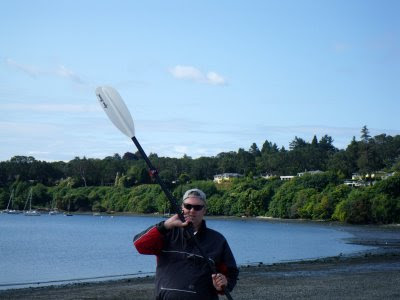
Pointing your paddle to one side or the other indicates the direction that you wish to travel. Here, our model is pointing his paddle to his right, indicating that he wishes to travel to the right.
If our model was holding his paddle in a similar fashion but waving it over his head, this would indicate "EMERGENCY." (Waving your arm over your head also means Emergency.)

This signal means that "my tandem paddle partner is very annoying and if he doesn't shut up soon I'm going to stab him through the chest with his own paddle."

This signal is seldom used on the water, but can sometimes be seen when expeditions have made camp for the night. It means that "this moron forgot to pack the food for our five-day trip."
Groups displaying this signal should be avoided whenever possible. They will be grouchy and annoyed and could possibly resort to cannibalism.
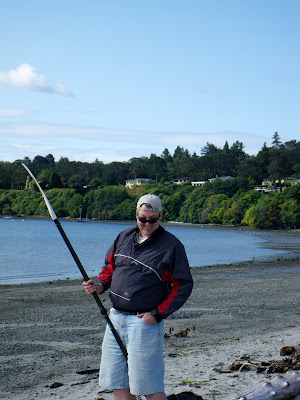
This signal means "you heard right, ladies: carbon shaft."

This signal is often used by Canadian paddlers and means "two minutes for hooking."
As kayakers, we should paddle the ocean with the ability to communicate with others and so we carry radios, cell phones and even whistles. But we have a hearing-impaired paddler in our group and I was wondering if there are any recognized visual signals used in kayaking.
Yours,
Toasted in Tofino
Dear Toasted,
There are many signals that can be used to communicate between paddlers to increase safety during your paddle. Here are some of the most common ones. (Remember that not everyone may use the same signals, so talk them over with your fellow paddlers ahead of time!)

This signal means "GO, proceed in the direction previously discussed." (It can also be done by raising one arm straight into the air).

Holding your horizontally paddle over head is indicating to your fellow paddlers that they should "STOP and hold their position." (This signal can also be done by holding your arms outstretched.)

Holding your horizontally paddle over head and alternately moving each end of the paddle up and down indicates to your fellow paddlers that they should "move BACKWARDS."

Pointing your paddle to one side or the other indicates the direction that you wish to travel. Here, our model is pointing his paddle to his right, indicating that he wishes to travel to the right.
If our model was holding his paddle in a similar fashion but waving it over his head, this would indicate "EMERGENCY." (Waving your arm over your head also means Emergency.)

This signal means that "my tandem paddle partner is very annoying and if he doesn't shut up soon I'm going to stab him through the chest with his own paddle."

This signal is seldom used on the water, but can sometimes be seen when expeditions have made camp for the night. It means that "this moron forgot to pack the food for our five-day trip."
Groups displaying this signal should be avoided whenever possible. They will be grouchy and annoyed and could possibly resort to cannibalism.

This signal means "you heard right, ladies: carbon shaft."

This signal is often used by Canadian paddlers and means "two minutes for hooking."
Wednesday, January 21, 2009
Knots
Dear Kayak Yak
My wife has suddenly developed an interest in tying knots. I'm not sure why. Maybe it's the new "in" thing, because I've noticed our pool boy has been practicing tying knots as well. Anyway, I was wondering if you knew of any good kayak-related knots.
Yours,
Clapped Out in Cloverdale
Dear Clapped
We sure do. Paula learned this rope trick at Paddlefest. It's great for towing someone.
First, you get some rope.

Then you pass the rope through the front towing hook of the kayak to be towed.

Pass through enough rope so that it goes all the way to the cockpit of the kayak to be towed.

Then you make a bunny ear.

Loop the bunny ear under the line in front of the two hook and through the circle.
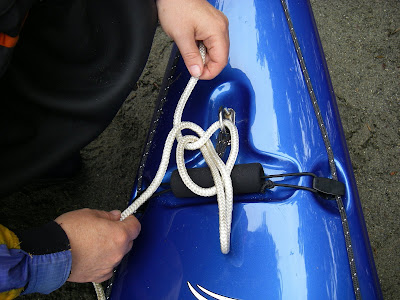
Tighten it up.

Now you can tow someone. The really neat thing about this knot is that the pull of the towing kayak keeps it tight, yet the person being towed can unhitch themselves with a very gentle tug on their end.

My wife has suddenly developed an interest in tying knots. I'm not sure why. Maybe it's the new "in" thing, because I've noticed our pool boy has been practicing tying knots as well. Anyway, I was wondering if you knew of any good kayak-related knots.
Yours,
Clapped Out in Cloverdale
Dear Clapped
We sure do. Paula learned this rope trick at Paddlefest. It's great for towing someone.
First, you get some rope.

Then you pass the rope through the front towing hook of the kayak to be towed.

Pass through enough rope so that it goes all the way to the cockpit of the kayak to be towed.

Then you make a bunny ear.

Loop the bunny ear under the line in front of the two hook and through the circle.

Tighten it up.

Now you can tow someone. The really neat thing about this knot is that the pull of the towing kayak keeps it tight, yet the person being towed can unhitch themselves with a very gentle tug on their end.

Tuesday, April 01, 2008
Dear Kayak Yak - Paddles
Dear Kayak Yak
I'm new to kayaking and I get confused by all the different kinds of paddles and blades. Can you offer a short paddle primer?
Yours,
Baffled in Banff
Dear Baffled
One paddle primer coming up!

This is what a conventional paddle looks like. While there is some variation in the blade shape, most paddles look like this. Some expedition paddlers prefer longer and thinner blades, while some whitewater paddlers like shorter and wider blades.
There can be even more variation, like this wing paddle...

...but most conventional paddles have the same basic look.
Then there's the more traditional Greenland paddle.

This paddle is usually made from wood and features a long but very thin blade. Generally shorter than a conventional paddle, it is surprisingly efficient. Many Greenland paddlers swear by them and would never go back to a conventional paddle.
Then there's the Canadian paddle.

This paddle is similar to the Greenland paddle in that it is made from wood (although new versions made from graphite are now on the market). The hook of the blade allows for more efficient paddling, and should allow for a harder shot from the point and more goal scoring.

Happy paddling!


I'm new to kayaking and I get confused by all the different kinds of paddles and blades. Can you offer a short paddle primer?
Yours,
Baffled in Banff
Dear Baffled
One paddle primer coming up!

This is what a conventional paddle looks like. While there is some variation in the blade shape, most paddles look like this. Some expedition paddlers prefer longer and thinner blades, while some whitewater paddlers like shorter and wider blades.
There can be even more variation, like this wing paddle...

...but most conventional paddles have the same basic look.
Then there's the more traditional Greenland paddle.

This paddle is usually made from wood and features a long but very thin blade. Generally shorter than a conventional paddle, it is surprisingly efficient. Many Greenland paddlers swear by them and would never go back to a conventional paddle.
Then there's the Canadian paddle.

This paddle is similar to the Greenland paddle in that it is made from wood (although new versions made from graphite are now on the market). The hook of the blade allows for more efficient paddling, and should allow for a harder shot from the point and more goal scoring.

Happy paddling!


Sunday, April 01, 2007
Dear Kayak Yak - Transporting Your Kayak
Dear Kayak Yak,
I've seen lots of kayaks on vehicles, but with the rainy July we've had, I've been wondering if there is a way of transporting kayaks that prevents the seats from getting wet if it rains. I know you can get neoprene cockpit covers that are similar to hatch covers, but new kayaking gear can get pretty expensive. (I already had to sell my dog and one kidney to afford a new paddle!) Is there a cheaper alternative?
Yours,
Wet in Whistler
Dear Wet
Yes, new gear is very expensive, but recently Alison came up with a cheap transporting idea to save herself from a wet seat on a rainy day.

Dear Kayak Yak Yak
Normally, I only carry one kayak on my roof rack, but recently I also carried an additional kayak belonging to a friend. It was a tight fit and the two kayaks were rubbing together. Is there any way to help prevent the kayaks from being damaged further if I have to carry another kayak again?
Sincerely,
Hosed in Hope
Dear Hosed,
Socks.
Yes, socks. You may not believe it, but socks could be the most important thing you carry in your kayak. First, they keep your feet warm. They can also be used in a first aid situation as a towel or bandage. You can use them to check wind speed and direction. Finally, they can even be used as food during an emergency (mind you, they do require a lot of cooking).
But to answer your question, socks are also very important when loading your kayaks and can prevent them from rubbing together if you follow these simple directions.
First, you steal a sock from Bernie. Then, once you've loaded one kayak, you attach the sock as you can see in the photo below.
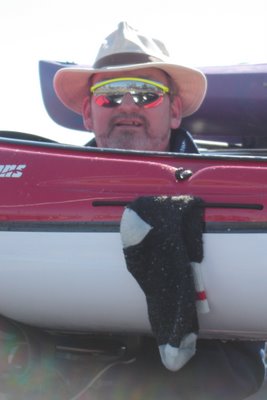
Thus when you load the second kayak, the sock prevents the two kayaks from rubbing together!
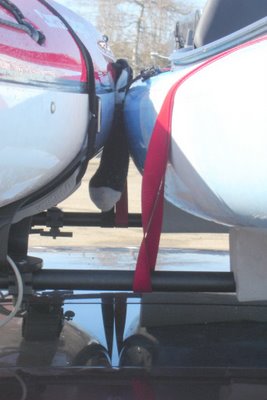
And there you have it! Two kayaks on a small car! One sock made all the difference!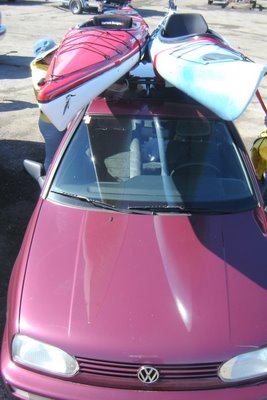
Dear Kayak Yak Yak,
There's been a lot of lightning storms around this year. Is it safe to go kayaking during a thunderstorm?
Yours,
Vexed in Vanderhoof
Dear Vexed,
Lightning can be very dangerous and NOAA recommends that "if you are boating or swimming, get to land and find shelter immediately!"
Our own Bernie tried kayaking during a recent lightning storm. Fortunately the lightning did not strike him until he was on shore, otherwise a great paddle could have been ruined!

I've seen lots of kayaks on vehicles, but with the rainy July we've had, I've been wondering if there is a way of transporting kayaks that prevents the seats from getting wet if it rains. I know you can get neoprene cockpit covers that are similar to hatch covers, but new kayaking gear can get pretty expensive. (I already had to sell my dog and one kidney to afford a new paddle!) Is there a cheaper alternative?
Yours,
Wet in Whistler
Dear Wet
Yes, new gear is very expensive, but recently Alison came up with a cheap transporting idea to save herself from a wet seat on a rainy day.

Dear Kayak Yak Yak
Normally, I only carry one kayak on my roof rack, but recently I also carried an additional kayak belonging to a friend. It was a tight fit and the two kayaks were rubbing together. Is there any way to help prevent the kayaks from being damaged further if I have to carry another kayak again?
Sincerely,
Hosed in Hope
Dear Hosed,
Socks.
Yes, socks. You may not believe it, but socks could be the most important thing you carry in your kayak. First, they keep your feet warm. They can also be used in a first aid situation as a towel or bandage. You can use them to check wind speed and direction. Finally, they can even be used as food during an emergency (mind you, they do require a lot of cooking).
But to answer your question, socks are also very important when loading your kayaks and can prevent them from rubbing together if you follow these simple directions.
First, you steal a sock from Bernie. Then, once you've loaded one kayak, you attach the sock as you can see in the photo below.
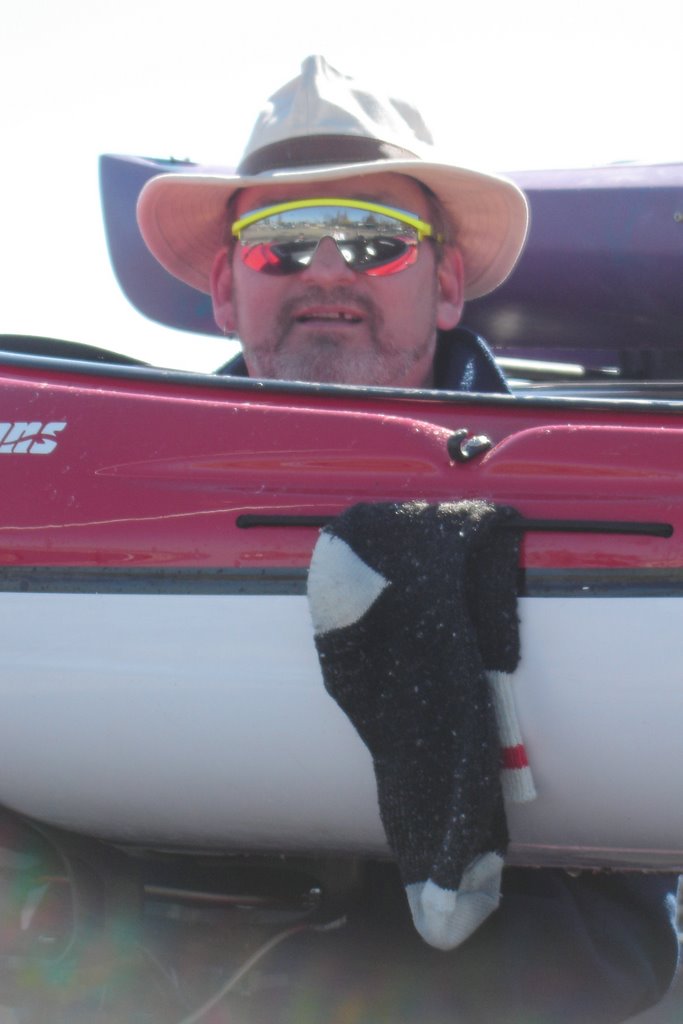
Thus when you load the second kayak, the sock prevents the two kayaks from rubbing together!

And there you have it! Two kayaks on a small car! One sock made all the difference!

Dear Kayak Yak Yak,
There's been a lot of lightning storms around this year. Is it safe to go kayaking during a thunderstorm?
Yours,
Vexed in Vanderhoof
Dear Vexed,
Lightning can be very dangerous and NOAA recommends that "if you are boating or swimming, get to land and find shelter immediately!"
Our own Bernie tried kayaking during a recent lightning storm. Fortunately the lightning did not strike him until he was on shore, otherwise a great paddle could have been ruined!

Subscribe to:
Posts (Atom)