Spring has sprung officially, and there's official good news to celebrate on this first day of spring. The BC government has finally signed an agreement to create a new provincial park on Quadra Island! Read about it here in the Vancouver Sun newspaper.
This new park is terrific news for kayakers and yachters and ecotourists and others who love Waiatt Bay. For almost 20 years, a partnership of groups (including the Pacific Marine Heritage Trust, the Quadra Island Conservancy Stewardship Society, the Save the Heart of Quadra Parks committee, the BC Marine Parks Forever Society, VanCity credit union and BC Parks) has been working on this project.
A new park will be created, linking Octopus Islands Marine Provincial Park (click here for maps and description) and Small Inlet Marine Provincial Park (click here for maps and description) across the narrow isthmus joining the northern end of Quadra to the main part of the island. And it's not a little park, either -- the province has accquired 395 hectares of waterfront property!
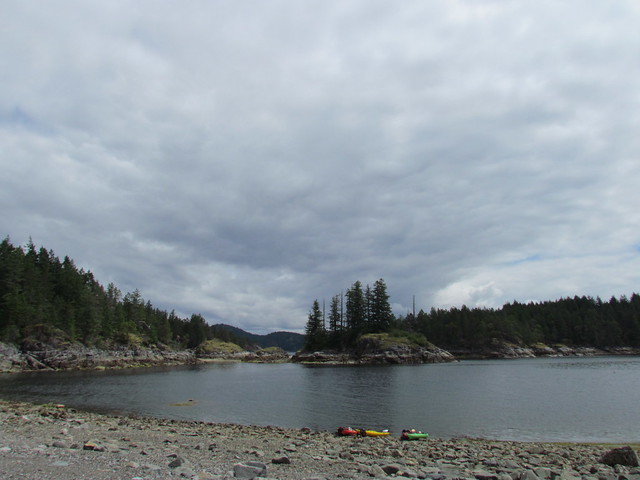
Of course, these 395 hectares have been bought for $5.85 million from a forest company, Merrill & Ring. The province traded some cash and timber rights on nearby East Thurlow Island, as reported in this BC government news release which has several quotes from officials and associations, and there were large contributions from the other partners. And alas, near as I could tell from my visit to Waiatt Bay, much of this ecologically sensitive land is covered with second-growth forest rather than un-logged first growth. Heck, the shoreline where my group stayed is even noted on the charts as "Log Dump" because it was the place where logs were slid into the water to be transported in log booms and Davis rafts.
We at Kayak Yak have written several blog posts about kayaking at Quadra Island and related issues of interest, and my post about helping intertidal biologist Amy Groesbeck with her clam garden research. The land and shores within the new marine park includes areas of great historical and ongoing significance to First Nations people, from middens at village sites to clam gardens and a traditional portage route between Small Inlet and Waiatt Bay. It would be nice to see ecotourism projects being done by local First Nations people ...
Still wanting to know more about the clam gardens protected within this new marine park? Check out this article from a science website, and this article at the Vancouver Sun, and the video.
There are plenty of articles online to read about the new park at Waiatt Bay. Check here for another article, and scroll down for more stories of interest to paddlers and outdoor enthusiasts.
Showing posts with label Quadra Island. Show all posts
Thursday, March 20, 2014
Sunday, March 16, 2014
Clam Garden Researcher Publishes Paper!
Terrific news from our friend on the water, biologist Amy Groesbeck! We met her studying clam gardens on Quadra Island. Quoted here from her Facebook announcement:
Here's the link to the article:
http://www.plosone.org/article/info%3Adoi%2F10.1371%2Fjournal.pone.0091235
The article includes photos, maps, and diagrams. It's also pretty easy to understand for us ordinary paddlers who aren't official university-trained biologists. Go Amy!
And what the heck, because she said I could, here's the abstract, with an important sentence highlighted in green:
Do you want to know what the heck I've been working on the last 3 years??
Our Paper Came out in PLOS ONE Today! Congratulations to my mentors and co-authors Dana, Kirsten Rowell, Anne! and thank you to everyone who helped make this project possible (there are so many!)The paper's title is: "Ancient Clam Gardens Increased Shellfish Production: Adaptive Strategies from the Past Can Inform Food Security Today." That's a great title. I love it when academic papers have titles that actually say something in plain language like "clam gardens increased shellfish production."
Here's the link to the article:
http://www.plosone.org/article/info%3Adoi%2F10.1371%2Fjournal.pone.0091235
The article includes photos, maps, and diagrams. It's also pretty easy to understand for us ordinary paddlers who aren't official university-trained biologists. Go Amy!
And what the heck, because she said I could, here's the abstract, with an important sentence highlighted in green:
Maintaining food production while sustaining productive ecosystems is among the central challenges of our time, yet, it has been for millennia. Ancient clam gardens, intertidal rock-walled terraces constructed by humans during the late Holocene, are thought to have improved the growing conditions for clams. We tested this hypothesis by comparing the beach slope, intertidal height, and biomass and density of bivalves at replicate clam garden and non-walled clam beaches in British Columbia, Canada. We also quantified the variation in growth and survival rates of littleneck clams (Leukoma staminea) we experimentally transplanted across these two beach types. We found that clam gardens had significantly shallower slopes than non-walled beaches and greater densities of L. staminea and Saxidomus giganteus, particularly at smaller size classes. Overall, clam gardens contained 4 times as many butter clams and over twice as many littleneck clams relative to non-walled beaches. As predicted, this relationship varied as a function of intertidal height, whereby clam density and biomass tended to be greater in clam gardens compared to non-walled beaches at relatively higher intertidal heights. Transplanted juvenile L. staminea grew 1.7 times faster and smaller size classes were more likely to survive in clam gardens than non-walled beaches, specifically at the top and bottom of beaches. Consequently, we provide strong evidence that ancient clam gardens likely increased clam productivity by altering the slope of soft-sediment beaches, expanding optimal intertidal clam habitat, thereby enhancing growing conditions for clams. These results reveal how ancient shellfish aquaculture practices may have supported food security strategies in the past and provide insight into tools for the conservation, management, and governance of intertidal seascapes today.
Thursday, July 05, 2012
Kayaking Quadra Island
Summer.
We've heard of this mythical season, seen the occasional glimpse, the teasing hint of it, but it remains elusive. For instance, as Louise and I drove up the east coast of Vancouver Island for a quick getaway last Tuesday to Quadra Island, we encountered cloud, rain and a little sunshine. Often all three at once.
Quadra Island is a short ferry ride from Campbell River. (And I do mean short, only about ten minutes. I've never taken a ferry ride this brief. It took longer to load the ferry than to make the crossing. But I digress.) On arrival in Campbell River...

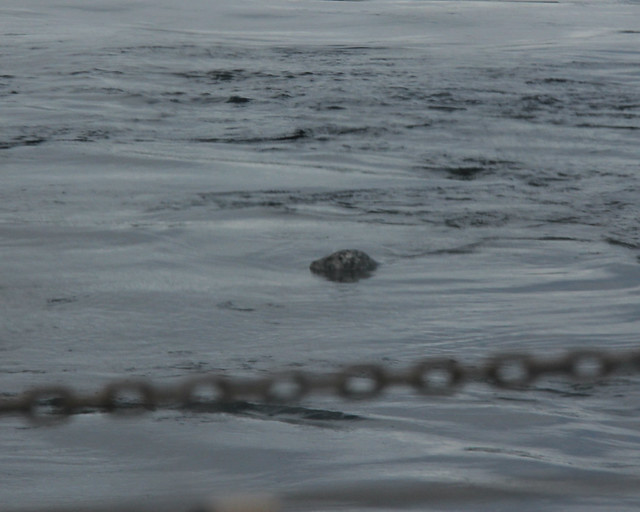
...we could see band upon band of dark clouds passing by overhead, dumping their load of moisture as they passed. Soon the venerable Powell River Queen arrived and we departed, as a lone seal swam by the ferry to make sure all was ship-shape.

Arriving a few minutes later at Quathiaski Cove on Quadra Island, we headed east across the narrow lower portion of the island to the small village of Heriot Bay, where we did a bit of shopping at Works of H'Art, before heading to the southern tip at Cape Mudge, and our home for the next couple of days, The Tsa-Kwa-Luten Lodge.
Owned and operated by the We Wai Kai First Nation and situated on their ancestral land, the Lodge is located in a stunningly beautiful part on the world. We have a stunning view out over Discovery Passage, with the ocean at our feet, tall trees swaying, and snow-capped mountains in the distance. Well, I imagine we do -- it's still all socked in and raining and we can't see a darn thing.

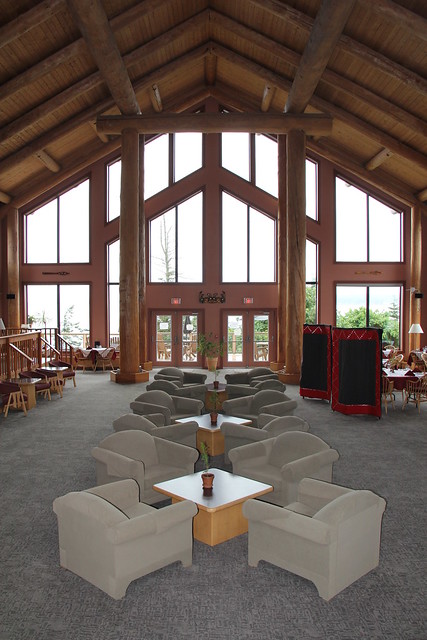
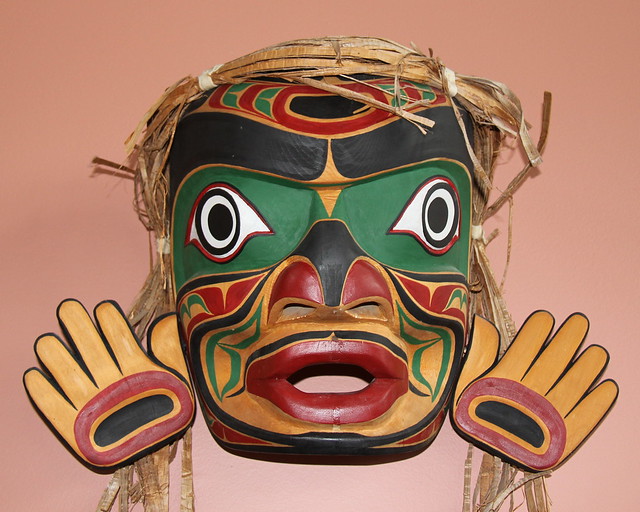
The lobby of the Lodge is gorgeous and decorated with wonderful First Nations art.


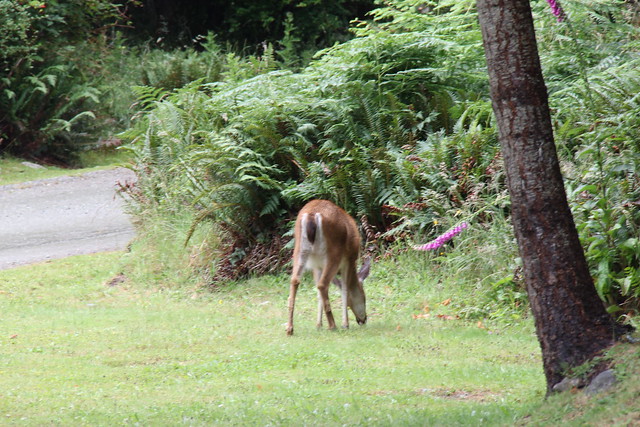
And you've got to love a place that has deer wandering through the parking lot...

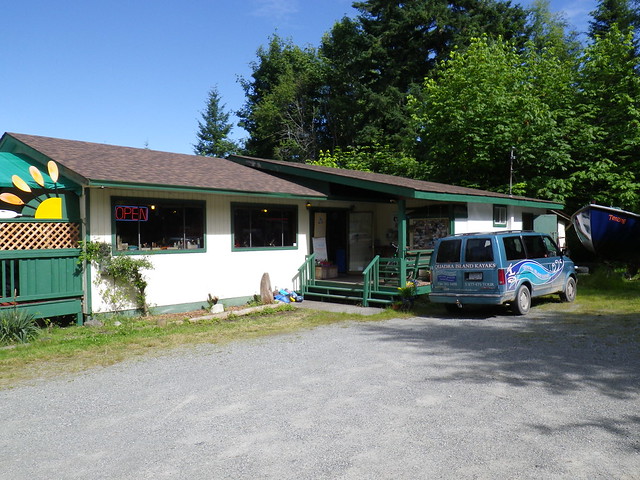
The next morning we returned to Heriot Bay and found the Quadra Island Kayaks shop, known locally as the Yak Shack, where we signed up for a six hour tour.

The rain from the day before had ended, and the clouds were slowly burning away with sunny skies expected in the afternoon.
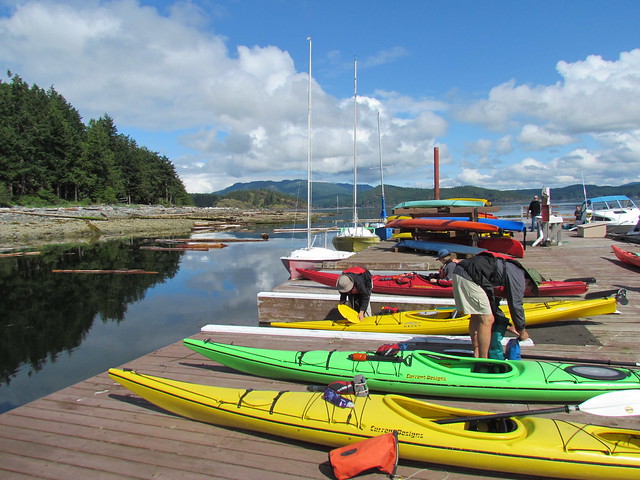
We hoped down to the docks, met our guide Samara from New Zealand, and our fellow paddlers on our tour, George and Lindy from Toronto. With conditions looking to improve, we put away our paddling jackets and hoped for sun. We prepped our kayaks on the dock...

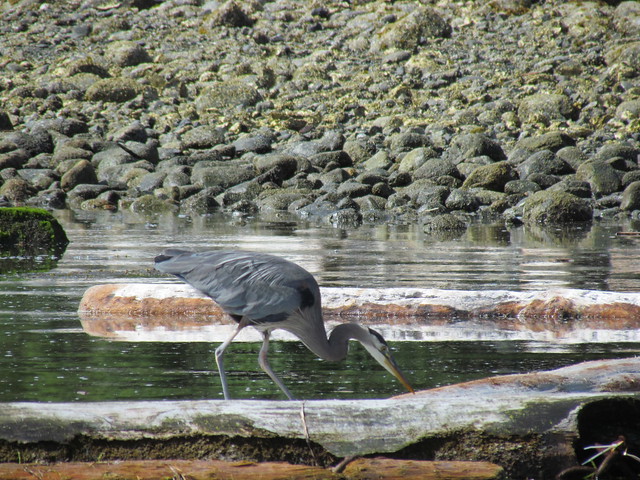
...while a nearby heron went about his business.

And we're off! Louise and I both ended up in Current Design Storms.

We launched in Drew Harbour and paddled to the point of nearby Rebecca Spit, a lovely slender finger of land sticking out into Sutil Channel. From there, a 2km crossing through calm conditions...

...brought us to the Breton Islands, where we found some seals lounging away the morning on a small islet.


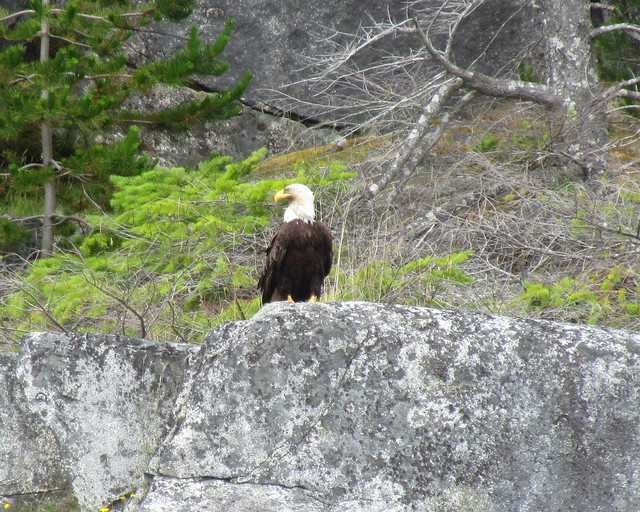
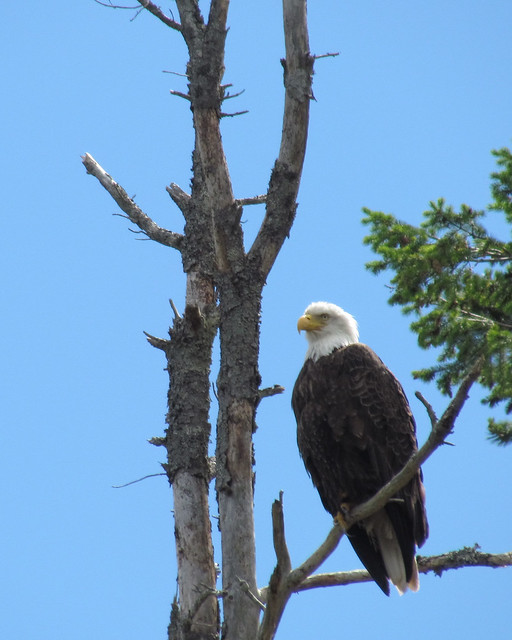
From there, we crossed to No Name Island (so named because I can't find a name for it on any map). Although we'd seen a few earlier, here we started seeing a lot of eagles. There were at least a half dozen or so flying around, as well as a couple of turkey vultures. Most of them weren't too interested in posing, but this one sat down for a few moments.

Passing around No Name Island, we pulled into Moulds Bay for lunch. Samara brought out a yummy feast prepared back at the Yak Shack. It was so good that I was distracted and forgot to take a picture of it, but you can see a portion of it in this portrait of a satisfied customer.
Sadly, the sun was not winning its battle against the clouds, and by the time we were ready to shove off again, a breeze had come up and skies looked a little more threatening than when we left. The paddling jackets came out of hiding as we suited up.

We crossed the mouth of Open Bay and we were into some chop. The breeze came up a little more on the water, and Louise was a little leery, but she handled it perfectly, as did some of the others in the group who had very limited kayaking experience.

Another crossing, this time across Hyacinthe Bay, and we were out of the chop and cruising down the coast of Quadra again.

The eagle pointed the way home for us.

We had a great paddle with George and Lindy and Samara was a terrific guide. Everyone we met on Quadra Island seemed like friendly, down to earth, just plain good folk, and this certainly is true of the folks at Quadra Island Kayak. Definitely check them out if kayaking on Quadra Island is in your future.
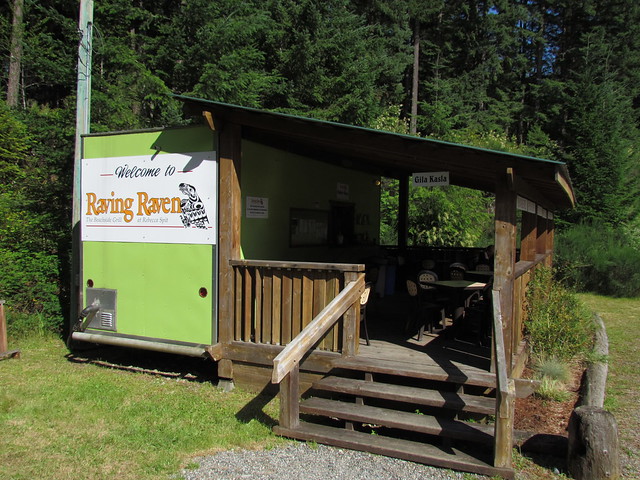
Of course, after six hours on the water, food was in our future, so we drove the short distance to Rebecca Spit and wolfed down cheeseburgers at The Raving Raven. Yum!

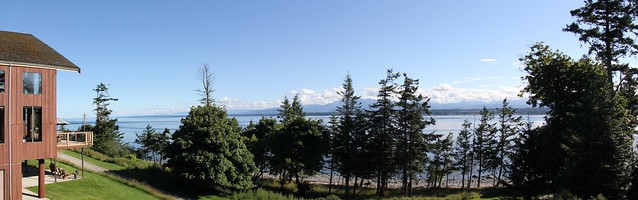
We headed back to the Lodge, and finally the clouds parted, and the view finally appeared. No, it was not still raining and I was not holding up a brochure in front the camera. It really is this beautiful...

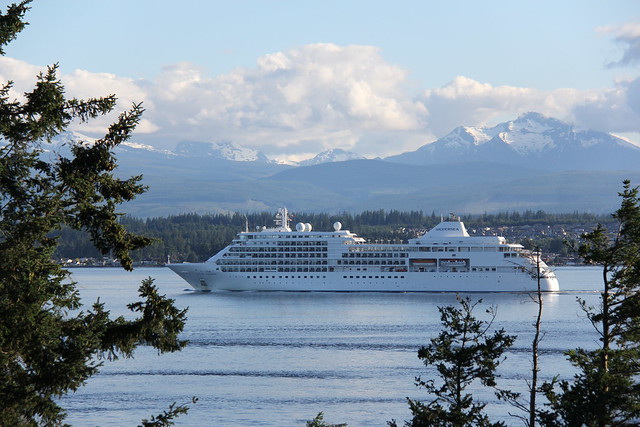
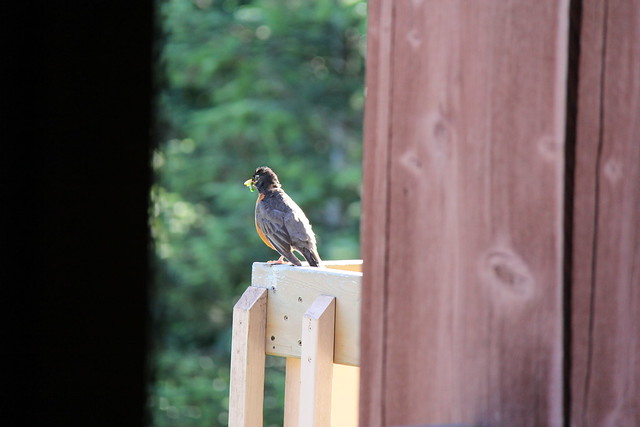
....and you never know what you're going to see out your window. Maybe something big...

...like the Silversea Silver Shadow, or something small...

...like a robin resting on your neighbour's balcony.
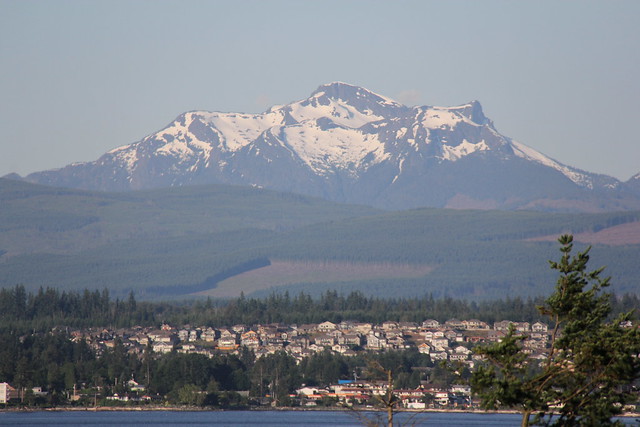
This morning, sadly our last here, we awoke to picture postcard perfection. Sunlight on the mountain snows...

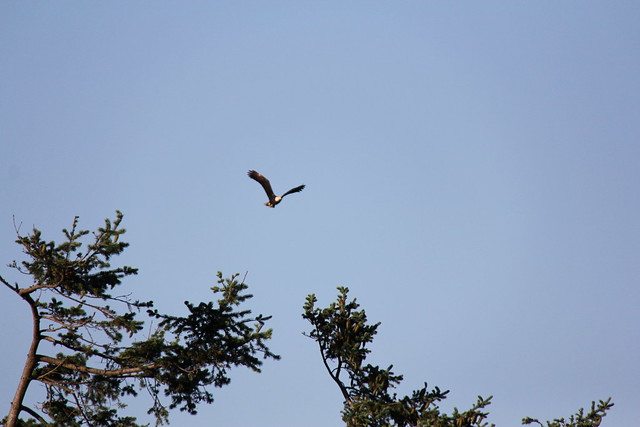
...an eagle flying past our window...

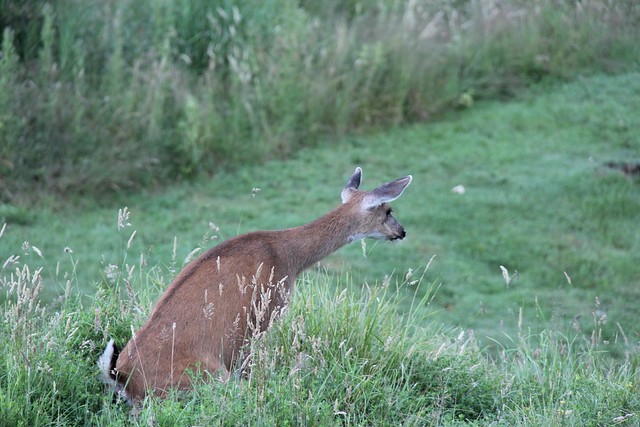
...and a deer, just below our window.

Nature calls for them too, I guess.
Clearly, someone had a good time!

Trip Length: 13.29 km
YTD: 77.15 km
More pictures are here.
We've heard of this mythical season, seen the occasional glimpse, the teasing hint of it, but it remains elusive. For instance, as Louise and I drove up the east coast of Vancouver Island for a quick getaway last Tuesday to Quadra Island, we encountered cloud, rain and a little sunshine. Often all three at once.
Quadra Island is a short ferry ride from Campbell River. (And I do mean short, only about ten minutes. I've never taken a ferry ride this brief. It took longer to load the ferry than to make the crossing. But I digress.) On arrival in Campbell River...

...we could see band upon band of dark clouds passing by overhead, dumping their load of moisture as they passed. Soon the venerable Powell River Queen arrived and we departed, as a lone seal swam by the ferry to make sure all was ship-shape.

Arriving a few minutes later at Quathiaski Cove on Quadra Island, we headed east across the narrow lower portion of the island to the small village of Heriot Bay, where we did a bit of shopping at Works of H'Art, before heading to the southern tip at Cape Mudge, and our home for the next couple of days, The Tsa-Kwa-Luten Lodge.
Owned and operated by the We Wai Kai First Nation and situated on their ancestral land, the Lodge is located in a stunningly beautiful part on the world. We have a stunning view out over Discovery Passage, with the ocean at our feet, tall trees swaying, and snow-capped mountains in the distance. Well, I imagine we do -- it's still all socked in and raining and we can't see a darn thing.

The lobby of the Lodge is gorgeous and decorated with wonderful First Nations art.


And you've got to love a place that has deer wandering through the parking lot...

The next morning we returned to Heriot Bay and found the Quadra Island Kayaks shop, known locally as the Yak Shack, where we signed up for a six hour tour.

The rain from the day before had ended, and the clouds were slowly burning away with sunny skies expected in the afternoon.
We hoped down to the docks, met our guide Samara from New Zealand, and our fellow paddlers on our tour, George and Lindy from Toronto. With conditions looking to improve, we put away our paddling jackets and hoped for sun. We prepped our kayaks on the dock...

...while a nearby heron went about his business.

And we're off! Louise and I both ended up in Current Design Storms.

We launched in Drew Harbour and paddled to the point of nearby Rebecca Spit, a lovely slender finger of land sticking out into Sutil Channel. From there, a 2km crossing through calm conditions...

...brought us to the Breton Islands, where we found some seals lounging away the morning on a small islet.


From there, we crossed to No Name Island (so named because I can't find a name for it on any map). Although we'd seen a few earlier, here we started seeing a lot of eagles. There were at least a half dozen or so flying around, as well as a couple of turkey vultures. Most of them weren't too interested in posing, but this one sat down for a few moments.

Passing around No Name Island, we pulled into Moulds Bay for lunch. Samara brought out a yummy feast prepared back at the Yak Shack. It was so good that I was distracted and forgot to take a picture of it, but you can see a portion of it in this portrait of a satisfied customer.
Sadly, the sun was not winning its battle against the clouds, and by the time we were ready to shove off again, a breeze had come up and skies looked a little more threatening than when we left. The paddling jackets came out of hiding as we suited up.

We crossed the mouth of Open Bay and we were into some chop. The breeze came up a little more on the water, and Louise was a little leery, but she handled it perfectly, as did some of the others in the group who had very limited kayaking experience.

Another crossing, this time across Hyacinthe Bay, and we were out of the chop and cruising down the coast of Quadra again.

The eagle pointed the way home for us.

We had a great paddle with George and Lindy and Samara was a terrific guide. Everyone we met on Quadra Island seemed like friendly, down to earth, just plain good folk, and this certainly is true of the folks at Quadra Island Kayak. Definitely check them out if kayaking on Quadra Island is in your future.
Of course, after six hours on the water, food was in our future, so we drove the short distance to Rebecca Spit and wolfed down cheeseburgers at The Raving Raven. Yum!

We headed back to the Lodge, and finally the clouds parted, and the view finally appeared. No, it was not still raining and I was not holding up a brochure in front the camera. It really is this beautiful...

....and you never know what you're going to see out your window. Maybe something big...

...like the Silversea Silver Shadow, or something small...

...like a robin resting on your neighbour's balcony.
This morning, sadly our last here, we awoke to picture postcard perfection. Sunlight on the mountain snows...

...an eagle flying past our window...

...and a deer, just below our window.

Nature calls for them too, I guess.
Clearly, someone had a good time!

Trip Length: 13.29 km
YTD: 77.15 km
More pictures are here.
Wednesday, August 17, 2011
Stuff!
We didn't paddle as a group this weekend. (I don't count the times I get out on the bay by myself as an "outing" -- just like John and Louise don't count going for a run or brisk walk along the Gorge, or Bernie doesn't get out his bike when he's "only" walking a mile to the public library and then back.) It was a 'check on the aging parents' weekend in which J and L checked on their moms, we checked on my folks and Bernie called his dad, and our son phoned Bernie to wish him a happy birthday. I guess that makes us the aging parents being checked on, too... coffee at Olive Olio's instead of paddling, sheesh.
Besides, John's get up and go got up and went. Stephanie thinks she saw it at 6:30 am when she was checking on her chickens, and it was speeding down the road honking with delight. Brian says it ran past him at the car show in Oak Bay, pantless. I can confirm that. After coffee I fiddled in my garden plot on campus then hopped on a bus and hopped off to walk along Bowker Creek to the Monterey Rec Centre. We'd just been talking over coffee about the Bowker Creek watershed, and how the creek runs from UVic down to Shelbourne Street and wanders around before getting to Willows Beach, so it was nice to see some of the restoration going on along this creek. As I walked, I could hear music. The source was the classic car show on Oak Bay Avenue, and there was John's get up and go, having more fun than he was that morning. It was sitting in someone's restored Triumph, polishing the lovely chrome. He's really got to keep a better handle on his get up and go, or at least make it wear pants.
Eventually, I walked back to a convenient bus stop and knitted my way home. Checked my e-mail and abruptly felt less decrepit to find an e-mail back from ICEBREAKER! The folks who make Icebreaker merino wool clothing were really pleased to hear from me about wearing clothes they made during my trip to be a volunteer clam researcher at Waiatt Bay on Quadra Island. They're sending me a pair of merino wool leggings (the foot-less, calf-length kind called Legless) to wear and test for them. I think Legless will be good to wear while commando kayaking... anything I can wear both on the bus and in my kayak sounds good for keeping my gear bag small.
All Icebreaker wants is for me to sign up for their e-mail newsletter. Well, that seems like a good idea. I went to their link and checked it out. Turns out, people who sign up for their newsletter have a tree planted in their name, and get entered in a draw for a free top. Sounds pretty good.
Besides, John's get up and go got up and went. Stephanie thinks she saw it at 6:30 am when she was checking on her chickens, and it was speeding down the road honking with delight. Brian says it ran past him at the car show in Oak Bay, pantless. I can confirm that. After coffee I fiddled in my garden plot on campus then hopped on a bus and hopped off to walk along Bowker Creek to the Monterey Rec Centre. We'd just been talking over coffee about the Bowker Creek watershed, and how the creek runs from UVic down to Shelbourne Street and wanders around before getting to Willows Beach, so it was nice to see some of the restoration going on along this creek. As I walked, I could hear music. The source was the classic car show on Oak Bay Avenue, and there was John's get up and go, having more fun than he was that morning. It was sitting in someone's restored Triumph, polishing the lovely chrome. He's really got to keep a better handle on his get up and go, or at least make it wear pants.
Eventually, I walked back to a convenient bus stop and knitted my way home. Checked my e-mail and abruptly felt less decrepit to find an e-mail back from ICEBREAKER! The folks who make Icebreaker merino wool clothing were really pleased to hear from me about wearing clothes they made during my trip to be a volunteer clam researcher at Waiatt Bay on Quadra Island. They're sending me a pair of merino wool leggings (the foot-less, calf-length kind called Legless) to wear and test for them. I think Legless will be good to wear while commando kayaking... anything I can wear both on the bus and in my kayak sounds good for keeping my gear bag small.
All Icebreaker wants is for me to sign up for their e-mail newsletter. Well, that seems like a good idea. I went to their link and checked it out. Turns out, people who sign up for their newsletter have a tree planted in their name, and get entered in a draw for a free top. Sounds pretty good.
Thursday, August 04, 2011
Waiatt Bay, Quadra Island
This summer, I got the chance to do something really special. As a volunteer assistant, I joined a biology project. A friend of mine in Straitwatch passed on an appeal from her friend Amy for volunteers to stay at an isolated campsite on Quadra Island, and take samples from beaches. Paddling skills would be an asset.
I joined three other volunteers and Amy for five days on the shores of Waiatt Bay. All these photos were taken by Amy Groesbeck, earlier this summer at similar trips. You won't see any photos of me in this post. You wouldn't want to. The day before the trip, I went to the dermatologist and had eight pink fleshy moles burned off my face with liquid nitrogen. Yuck. A good week to be out in the middle of the woods and the sea, away from most people. It was a good time -- I got on the water every day in small boats, and paddled miles of unfamiliar shorelines.
There's an app for that
Our transportation from Heriot Bay to Waiatt Bay at the north end of Quadra Island was on a boat called the Gung Ho, skippered by Harper Graham. He has a sensible manner that makes passengers feel confident that he knows where he's going and what he's got to do to get there. Of course he knows! On the dashboard in his wheelhouse, next to the throttle controls for the boat's engine and a GPS locator, lies an iPhone in its rubbery case. Yup, an iPhone. He took a text message or two before we finished motoring out of Heriot Bay. He also opened up an app or two and swiped at the phone's screen as he approached the islets in the bay. Perfect navigation. There's an app for that, apparently.
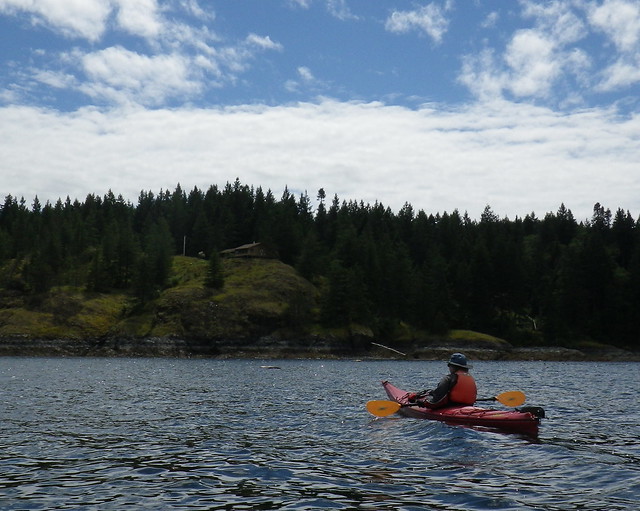
The bay is sheltered with several small islands that make up Octopus Islands Marine Park. Though it's only an hour away from Heriot Bay, Waiatt feels really isolated. That's partly because there's only one cabin visible along the shore, and partly because the second-growth timber has gotten pretty thick so the logging clear-cuts are all grown back in.
Here's a photo that Amy took of the place we camped, on the north shore of Waiatt Bay at the place the chart calls "Log Dump." This little cove has a stream running into the bay, and a midden where we camped, all thoroughly stomped on by the logging done here. Two old sheds and a camper are all falling to pieces in the trees.
To see lots of photos of how Amy Groesbeck investigates clam gardens, go to her Flickr page and check out the right hand column of photo galleries. Some of them are labelled "Clam Garden 2011 - Trip 1" which took place in April 2011, through Trip 4 which took place in late June 2011. Those are the ones especially clam-appropriate.
All I have is a red canoe, three paddles and the truth(with apologies to U2 and Bono)
The skills to handle small boats are practical skills, with real-life applications for modern work in the sciences. One field that puts canoes and kayaks to serious use is... intertidal biology! At least, it does here on the wet coast.
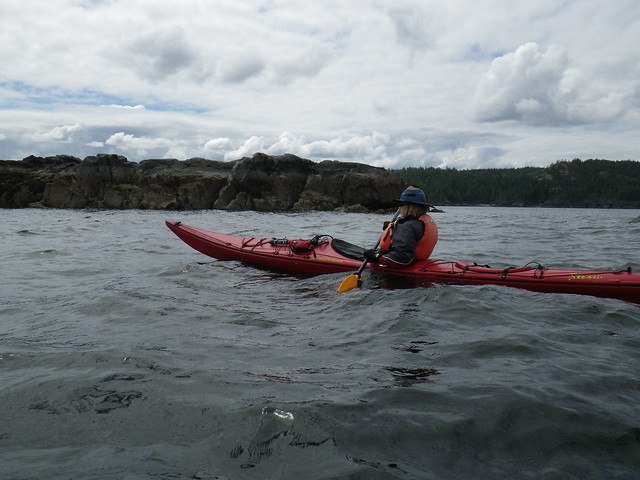
We set out with two ancient canoes -- one green, one red -- and my five-year-old little inflatable kayak. The photo Amy took shows a dark green boat she used on an earlier trip this summer. The canoes were laden with highly technical scientific sampling equipment. That's 5-gallon plastic pails, garden trowels, rubber-palmed garden gloves, spiral-bound notebooks and Zip-Loc freezer bags.
Okay, Amy had a transit of some kind with a laser level, too.
And here's Amy holding some squares she made, 25 cm on a side made out of 1-inch PVC tubing, so we could dig holes exactly 25 cm across. We had to dig them 30 cm deep, which is exactly the length from my elbow to my knuckles. I love the precision of scientific work! In a few beaches, there were experiments placed where Amy buried hand-made mesh bags holding living clams.
Oh, and I was also trained in how to make a sampling device. A kitchen scrubber called a Tuffy was attached to a ten-inch piece of rebar with a cable tie. Easy as pie. After the rebar was pounded into a clam garden, the Tuffy would sit there for four days, collecting anonymous sludge and (with any luck) clam spat. Apparently, intertidal biologists have been trying to figure out how to collect clam spat, and inventing various devices. Someone lucked into using kitchen scrubbers, and found that the Tuffy brand was particularly effective. Did I mention that this project had some funding from grants? Your tax dollars at work, and very efficiently, too. Why waste a biologist's time hand-knitting spat collecting filters when an affordable commercial alternative is easily available. The fun part is pounding the rebar into the garden, when the pounding has to be done underwater. Smack! Smack! into the water. "Science! Doing it all for science!" Spit out muddy sea water. "I'm still having fun!"
Dunno what YOU did on your vacation, but I sat on muddy beaches, dug holes, and collected clam spat. I didn't even ask if spat was gametes or zygotes. I wasn't the one picking up the Tuffy scrubbers and putting them in Zip-Loc freezer bags, and I didn't really need to know.
Nature's Art
On one island owned by a family that Amy knows, there's a cabin, hidden in the trees. It's decorated with all kinds of handmade art objects, made from wood and beach materials and boating materials. Visitors to the bay have been bringing their art objects here for years! When we got back to our camp at the log dump site, I took out my knitting and made a sweater. A little one, doll-size. The next day, we found a piece of driftwood and made a little person to put in the art cabin.
All in all they're just another rock in the wall
If you look over a clam garden at high tide, whether from a boat or from the shore, you probably wouldn't see anything to tell you that this is a place shaped by human gardeners.
When the tide is a little lower than full, you might guess at the shallows near shore, usually in a small bay or between two rocky points. But when the tide is low, approaching a zero tide, the clam garden is revealed.
From shore it looks like a flat, almost level shallow beach. It's mostly free of rocks bigger than your head. Most of the beach is sediments mixed with small stones and bits of broken clam shell. The clam shell hash was added deliberately, to change the local pH of the water and send chemical messages to floating clam spat that here was some good clam habitat to settle down and grow! At the edge of the garden is a rocky ledge. Most of these ledges don't stand up much higher than the level of the beach, maybe ankle-high. But if you look past the edge of the ledge, you can see that the sea bottom drops down suddenly. You're standing at the top of a wall made of rocks piled on rocks.
One of these walls can be as high as three or four metres or more above its underwater base. Most of the visible rocks look small enough for one person to have rolled down the beach into place, about twenty to thirty centimetres across. The rocks at the bottom of the wall three or four metres or more underwater may be larger, maybe half a metre across or bigger.
But that's really enough talking that I can do about clam gardens. To learn more about them, check out the totally awesome book Clam Garden by Judith Williams. You can read more about it at the publisher's website. There's a copy in the Greater Victoria Public Library!
A bird in the hand is worth a snake in the shallows
We got to see lots of wildlife, around the shores of Waiatt Bay. My little kayak is so quiet that I could sneak up on these animals, shyer than their city cousins in Cadboro Bay. A few seals swam by to check out our boats. Raccoons like clam gardens! A couple of times we saw two or three raccoons waddling over the flats at low tide, digging for clams and various invertebrates. A mink poked out its head from the shoreline bushes to look at the canoes that had just gone by, then stare at me and squeak "oh crap!" before darting away. And right in our camp, a little brown weasel came scampering by and glared at everyone. For birds, there were ravens watching our every move, as well as kingfishers and a hummingbird, and a large eagle. I'm sure that we all were very glad that no black bears or cougars came by for a visit.
The most striking animal sighting was when Sara squeaked while sitting on a rocky ledge one afternoon. "A snake!" she squawked. A garter snake was sunning itself on the ledge beside her. When it slithered into the lukewarm sea water, our overjoyed amateur naturalists joined the actual biologists. A snake that swam in sea water! oooOOOoo!
Well, maybe the most striking animal was the polychaete, a bristly marine worm that snaked out of a tunnel in the side of the sampling hole that Sara was digging. Another squawk announced her shock at the arrival of the sandworm. This probably wasn't the kind of polychaete that the Kayak Yak paddle group found in Portage Inlet, making jelly ball egg sacs. That worm, according to Dr Kelly Sendal, probably looks rather like a bratwurst. This one in Sara's gloved hands looked more like a giant pink earthworm with tiny millipede legs. She carefully put it aside and went back to digging. And found another one in her next hole. Only a tiny squawk that time. Tough gal!
I love your lab!
The first time we catalogued clams, both living clams and the shells of dead clams, our group gathered under the tarp over our kitchen area. Seated on five-gallon pails, we hunched over our shells. Annemarie sorted shells, Amy and Kim measured shells with calipers, Sarah and I recorded the measurements in Amy's notebooks. Plenty of banter. "Clam me," I said. "All Clams, All Dead." A rain squall fell around us, and we got chilled and stiff before we were done and dinner could be made.
The second time was much more idyllic. That afternoon was sunny, so after lunch on a rocky slope below a midden across the bay from camp, we set up the calipers and notebooks. Each of us moved into the shade or sunshine at will by shifting a couple of feet on the moss. Our postures were not hunched this time, but varied from leaning on one elbow like a diner at a Roman feast to laying back against rocky slopes perfectly designed to support our backs and heads. More banter, as living clams were found among the dead samples and a dead clam among the living samples. Zombie clams don't groan "braiiinnzz", we decided, because they don't have brains. They call out for nerves.
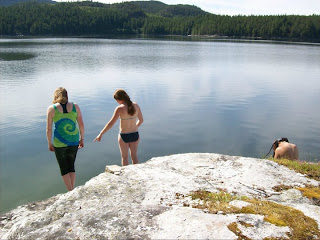
Looking out across the bay was wonderful. I'd always thought that doing science involved wearing lab coats, not bathing suits or my shortie wetsuit. This place was much nicer than a basement lab somewhere. "I love what you've done with your lab!"
In an Octopus's Garden
We came to a clam garden one day that had an unusual living thing at the edge of a particularly high wall. It looked rather like a dahlia flower made out of yellowish jellyfish. "What the heck is that?" Amy wondered out loud. "A squid's egg sac?"
"Or an octopus's egg sac?" I suggested. "There are supposedly a lot of octopus around here. This is Octopus Islands Marine Park, after all." That didn't seem likely. Octopus mothers usually put their egg sacs in sheltered places, and protect them till the little ones hatch. But I found photos online of octopus egg sacs that look pretty much like what we saw.
We got to work taking samples, and Amy wrote notes in her books. When she asked "What shall we call this beach?" there was really only one name to consider: Octopus's Garden.
Here Comes The Rain Again
The weather was almost perfect -- very little breeze on the water the second day, and a half-hour rain sqall were the only variations from sunny and mild. In this sheltered bay the ocean water gets about as warm as it does anywhere along the coast, so it felt much warmer than where I usually paddle near Victoria. There were some two dozen sailboats anchored in sheltered places around Waiatt Bay, the most crowded that Amy had ever seen this area. Nights were cool but not really cold. And just in case perfect was asking too much, an hour before the Gung Ho returned to take us back to Heriot Bay, the clouds opened up. All our tents were soaked as we stuffed them into their bags. But it was still fun! And I sure hope to do it again next year.
I joined three other volunteers and Amy for five days on the shores of Waiatt Bay. All these photos were taken by Amy Groesbeck, earlier this summer at similar trips. You won't see any photos of me in this post. You wouldn't want to. The day before the trip, I went to the dermatologist and had eight pink fleshy moles burned off my face with liquid nitrogen. Yuck. A good week to be out in the middle of the woods and the sea, away from most people. It was a good time -- I got on the water every day in small boats, and paddled miles of unfamiliar shorelines.
There's an app for that
Our transportation from Heriot Bay to Waiatt Bay at the north end of Quadra Island was on a boat called the Gung Ho, skippered by Harper Graham. He has a sensible manner that makes passengers feel confident that he knows where he's going and what he's got to do to get there. Of course he knows! On the dashboard in his wheelhouse, next to the throttle controls for the boat's engine and a GPS locator, lies an iPhone in its rubbery case. Yup, an iPhone. He took a text message or two before we finished motoring out of Heriot Bay. He also opened up an app or two and swiped at the phone's screen as he approached the islets in the bay. Perfect navigation. There's an app for that, apparently.
The bay is sheltered with several small islands that make up Octopus Islands Marine Park. Though it's only an hour away from Heriot Bay, Waiatt feels really isolated. That's partly because there's only one cabin visible along the shore, and partly because the second-growth timber has gotten pretty thick so the logging clear-cuts are all grown back in.
Here's a photo that Amy took of the place we camped, on the north shore of Waiatt Bay at the place the chart calls "Log Dump." This little cove has a stream running into the bay, and a midden where we camped, all thoroughly stomped on by the logging done here. Two old sheds and a camper are all falling to pieces in the trees.
To see lots of photos of how Amy Groesbeck investigates clam gardens, go to her Flickr page and check out the right hand column of photo galleries. Some of them are labelled "Clam Garden 2011 - Trip 1" which took place in April 2011, through Trip 4 which took place in late June 2011. Those are the ones especially clam-appropriate.
All I have is a red canoe, three paddles and the truth(with apologies to U2 and Bono)
The skills to handle small boats are practical skills, with real-life applications for modern work in the sciences. One field that puts canoes and kayaks to serious use is... intertidal biology! At least, it does here on the wet coast.
We set out with two ancient canoes -- one green, one red -- and my five-year-old little inflatable kayak. The photo Amy took shows a dark green boat she used on an earlier trip this summer. The canoes were laden with highly technical scientific sampling equipment. That's 5-gallon plastic pails, garden trowels, rubber-palmed garden gloves, spiral-bound notebooks and Zip-Loc freezer bags.
Okay, Amy had a transit of some kind with a laser level, too.
And here's Amy holding some squares she made, 25 cm on a side made out of 1-inch PVC tubing, so we could dig holes exactly 25 cm across. We had to dig them 30 cm deep, which is exactly the length from my elbow to my knuckles. I love the precision of scientific work! In a few beaches, there were experiments placed where Amy buried hand-made mesh bags holding living clams.
Oh, and I was also trained in how to make a sampling device. A kitchen scrubber called a Tuffy was attached to a ten-inch piece of rebar with a cable tie. Easy as pie. After the rebar was pounded into a clam garden, the Tuffy would sit there for four days, collecting anonymous sludge and (with any luck) clam spat. Apparently, intertidal biologists have been trying to figure out how to collect clam spat, and inventing various devices. Someone lucked into using kitchen scrubbers, and found that the Tuffy brand was particularly effective. Did I mention that this project had some funding from grants? Your tax dollars at work, and very efficiently, too. Why waste a biologist's time hand-knitting spat collecting filters when an affordable commercial alternative is easily available. The fun part is pounding the rebar into the garden, when the pounding has to be done underwater. Smack! Smack! into the water. "Science! Doing it all for science!" Spit out muddy sea water. "I'm still having fun!"
Dunno what YOU did on your vacation, but I sat on muddy beaches, dug holes, and collected clam spat. I didn't even ask if spat was gametes or zygotes. I wasn't the one picking up the Tuffy scrubbers and putting them in Zip-Loc freezer bags, and I didn't really need to know.
Nature's Art
On one island owned by a family that Amy knows, there's a cabin, hidden in the trees. It's decorated with all kinds of handmade art objects, made from wood and beach materials and boating materials. Visitors to the bay have been bringing their art objects here for years! When we got back to our camp at the log dump site, I took out my knitting and made a sweater. A little one, doll-size. The next day, we found a piece of driftwood and made a little person to put in the art cabin.
All in all they're just another rock in the wall
If you look over a clam garden at high tide, whether from a boat or from the shore, you probably wouldn't see anything to tell you that this is a place shaped by human gardeners.
When the tide is a little lower than full, you might guess at the shallows near shore, usually in a small bay or between two rocky points. But when the tide is low, approaching a zero tide, the clam garden is revealed.
From shore it looks like a flat, almost level shallow beach. It's mostly free of rocks bigger than your head. Most of the beach is sediments mixed with small stones and bits of broken clam shell. The clam shell hash was added deliberately, to change the local pH of the water and send chemical messages to floating clam spat that here was some good clam habitat to settle down and grow! At the edge of the garden is a rocky ledge. Most of these ledges don't stand up much higher than the level of the beach, maybe ankle-high. But if you look past the edge of the ledge, you can see that the sea bottom drops down suddenly. You're standing at the top of a wall made of rocks piled on rocks.
One of these walls can be as high as three or four metres or more above its underwater base. Most of the visible rocks look small enough for one person to have rolled down the beach into place, about twenty to thirty centimetres across. The rocks at the bottom of the wall three or four metres or more underwater may be larger, maybe half a metre across or bigger.
But that's really enough talking that I can do about clam gardens. To learn more about them, check out the totally awesome book Clam Garden by Judith Williams. You can read more about it at the publisher's website. There's a copy in the Greater Victoria Public Library!
A bird in the hand is worth a snake in the shallows
We got to see lots of wildlife, around the shores of Waiatt Bay. My little kayak is so quiet that I could sneak up on these animals, shyer than their city cousins in Cadboro Bay. A few seals swam by to check out our boats. Raccoons like clam gardens! A couple of times we saw two or three raccoons waddling over the flats at low tide, digging for clams and various invertebrates. A mink poked out its head from the shoreline bushes to look at the canoes that had just gone by, then stare at me and squeak "oh crap!" before darting away. And right in our camp, a little brown weasel came scampering by and glared at everyone. For birds, there were ravens watching our every move, as well as kingfishers and a hummingbird, and a large eagle. I'm sure that we all were very glad that no black bears or cougars came by for a visit.
The most striking animal sighting was when Sara squeaked while sitting on a rocky ledge one afternoon. "A snake!" she squawked. A garter snake was sunning itself on the ledge beside her. When it slithered into the lukewarm sea water, our overjoyed amateur naturalists joined the actual biologists. A snake that swam in sea water! oooOOOoo!
Well, maybe the most striking animal was the polychaete, a bristly marine worm that snaked out of a tunnel in the side of the sampling hole that Sara was digging. Another squawk announced her shock at the arrival of the sandworm. This probably wasn't the kind of polychaete that the Kayak Yak paddle group found in Portage Inlet, making jelly ball egg sacs. That worm, according to Dr Kelly Sendal, probably looks rather like a bratwurst. This one in Sara's gloved hands looked more like a giant pink earthworm with tiny millipede legs. She carefully put it aside and went back to digging. And found another one in her next hole. Only a tiny squawk that time. Tough gal!
I love your lab!
The first time we catalogued clams, both living clams and the shells of dead clams, our group gathered under the tarp over our kitchen area. Seated on five-gallon pails, we hunched over our shells. Annemarie sorted shells, Amy and Kim measured shells with calipers, Sarah and I recorded the measurements in Amy's notebooks. Plenty of banter. "Clam me," I said. "All Clams, All Dead." A rain squall fell around us, and we got chilled and stiff before we were done and dinner could be made.
The second time was much more idyllic. That afternoon was sunny, so after lunch on a rocky slope below a midden across the bay from camp, we set up the calipers and notebooks. Each of us moved into the shade or sunshine at will by shifting a couple of feet on the moss. Our postures were not hunched this time, but varied from leaning on one elbow like a diner at a Roman feast to laying back against rocky slopes perfectly designed to support our backs and heads. More banter, as living clams were found among the dead samples and a dead clam among the living samples. Zombie clams don't groan "braiiinnzz", we decided, because they don't have brains. They call out for nerves.
Looking out across the bay was wonderful. I'd always thought that doing science involved wearing lab coats, not bathing suits or my shortie wetsuit. This place was much nicer than a basement lab somewhere. "I love what you've done with your lab!"
In an Octopus's Garden
We came to a clam garden one day that had an unusual living thing at the edge of a particularly high wall. It looked rather like a dahlia flower made out of yellowish jellyfish. "What the heck is that?" Amy wondered out loud. "A squid's egg sac?"
"Or an octopus's egg sac?" I suggested. "There are supposedly a lot of octopus around here. This is Octopus Islands Marine Park, after all." That didn't seem likely. Octopus mothers usually put their egg sacs in sheltered places, and protect them till the little ones hatch. But I found photos online of octopus egg sacs that look pretty much like what we saw.
We got to work taking samples, and Amy wrote notes in her books. When she asked "What shall we call this beach?" there was really only one name to consider: Octopus's Garden.
Here Comes The Rain Again
The weather was almost perfect -- very little breeze on the water the second day, and a half-hour rain sqall were the only variations from sunny and mild. In this sheltered bay the ocean water gets about as warm as it does anywhere along the coast, so it felt much warmer than where I usually paddle near Victoria. There were some two dozen sailboats anchored in sheltered places around Waiatt Bay, the most crowded that Amy had ever seen this area. Nights were cool but not really cold. And just in case perfect was asking too much, an hour before the Gung Ho returned to take us back to Heriot Bay, the clouds opened up. All our tents were soaked as we stuffed them into their bags. But it was still fun! And I sure hope to do it again next year.
Subscribe to:
Posts (Atom)