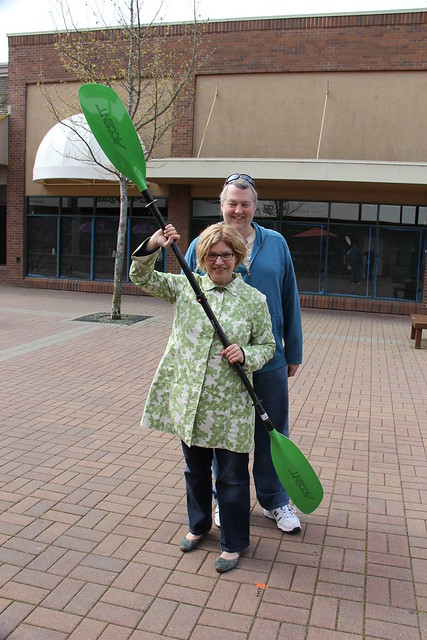
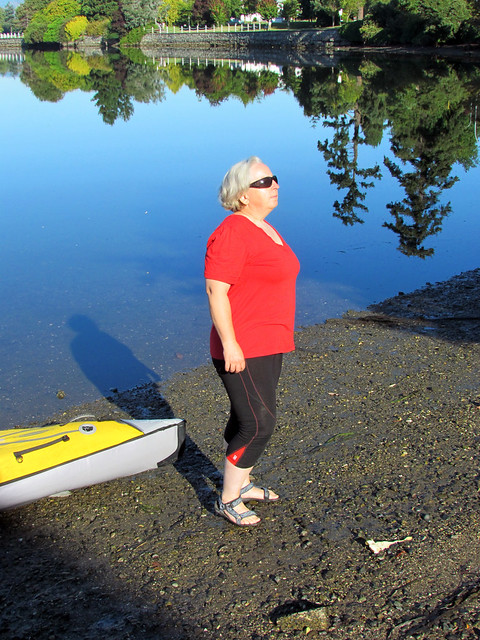
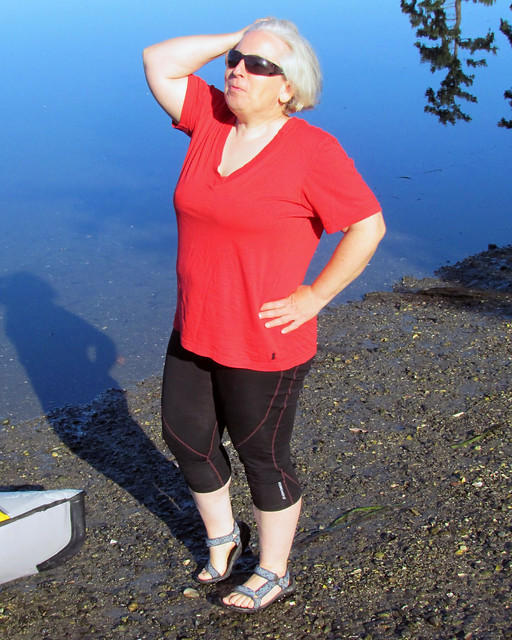
Whitewater kayakers wear helmets to protect their heads from collisions with river rocks. I hadn't realized until recently that Aleut sea kayakers in the Aleutian islands of what is now Alaska would traditionally wear a kind of helmet. Their style of helmet was more for protecting their eyes from glare and spray.
Here's a photo from the British Museum's website of an 18th-century Aleut hunting helmet worn while kayaking. The style was far more practical than it might seem at first glance. The description on the web page explains something of how the materials could have cultural significance as well as usefulness.
I don't like the thought of the cultural imperialism shown by the 'collectors' who brought this helmet and other cultural artifacts around the world to the British Museum... but I do find the online resources are at least making images of these items available for people to see and learn.
Showing posts with label gear. Show all posts
Saturday, October 24, 2015
Tuesday, October 20, 2015
Kayaking Mitts
When kayaking in the winter, it's good to have a pair of mitts or pogies to cover your hands. Pogies are big enough to fasten around the paddle, and let the paddler wear paddling gloves as well. That's particularly nice since my paddling gloves have just short fingers in a cut-off style. They were a gift from my daughter Lila and have been worn for 5 winters, while the pogies were used twice and have been put away for the next time Lila is paddling here. Her hands get chilled even more easily than Louise's hands! It's important to keep warm while paddling, since the ocean is cold here year-round.
Here's a traditional style of kayaking mitts from Greenland which are called aaqqatit. I found a photo from the British Museum website, with a description of these sealskin mitts in their collection. The mitts are distinct in that they have two thumbs. No, Greenlanders do NOT have two-thumbed hands! This design allows a padder to turn a mitt around if it becomes too slippery.
This two-thumbed style of mitt is well-suited to cold water paddlesports, and to fishermen on the North Sea, who traditionally wore a version knitted of wool. The style also makes a lot of sense to anyone who has ever worn mitts or gloves while working outdoors. For one thing, the mitt on your dominant hand wears out much more quickly than the other mitt. For another, it's far too easy to lose one of a pair. And when you live out in the boonies there is no handy store like Ocean River Sports or Capitol Iron just around the corner for picking up a new pair. The upshot is, any outdoor worker ends up with a few odd gloves or mitts.
Here's a traditional style of kayaking mitts from Greenland which are called aaqqatit. I found a photo from the British Museum website, with a description of these sealskin mitts in their collection. The mitts are distinct in that they have two thumbs. No, Greenlanders do NOT have two-thumbed hands! This design allows a padder to turn a mitt around if it becomes too slippery.
![]() |
| This photo is from the British Museum website |
This two-thumbed style of mitt is well-suited to cold water paddlesports, and to fishermen on the North Sea, who traditionally wore a version knitted of wool. The style also makes a lot of sense to anyone who has ever worn mitts or gloves while working outdoors. For one thing, the mitt on your dominant hand wears out much more quickly than the other mitt. For another, it's far too easy to lose one of a pair. And when you live out in the boonies there is no handy store like Ocean River Sports or Capitol Iron just around the corner for picking up a new pair. The upshot is, any outdoor worker ends up with a few odd gloves or mitts.
Saturday, September 26, 2015
Another Piece of Gear
I shouldn't be reading Facebook. It leads me to new websites -- sometimes really interesting ones about kayaking! But some of these websites showcase new pieces of gear that I never knew about, and never would have thought I needed.
Kayak Deck Slates.
Okay, paddlers, who's got a deck slate? Or a set of 'em? Hands up, anybody.
Deck Slates.
Kayak Deck Slates? Yes, slates for your kayak deck. They come in sets of two.
For those who were born after the invention of the file card, let alone the tablet smart phone, a slate is an erasable surface that you can write on. Slates are called that because they used to be made of a thin slice of stone called slate, and people wrote on them with a lead pencil.
These deck slates are a kind of laminated sticker to put on your kayak's front deck near the front end of the coaming, where you can reach them while paddling. They're sold online through Paddling Light and they actually look pretty nifty.
Let me be the first to admit that I've never heard of anyone putting slates on their kayak decks, though this website says they're popular in Britain. And now that I come to think about it, someone who needs more than one slate is doing rather more writing while kayaking than I plan to do. And though I have written while kayaking, I do it on a sheet of paper folded into a mini-notebook, with a pencil stub.
Oh, but apparently only one of these slates is for writing notes. The left-hand slate is set up for writing a tide chart. So I guess I could use the right-hand slate for noting what I saw when I pushed my SPOT OK button, or where I took a photograph, or resolutions to vote in the coming election for a candidate who when elected will lead Parliament to reduce oil tanker traffic making all these wakes in the Juan de Fuca Strait.
The listing for the deck slates is clear-spoken and informative, includes tips for installing the stickers, and points out that the slates are "Good in temperatures ranging from -65°F to 225°F." I'll keep that in mind next time anyone in my paddle group doesn't want to go on the water because the weather is too cold, or too hot.
Kayak Deck Slates. Betcha all the cool paddlers have 'em.
Kayak Deck Slates.
Okay, paddlers, who's got a deck slate? Or a set of 'em? Hands up, anybody.
Deck Slates.
Kayak Deck Slates? Yes, slates for your kayak deck. They come in sets of two.
For those who were born after the invention of the file card, let alone the tablet smart phone, a slate is an erasable surface that you can write on. Slates are called that because they used to be made of a thin slice of stone called slate, and people wrote on them with a lead pencil.
These deck slates are a kind of laminated sticker to put on your kayak's front deck near the front end of the coaming, where you can reach them while paddling. They're sold online through Paddling Light and they actually look pretty nifty.
Let me be the first to admit that I've never heard of anyone putting slates on their kayak decks, though this website says they're popular in Britain. And now that I come to think about it, someone who needs more than one slate is doing rather more writing while kayaking than I plan to do. And though I have written while kayaking, I do it on a sheet of paper folded into a mini-notebook, with a pencil stub.
Oh, but apparently only one of these slates is for writing notes. The left-hand slate is set up for writing a tide chart. So I guess I could use the right-hand slate for noting what I saw when I pushed my SPOT OK button, or where I took a photograph, or resolutions to vote in the coming election for a candidate who when elected will lead Parliament to reduce oil tanker traffic making all these wakes in the Juan de Fuca Strait.
The listing for the deck slates is clear-spoken and informative, includes tips for installing the stickers, and points out that the slates are "Good in temperatures ranging from -65°F to 225°F." I'll keep that in mind next time anyone in my paddle group doesn't want to go on the water because the weather is too cold, or too hot.
Kayak Deck Slates. Betcha all the cool paddlers have 'em.
Monday, September 15, 2014
Kayak Kaddy
A few years ago, Paula posted about the Kayak Kaboose, a device that is essentially a floating extra cargo hatch for your kayak. Attached to the back of your kayak, the kaboose floats behind in carrying your extra gear.
Now, another company has come up with something similar called The Kayak Kaddy. This looks to be a more compact version, and, as seen in the video below, can be towed easily behind a sit-on-top or even a SUP. If you have to take everything with you when you go kayaking, this piece of gear might be just what you need.
Thursday, July 24, 2014
Suiting Up
Louise has always been reluctant to shell out the $$$ needed for a drysuit, however she has finally seen the light and agrees that a drysuit would be a wise investment. She has decided to put off her purchase until next year, and for a very good reason. It's next year that Kokatat is introducing their new Idol drysuit with SwitchZip. This new zipper splits the drysuit into two pieces, making much easier to get in and out of, and allows the two pieces to function as, well, two pieces. Only need pants this trip? Just take the lower half!
The new suit will be available next year. Heck, maybe I need a new drysuit, too!
Monday, July 22, 2013
Wear Your PFD
Yes, it's summer. Yes, many people find a life jacket or a personal flotation device (PFD) to be hot or uncomfortable. Tough noogies. I'm going to repeat the advice that is frequently given to kayakers and to people out in canoes, rowboats, dinghies, and other small boats: a life jacket can't do you much good when you are not wearing it.
Oh, sure, a PFD can make a good cushion under your butt. The answer to that is to make a proper cushion for your butt, or to carry a second PFD to use as a cushion. It is darned nice when floating beside an overturned boat, collecting one's sense of aplomb, to have a cushion or spare PFD to hang onto -- but it's even nicer to be WEARING a PFD and holding onto that floating cushion.
Oh, sure, a PFD can make a person feel hot on a sunny day, or it can restrict some people's feeling of free movement. That's why I wear a Kokatat Orbit -- it doesn't make me feel constricted or wrapped up tightly. Even better is the Mustang style of inflatable PFD which has no lift until inflated, or the SeaO2 which has a little lift until inflated, and then it has way more lift than an ordinary PFD.
But after all the excuses, wear your PFD to make it easier for the search party to find you. Most of the recreational fishermen who are found drowned are a few feet away from their boats, where their life jackets are stuffed behind the seat along with a mickey or a six-pack.
I like the news that the Canadian regulations for stand-up-paddleboards are considering allowing paddlers not to wear a PFD if they are wearing a leash attaching them to the board. Regulations aren't just arbitrary rules -- they are rules meant to reflect what people are doing and how they can be safer.
Nobody plans to add a fatal accident to a fun outing on the water. Nobody wants to be part of a search party dragging a lake. And nobody wants to be hiring this couple with an underwater robot, even if it is pretty darned cool and is put to good use.
Oh, sure, a PFD can make a good cushion under your butt. The answer to that is to make a proper cushion for your butt, or to carry a second PFD to use as a cushion. It is darned nice when floating beside an overturned boat, collecting one's sense of aplomb, to have a cushion or spare PFD to hang onto -- but it's even nicer to be WEARING a PFD and holding onto that floating cushion.
Oh, sure, a PFD can make a person feel hot on a sunny day, or it can restrict some people's feeling of free movement. That's why I wear a Kokatat Orbit -- it doesn't make me feel constricted or wrapped up tightly. Even better is the Mustang style of inflatable PFD which has no lift until inflated, or the SeaO2 which has a little lift until inflated, and then it has way more lift than an ordinary PFD.
But after all the excuses, wear your PFD to make it easier for the search party to find you. Most of the recreational fishermen who are found drowned are a few feet away from their boats, where their life jackets are stuffed behind the seat along with a mickey or a six-pack.
I like the news that the Canadian regulations for stand-up-paddleboards are considering allowing paddlers not to wear a PFD if they are wearing a leash attaching them to the board. Regulations aren't just arbitrary rules -- they are rules meant to reflect what people are doing and how they can be safer.
Nobody plans to add a fatal accident to a fun outing on the water. Nobody wants to be part of a search party dragging a lake. And nobody wants to be hiring this couple with an underwater robot, even if it is pretty darned cool and is put to good use.
Sunday, July 14, 2013
Testing A Rowboat
Got a chance to help a friend with her first test paddle of a new boat! It wasn't a kayak, though -- it was an inflatable rowboat.
Some inflatable rowboats are simply nothing more than pool toys for little kids to play with in shallow water while being watched by attentive lifeguards. Others are darned near as tough as a Zodiac and cost nearly as much. My friend likes to find something better than a pool toy and more affordable than a Zodiac, and it looks like her newest boat has the qualities she needs.
It takes only a few minutes to unpack this rowboat and inflate it. Behold! Intex's new model, the Seahawk 2. It's a nice enough boat to deserve a proper set of oars and a big doublestroke air pump. Looks about nine feet long and big enough to hold two people. Here it is, sitting on the lawn next to my little inflatable, an older version of an Advanced Elements Lagoon.
We carried our boats down to the shore and launched. My friend does a floating launch to avoid wear-and-tear on the rubber boat, but I wasn't able to get a video of the launch technique.
What a good day for a test paddle! The sun was bright without being too hot, the beach had several people yet wasn't over-crowded, and there were just a few ruffled wavelets as the breeze picked up. Over the next hour and a half we paddled along the bay shore and drifted, relaxing and letting the boats drift.
The verdict? This model is a reasonable choice of rowboat, very affordable, and it packs up small enough to carry on a bus or tuck easily into a car's trunk. Plus, if there's only one person in it, there's plenty of room for fishing gear and maybe a cooler full of a picnic. Must make plans for the future!
Some inflatable rowboats are simply nothing more than pool toys for little kids to play with in shallow water while being watched by attentive lifeguards. Others are darned near as tough as a Zodiac and cost nearly as much. My friend likes to find something better than a pool toy and more affordable than a Zodiac, and it looks like her newest boat has the qualities she needs.
It takes only a few minutes to unpack this rowboat and inflate it. Behold! Intex's new model, the Seahawk 2. It's a nice enough boat to deserve a proper set of oars and a big doublestroke air pump. Looks about nine feet long and big enough to hold two people. Here it is, sitting on the lawn next to my little inflatable, an older version of an Advanced Elements Lagoon.
We carried our boats down to the shore and launched. My friend does a floating launch to avoid wear-and-tear on the rubber boat, but I wasn't able to get a video of the launch technique.
What a good day for a test paddle! The sun was bright without being too hot, the beach had several people yet wasn't over-crowded, and there were just a few ruffled wavelets as the breeze picked up. Over the next hour and a half we paddled along the bay shore and drifted, relaxing and letting the boats drift.
| Test subject confirms the boat is large enough to recline with either head or feet elevated! |
Wednesday, July 03, 2013
Need a Spare?
Here's something that might come in handy for someone looking for a spare cell phone. It's called a SpareOne, an AA battery powered cell phone. You can use it to make to make an emergency cell call, or if you pop your cell phone's SIM card into it, you can use it like a regular cell phone. The battery will last forever, well, ten hours of talk time. There are some drawbacks -- although it comes in a waterproof bag, the phone itself is not waterproof, and it is only a cell phone, not a satellite phone. If you're out of cell coverage, you're out of luck. And you should check if it will work on your cell network. One online reviewer noted that it is a 2G phone and one of our local cell networks no longer supports 2G, so the phone didn't work on it.
This won't beat a sat phone, SPOT, or EPIRB if you're far off the beaten path and not in range of a cell network in an emergency, but it might be a good additional piece of communications gear if you're considering a backup for your cell phone.
Tuesday, July 02, 2013
Improvised Kayak Rack
Out for a walk during the long weekend, we passed by Mike Jackson's place and saw that he'd made a kayak rack out of something unexpected:
Not a bad idea!
I've used a couple of resin lawn chairs -- right side up -- when maintaining my inflatable kayaks, but those are lighter than Mike's sea kayak. The chairs hold the inflatable up at a reasonable height for cleaning or spraying with 303 Protectant. An inflatable can be balanced across the backs of two chairs if the backs aren't too round, or the bow and stern of the light little Lagoon will fit on the seats.
There are a lot of these resin lawn chairs around. When one gets a crack or breaks, there's no way to repair it reliably. Nice to have another way to use them, before eventually recycling them.
I do like when things can be repaired, and continue to be used... like the big concrete animals at Gyro Park. The Saanich work crew have sandblasted all three big animals, repaired the cracked concrete, and re-painted them. The Cadborosaurus is looking pretty good now!
Here's Louise looking it over. We can see this big beast from the water when we're paddling, but the giant red octopus shows up better from a distance.
Not a bad idea!
I've used a couple of resin lawn chairs -- right side up -- when maintaining my inflatable kayaks, but those are lighter than Mike's sea kayak. The chairs hold the inflatable up at a reasonable height for cleaning or spraying with 303 Protectant. An inflatable can be balanced across the backs of two chairs if the backs aren't too round, or the bow and stern of the light little Lagoon will fit on the seats.
There are a lot of these resin lawn chairs around. When one gets a crack or breaks, there's no way to repair it reliably. Nice to have another way to use them, before eventually recycling them.
I do like when things can be repaired, and continue to be used... like the big concrete animals at Gyro Park. The Saanich work crew have sandblasted all three big animals, repaired the cracked concrete, and re-painted them. The Cadborosaurus is looking pretty good now!
Here's Louise looking it over. We can see this big beast from the water when we're paddling, but the giant red octopus shows up better from a distance.
Sunday, June 09, 2013
Traditional Kayak Clothing
The other day I was looking at my paddle jacket, and feeling unhappy. Water soaks through. The neck and wrist closures are still good, which is nice because Velcro does eventually wear out. The jacket still fits over my head, and over my wetsuit and merino wool shirt, which is good because it means that my waistline hasn't expanded too dreadfully during a semester of fewer paddling sessions. There are no tears in the main fabric of the jacket, though there are some black stained spots; dunno how to remove those speckled stains, but maybe a mild bleach solution will help.
The problem is, water soaks through. Dip an elbow, get a wet and cold elbow.
It's not a surprise. The jacket was second-hand when Tom Jacklin found it and another for Bernie and me in a thrift store, five years ago. I sprayed it then with a water-proofing treatment, and did another coat last year.
Now it's time to do a little triage: is it time to do another coat of waterproofing spray at about $12 a bottle? Or is a dry suit a better investment? I did a little research.
Dry suits are worth the cost, if one can afford it, but it's not in my budget this year. I'd have to get one made to measure, anyway. Waterproofing spray would be the answer to keep a new paddle jacket waterproof, but for this older jacket the sprays are no longer effective. Instead, I'm going to use a waxing technique that I've learned about from some DIY websites... it isn't pretty to smear paraffin wax over a garment, but heck! this garment ain't pretty any more. I'm looking for something to help keep me warmer when I get splashed (not if, but WHEN), and maybe help keep me alive if I tip over during a crossing between islands this summer.
And I'm not going to whine about my paddle jacket. Not after looking at some of the images of traditional Inuit paddle gear, made from gut. You can see and read a little about these gut garments at the Inuvialuit Living History Website. A great website, well worth wandering through at leisure!
Other traditional kayak clothing can be seen in the film People of a Feather. Click here to see the trailer for this terrific documentary, which opens with a scene of a traditional boat in use in Hudson's Bay!
The problem is, water soaks through. Dip an elbow, get a wet and cold elbow.
It's not a surprise. The jacket was second-hand when Tom Jacklin found it and another for Bernie and me in a thrift store, five years ago. I sprayed it then with a water-proofing treatment, and did another coat last year.
Now it's time to do a little triage: is it time to do another coat of waterproofing spray at about $12 a bottle? Or is a dry suit a better investment? I did a little research.
Dry suits are worth the cost, if one can afford it, but it's not in my budget this year. I'd have to get one made to measure, anyway. Waterproofing spray would be the answer to keep a new paddle jacket waterproof, but for this older jacket the sprays are no longer effective. Instead, I'm going to use a waxing technique that I've learned about from some DIY websites... it isn't pretty to smear paraffin wax over a garment, but heck! this garment ain't pretty any more. I'm looking for something to help keep me warmer when I get splashed (not if, but WHEN), and maybe help keep me alive if I tip over during a crossing between islands this summer.
And I'm not going to whine about my paddle jacket. Not after looking at some of the images of traditional Inuit paddle gear, made from gut. You can see and read a little about these gut garments at the Inuvialuit Living History Website. A great website, well worth wandering through at leisure!
Other traditional kayak clothing can be seen in the film People of a Feather. Click here to see the trailer for this terrific documentary, which opens with a scene of a traditional boat in use in Hudson's Bay!
Monday, January 07, 2013
Coolest Night Paddling
Okay, so we've been on several evening paddles. And Alison has paddled after dark in Sooke Basin.
But now I know what I want for the next time we go paddling at dusk. I want my kayak to light up on the inside, like the new folding kayaks made out of coroplast (corugated plastic). Oru Kayak makes them, and I can't wait to see one at the next paddlefest...
But then I found these other guys do even cooler paddling in the dark -- they've got lights under the hulls of their stand-up paddleboards. Check them out!
Is that cool?
Now I am *so* going to find a way to install lights on the hull of my kayak. On the outside and inside. And on top on the deck. And on my hat. And maybe one on a line that I can lower into the water and watch it sink.
But now I know what I want for the next time we go paddling at dusk. I want my kayak to light up on the inside, like the new folding kayaks made out of coroplast (corugated plastic). Oru Kayak makes them, and I can't wait to see one at the next paddlefest...
But then I found these other guys do even cooler paddling in the dark -- they've got lights under the hulls of their stand-up paddleboards. Check them out!
Is that cool?
Now I am *so* going to find a way to install lights on the hull of my kayak. On the outside and inside. And on top on the deck. And on my hat. And maybe one on a line that I can lower into the water and watch it sink.
Saturday, May 05, 2012
Surprise!
Yesterday was Louie's mumble-mumbleth birthday. With a little help from my sister, her present was delivered to her at a coffee shop.
Bet you can't guess what it is.

Okay, maybe you can.

It's an ergonomic Accent paddle. We checked these paddles out at MEC a few weeks ago and they seem like decent value for the money. Louise has a funny paddling habit where she slowly slides her hands down the paddle as she paddles which results in the paddle becoming totally off centre. Hopefully, the ergonomic design of this paddle will help keep her paddle in the right place, or rather keep her hands in the right place on the paddle.

We'll let you know how she likes it - stay tuned!
Bet you can't guess what it is.

Okay, maybe you can.

It's an ergonomic Accent paddle. We checked these paddles out at MEC a few weeks ago and they seem like decent value for the money. Louise has a funny paddling habit where she slowly slides her hands down the paddle as she paddles which results in the paddle becoming totally off centre. Hopefully, the ergonomic design of this paddle will help keep her paddle in the right place, or rather keep her hands in the right place on the paddle.

We'll let you know how she likes it - stay tuned!
Tuesday, November 22, 2011
A Bit of Fluff
On the weekend, I was out in the Mini-Tripper kayak, the one with the big, wide-open cockpit. Looking down at my sandals, I saw they were messy and picked off a piece of seaweed and another piece of black fluff. Both the messy bits went over the side.
Then I thought a little more about that bit of fluff. Probably from my clothes. I bought new socks the other day, so that fluff might be from a sock. Polyester.
Polyester might not seem like something to write about in a kayaking blog. But if you've read the news on Science Daily, you'll know that clothing is a source of tiny particles of plastic that can be found in sea water. Go to this link and see the article.
Basically, tiny bits of polyester and acrylic are breaking off clothing in washing machines. The water draining out of washing machines ends up in the ocean. Shorelines tested all over the world show microplastic debris on the beaches and in the guts of marine life.
One speck in a microbial life form isn't too much. But the microplastic doesn't digest, and it accumulates in the food chain.
Scientist Mark Browne and his colleagues wrote a report saying that "more than 1,900 fibers can rinse off of a single garment during a wash cycle, and these fibers look just like the microplastic debris on shorelines." The report calls for designers of washing machines "to develop methods for removing microplastic from sewage."
I don't know how guilty I can feel about fibers wearing off my clothing and sludging into the wastewater pipes. Guilty enough that I am going to make the effort to buy natural fiber clothes when I can, and that means no more cheap polyester socks. I already knew that I like the feel of wool, silk, and cotton, as well as other natural fibers. I already knew that merino wool clothes are better for paddling than polyester!
Then I thought a little more about that bit of fluff. Probably from my clothes. I bought new socks the other day, so that fluff might be from a sock. Polyester.
Polyester might not seem like something to write about in a kayaking blog. But if you've read the news on Science Daily, you'll know that clothing is a source of tiny particles of plastic that can be found in sea water. Go to this link and see the article.
Basically, tiny bits of polyester and acrylic are breaking off clothing in washing machines. The water draining out of washing machines ends up in the ocean. Shorelines tested all over the world show microplastic debris on the beaches and in the guts of marine life.
One speck in a microbial life form isn't too much. But the microplastic doesn't digest, and it accumulates in the food chain.
Scientist Mark Browne and his colleagues wrote a report saying that "more than 1,900 fibers can rinse off of a single garment during a wash cycle, and these fibers look just like the microplastic debris on shorelines." The report calls for designers of washing machines "to develop methods for removing microplastic from sewage."
I don't know how guilty I can feel about fibers wearing off my clothing and sludging into the wastewater pipes. Guilty enough that I am going to make the effort to buy natural fiber clothes when I can, and that means no more cheap polyester socks. I already knew that I like the feel of wool, silk, and cotton, as well as other natural fibers. I already knew that merino wool clothes are better for paddling than polyester!
Sunday, November 06, 2011
BigWaveDave.ca Supports Community Member
A quick note here for all kayakers, windsurfers, SUPers, and canoeists who make a point of checking BigWaveDave's website for all the low-down on weather, tides, and more. A windsurfer, Andrei Vojakine, who goes by the nickname Russian Dood on the BigWaveDave forum is being treated for brain cancer.
Click on the piratical image in the upper left-hand corner of the homepage for BigWaveDave to learn more about the Russian Dood and his story. The forum has begun collecting donations for the BC Cancer Foundation in his name. There will be a draw much like a raffle, but ya get only one ticket no matter how big the donation, eh? The donated prizes include art, jackets, a GoPro helmet cam and weekends at two of the nicest resorts on Vancouver Island.
Solidarity for the Russian Dood and all people being treated for brain cancer, including a relative of one of the Kayak Yak paddle group.
Click on the piratical image in the upper left-hand corner of the homepage for BigWaveDave to learn more about the Russian Dood and his story. The forum has begun collecting donations for the BC Cancer Foundation in his name. There will be a draw much like a raffle, but ya get only one ticket no matter how big the donation, eh? The donated prizes include art, jackets, a GoPro helmet cam and weekends at two of the nicest resorts on Vancouver Island.
Solidarity for the Russian Dood and all people being treated for brain cancer, including a relative of one of the Kayak Yak paddle group.
Monday, August 29, 2011
Testing Stuff!
Stuff arrived by courier this week. It was a package sent by Icebreaker, with a pair of their Legless merino wool leggings for me to test and write about. Yay!
These Legless tights are the Pace version, meant for runners to wear alone or under light trousers. Other versions of Legless tights are winter underwear meant to leave shins & ankles free from excessive layering with socks & trousers. They're capri length, to about mid-calf on the model on their website. (Full disclosure: I am NOT the model on the Icebreaker.com website. I do not look even remotely like the model wearing the Legless tights, Pace version. I have the finely-honed body of a freelance writer.)


One of my theories about clothing for kayakers is that "dress for immersion" doesn't always have to mean "wear a wetsuit" or "wear a dry suit." It can also mean "wear something I can swim in" where swimming is safe. On hot summer days when we're practising our wet exits at a sheltered lake, I wear a bathing suit or shorts and a t-shirt. But most days, I'm not planning to swim. When I'm kayaking in sheltered, familiar waters and staying close to shore, dressing for immersion means I wear a light merino wool shirt and leggings. In the cold ocean water, I'd be able to swim a few yards to shore.
But my old leggings wore out. And when I wrote to Icebreaker praising the many-mended leggings and shirts that I wear while paddling, they sent me a new pair of leggings to try.
Lemme say, the Legless are pretty much exactly what I'm looking for in paddling pants. They're short enough that I can wade and get into my boat. They dry quickly when splashed. They're warm when wet, something that polyester tights and bike shorts are NOT.
Another factor that works for me is that these tights look like summery, sporty clothes. When commando kayaking I like to be able to wear my paddling clothes on the bus without causing panic and a general exodus via the back door. I wore these tights with a long t-shirt and a long sweater on campus and at the library. (Don't panic. I have permission from my fashionistas Lila, Ben and Marlene, provided that the shirt is long enough to cover the rump.) The verdict from several consultants was that the look was "slimming." Nice thought.
We've been in a bit of a heat wave, and I wore these tights not only while kayaking, but while gardening and walking over a mile on pavement in the baking hot sunshine. In spite of being made of black wool, these tights were cooler than a similar pair of polyester tights.
For people unfamiliar with wearing wool as anything other than a bulky sweater, I can confirm that like other light merino wool garments, Legless tights can be thrown in the washing machine. (Cold water wash, and any other clothes in the load should not be "shedding" lots of fluff.) For drying, hang 'em up. They dry pretty quickly.
The only problem for me is that the promotional ad photos Icebreaker puts on its website are a little weird. Not the photos showing the garments worn by models... those are ok though all the models are young and trim. (Would it be so wrong to have a plump model staying healthy and active in sports gear?) No, it's the flashy promotional photos on Icebreaker's website that are kinda weird. A dark man with a ram's head. A woman riding him. I'm up for images of strength and vigor, but some of these photos look heterosexist and creepy. Not creepy enough to keep me from wearing these merino wool tights and my mended shirts!
Monday, June 06, 2011
Delta Fit Kit
Louise has been complaining for a while now that she hasn't felt as comfortable in her Delta 17 kayak as she has in the past. While we have investigated this problem, one thing we discovered is that her hips probably weren't in as much contact with the boat as they should be. This can be easily remedied with some padding, so we took a quick trip down to Ocean River Sports for some advice where we discovered that Delta Kayaks has just released a new kit especially designed to retro fit hip padding into their boats.
Called, naturally enough, the Delta Fit Kit, it consists of two pieces of plastic, some fasteners and pads. And instructions. Instructions are always good.
Before:
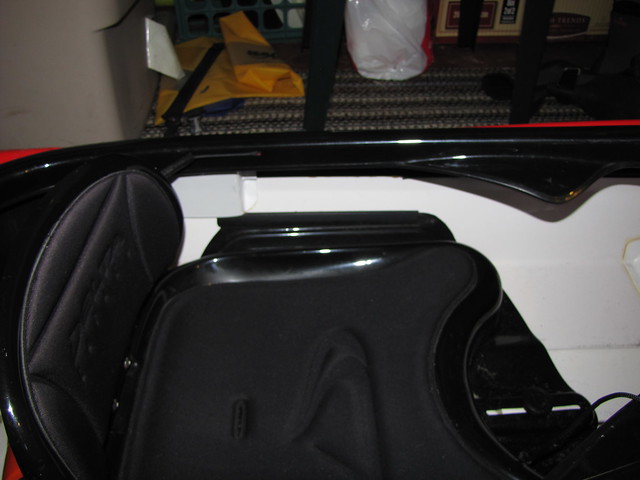
The cockpit of Louise's boat. You can see the white space between the seat and the underside of the coaming. This is, of course, the inside hull of the kayak. The plastic pieces of the Fit Kit attach to the seat and fit in on the underside of the coaming. When it's done, there should be a smaller inner wall of black plastic in front of the white hull.
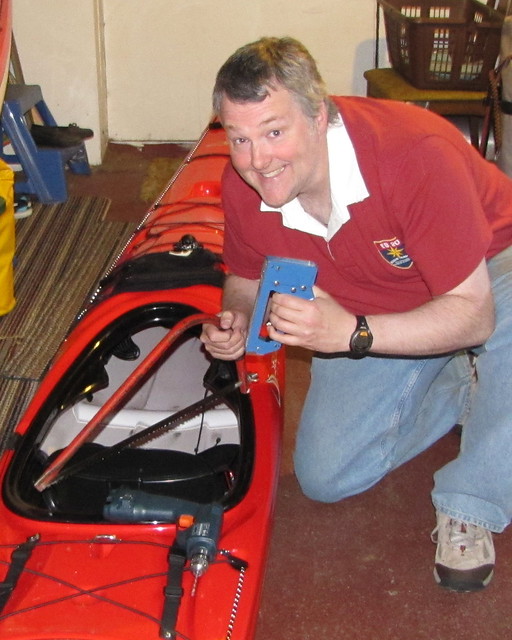
Of course, you shouldn't begin any job without having the proper tools ready to go. And nothing says "Let's work on a thin plastic kayak" more than a staple gun, drill and a rusty hack saw. Except for maybe a crowbar, sander and a welding torch. Bandages, a first aid book, a cell phone preprogrammed to call 9-1-1, and having the nearest trauma centre programmed as a waypoint into your GPS wouldn't hurt either
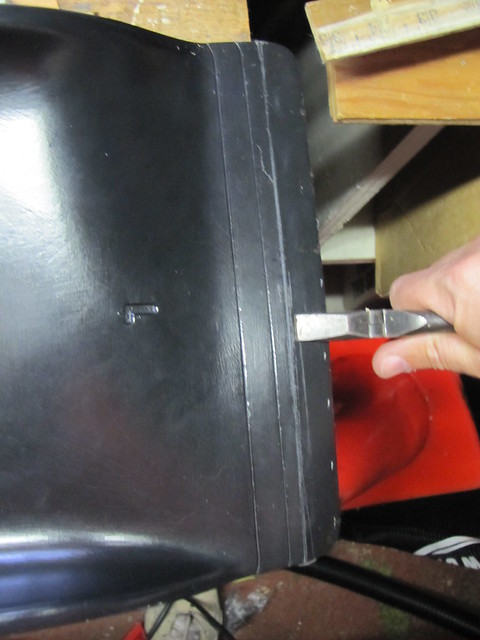
The first order of business is to trim your plastic pieces. Fortunately the instructions let you know just how much plastic to trim off for your particular kayak model. A little scoring with a box cutter...

...and a little bending with pliers and we're done.
Now comes the fun part: drilling!
The new side pieces fit in tight under the coaming and snap onto the edge of the seat. Both the salesperson and the instructions warned that it might take a significant amount of force to make this work, but surprisingly not all that much was required.
With the pieces in place, they need to be attached to the seat, so holes must be drilled for the fasteners.
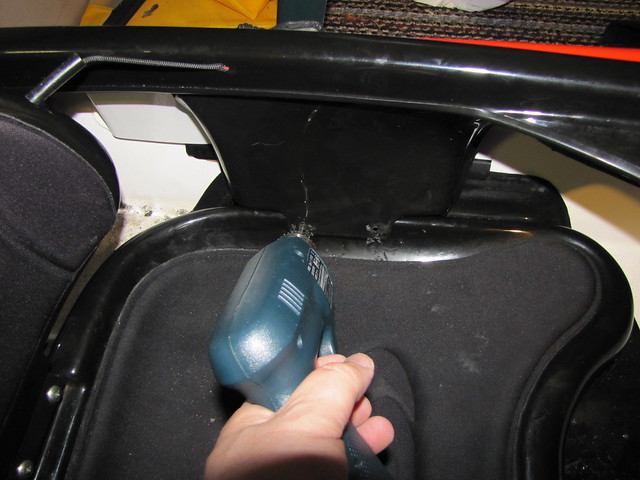
And if you haven't had any adrenalin rushes lately, may I recommend using a drill pointing towards the bottom of a plastic boat's hull! It does get the juices flowing!
And here we are with the plastic sides installed with the fasteners about to go in. They just push in very easily.
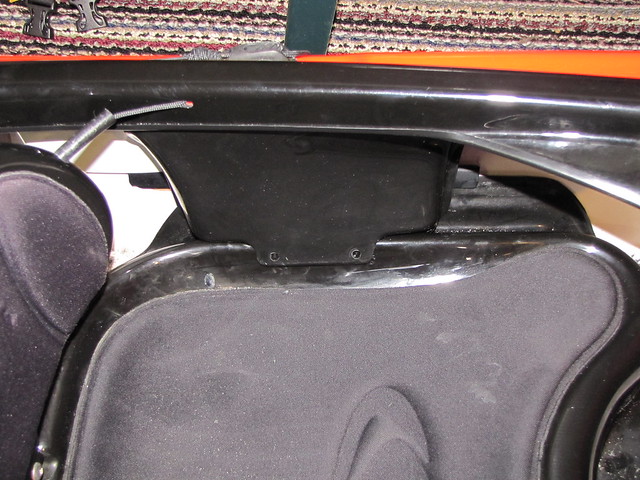
Louise hopped in and we tried to figure just how much padding she requires. The Kit comes with six pads, three for each side. We slid them in there for a test fit and two on each side seemed to be the magic number.
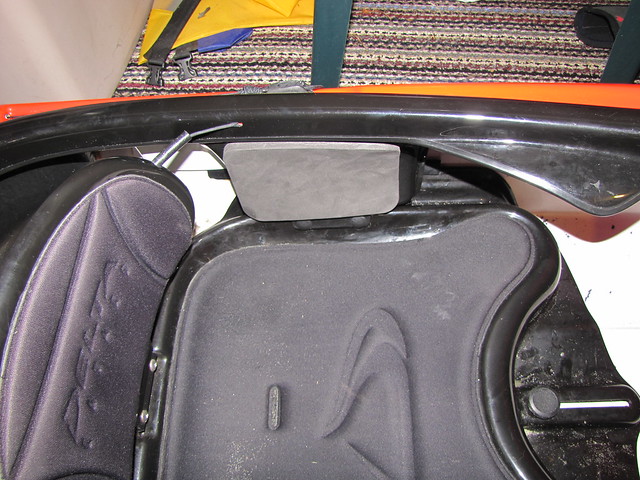
But we decicded for the moment to try only one on each side and see how it went on her next paddle.
Called, naturally enough, the Delta Fit Kit, it consists of two pieces of plastic, some fasteners and pads. And instructions. Instructions are always good.
Before:

The cockpit of Louise's boat. You can see the white space between the seat and the underside of the coaming. This is, of course, the inside hull of the kayak. The plastic pieces of the Fit Kit attach to the seat and fit in on the underside of the coaming. When it's done, there should be a smaller inner wall of black plastic in front of the white hull.
Of course, you shouldn't begin any job without having the proper tools ready to go. And nothing says "Let's work on a thin plastic kayak" more than a staple gun, drill and a rusty hack saw. Except for maybe a crowbar, sander and a welding torch. Bandages, a first aid book, a cell phone preprogrammed to call 9-1-1, and having the nearest trauma centre programmed as a waypoint into your GPS wouldn't hurt either

The first order of business is to trim your plastic pieces. Fortunately the instructions let you know just how much plastic to trim off for your particular kayak model. A little scoring with a box cutter...

...and a little bending with pliers and we're done.

Now comes the fun part: drilling!
The new side pieces fit in tight under the coaming and snap onto the edge of the seat. Both the salesperson and the instructions warned that it might take a significant amount of force to make this work, but surprisingly not all that much was required.
With the pieces in place, they need to be attached to the seat, so holes must be drilled for the fasteners.

And if you haven't had any adrenalin rushes lately, may I recommend using a drill pointing towards the bottom of a plastic boat's hull! It does get the juices flowing!
And here we are with the plastic sides installed with the fasteners about to go in. They just push in very easily.

Louise hopped in and we tried to figure just how much padding she requires. The Kit comes with six pads, three for each side. We slid them in there for a test fit and two on each side seemed to be the magic number.

But we decicded for the moment to try only one on each side and see how it went on her next paddle.
Wednesday, February 23, 2011
Judy's Modifications
We had a pleasant surprise on Sunday morning, even though there was ice on the Gorge, so our planned outing was called off. A bunch of us went for coffee instead. The pleasant surprise part came when walking along the beach at Gyro Park afterwards: two unfamiliar kayaks were coming to shore.
As they reached the beach, we walked over to say hi. The boats became recognizable at about the same time as the paddlers -- it was Judy and Mike, who live next door to the Beach House!
Mike has a sweet and simple sea kayak, and Judy was out in her little green Pelican that usually leans up against the side wall of their house (on the other side of the hedge from Bernie and my kayaks).
(And while we're at it... Oi! Anyone who is paddling an empty shell of a little recreation kayak with no bulkheads or flotation devices, listen up. You have no excuses now! Get some pool noodles if nothing else is available, and fasten them into your boat.)
Now I want to make a paddle float like the one Judy made!
As they reached the beach, we walked over to say hi. The boats became recognizable at about the same time as the paddlers -- it was Judy and Mike, who live next door to the Beach House!
Mike has a sweet and simple sea kayak, and Judy was out in her little green Pelican that usually leans up against the side wall of their house (on the other side of the hedge from Bernie and my kayaks).
"We call these 'drowning boats'," I teased her. "They haven't got any flotation and when a Pelican fills up, it sinks."
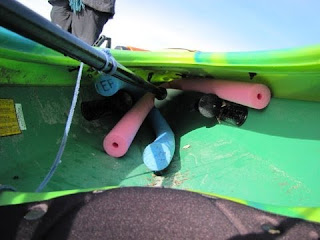
"Not this one!" Judy laughed. "I've got some flotation in the stern, and some pool noodles in the bow."
We checked, and I gotta say, this is the safest Pelican I've ever seen. Judy rigged it out with rope and a homemade paddle float on the deck, a big styrofoam float fastened behind the seat, and the pool noodles up in the bow. John got a picture of her improvised flotation innovation.
(And while we're at it... Oi! Anyone who is paddling an empty shell of a little recreation kayak with no bulkheads or flotation devices, listen up. You have no excuses now! Get some pool noodles if nothing else is available, and fasten them into your boat.)
Now I want to make a paddle float like the one Judy made!
Tuesday, February 22, 2011
Radio Licensing Course
This note was just sent to members of SISKA and VCKC, and is quoted in full:
VHF Radio – Licensing Course
This course is a joint offering by the South Island Sea Kayaking Association (SISKA) and the Victoria Canoe & Kayak Club (VCKC). You don’t need to have a radio to take this course.
Do you want to learn how to use a VHF radio when out paddling? If so, you should take this course. Not only is it very useful, it leads to getting your Restricted Operator’s Certificate (Marine) - aka ROC – which is a legal requirement if you use a radio on the water.
WHAT: A 3-evening course leading to the Restricted Operator’s Certificate (Maritime).
WHEN: The course will be held on Thursday evenings – March 3rd, 10th 17th, starting at 7.15pm.
WHERE: The VCKC Clubhouse, 355 Gorge Road West
FOR WHOM?: Anyone who has a VHF radio but does not hold a licence. Anyone holding a pre-digital licence (i.e. no Digital selective Calling [DSC] endorsement on their licence). Anyone who does not have a radio but may want/need to use one in an emergency. Anyone who has a boat with a radio and wants to learn how to use it properly
BY WHOM?: The course will be taught by Greg Diemert and Phil Miles of the Canadian Power Squadron.
HOW MUCH? The cost of the course is $65. This includes the course manual, a CD of notes and test questions, the registration and the certificate itself.
REGISTRATION: It will help if you let me know ahead of the course that you are interested (Alan Thomson, 3135thom@islandnet.com or 250-592-4170), but you can register and pay on the first night of the course. Cash or cheques only.
The course consists of 2 nights of classes and one night for the exam. If you want to study the manual ahead of the course, you can get the manual from Greg Diemert at Ensign Chrysler, 1061 Yates Street. Pick up from Greg at Ensign Monday/Tuesday 8.30 to 3.30 pm: Wed 12:30 to 6:30: Thursday/Friday 8:30 to 3:30. Or phone 250 386 2411.
NOTES
If you already have a Restricted Operator’s licence but without the Digital Selective Calling endorsement, it is recommended that you take the full course.
If you have the full licence already, but would like a refresher, it may be possible for you to sit in on the first two nights of the course – it will depend on student numbers. If there isn’t room on the course, an additional night (March 24th) has been reserved for a stand-alone refresher course.
VHF Radio – Licensing Course
This course is a joint offering by the South Island Sea Kayaking Association (SISKA) and the Victoria Canoe & Kayak Club (VCKC). You don’t need to have a radio to take this course.
Do you want to learn how to use a VHF radio when out paddling? If so, you should take this course. Not only is it very useful, it leads to getting your Restricted Operator’s Certificate (Marine) - aka ROC – which is a legal requirement if you use a radio on the water.
WHAT: A 3-evening course leading to the Restricted Operator’s Certificate (Maritime).
WHEN: The course will be held on Thursday evenings – March 3rd, 10th 17th, starting at 7.15pm.
WHERE: The VCKC Clubhouse, 355 Gorge Road West
FOR WHOM?: Anyone who has a VHF radio but does not hold a licence. Anyone holding a pre-digital licence (i.e. no Digital selective Calling [DSC] endorsement on their licence). Anyone who does not have a radio but may want/need to use one in an emergency. Anyone who has a boat with a radio and wants to learn how to use it properly
BY WHOM?: The course will be taught by Greg Diemert and Phil Miles of the Canadian Power Squadron.
HOW MUCH? The cost of the course is $65. This includes the course manual, a CD of notes and test questions, the registration and the certificate itself.
REGISTRATION: It will help if you let me know ahead of the course that you are interested (Alan Thomson, 3135thom@islandnet.com or 250-592-4170), but you can register and pay on the first night of the course. Cash or cheques only.
The course consists of 2 nights of classes and one night for the exam. If you want to study the manual ahead of the course, you can get the manual from Greg Diemert at Ensign Chrysler, 1061 Yates Street. Pick up from Greg at Ensign Monday/Tuesday 8.30 to 3.30 pm: Wed 12:30 to 6:30: Thursday/Friday 8:30 to 3:30. Or phone 250 386 2411.
NOTES
If you already have a Restricted Operator’s licence but without the Digital Selective Calling endorsement, it is recommended that you take the full course.
If you have the full licence already, but would like a refresher, it may be possible for you to sit in on the first two nights of the course – it will depend on student numbers. If there isn’t room on the course, an additional night (March 24th) has been reserved for a stand-alone refresher course.
Tuesday, February 01, 2011
My Birthday Is In Two Months. Just Saying.
A couple of days ago we showed you the Jetbuster Jetrider, a jet-powered kayak that does away with the need for a paddle. How about we do away with the kayak altogether and just go with jet power?This is the JetLev, a water-powered jet pack. Basically, it's the same as strapping a couple of fire hoses to your back, but unlike other jet-powered back packs, the engine and fuel tank stay on the ground (or in the water in this case), reducing the weight of the pack and the thrust required to maintain flight.
You can hit speeds of 30 kmh and a height of about 10 metres. All this can be yours for only $100,000. Come on, Lotto Max!
Check out these videos:
Sunday, January 30, 2011
Noodles Can Do So Much!
Saturday I didn't get on the water, but I did get some errands run. And there was an interesting news story in the local paper, about a pool noodle that was in the wrong place at the wrong time.
Noodles! Is there anything they can't do? They make improvised cushions for roof racks for your kayak, or for strapping the kayak directly to a car's roof (for goshsakes be sure to tie down the bow too, eh?). They also make good sponsons or can be snaked into a sit-on-top to keep it from filling with water. Bits of pool noodle make good rope floats. Yup, they have many uses. And now the local paper has let us know yet another application for noodles.
Subscribe to:
Posts (Atom)