Tuesday, June 21, 2011

Albert Head

Albert Head
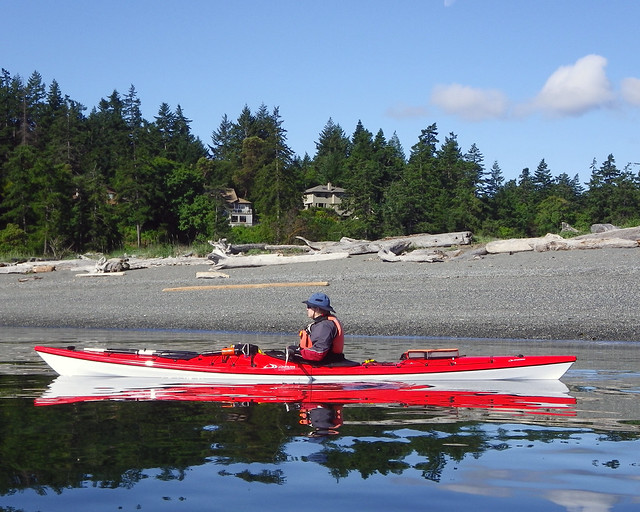
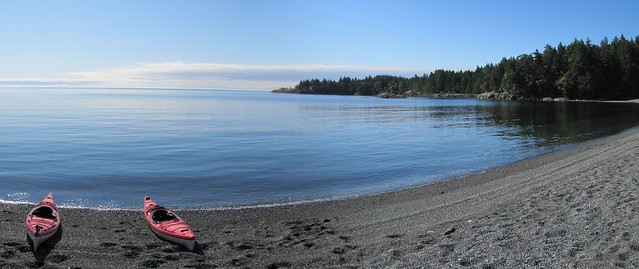
Yesterday was one of those days that was made especially for being outside and doing your thing, whatever your thing is. And Louise's and my thing was to kayak around Albert Head.

2011-06-20 Albert Head_0366 copy
It looks like Spring may finally be here...just in time for Summer to arrive on Tuesday.

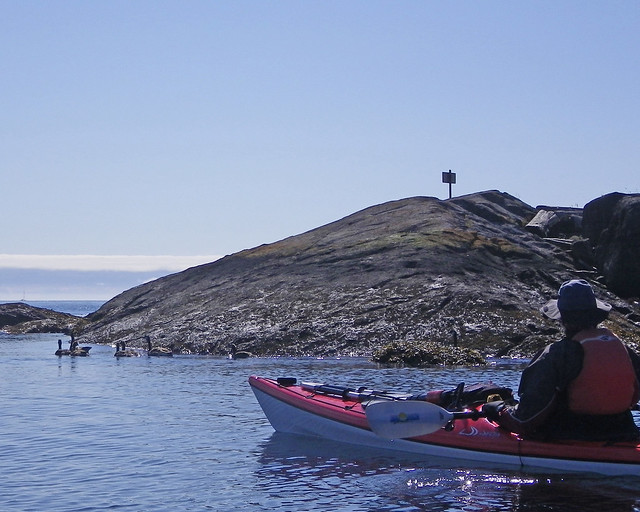
As we headed off around Albert Head, a small headland on Vancouver Island just west of Victoria, we passed a couple of families of geese enjoying the bright sunny morning.
2011-06-20 Albert Head_0370 copy

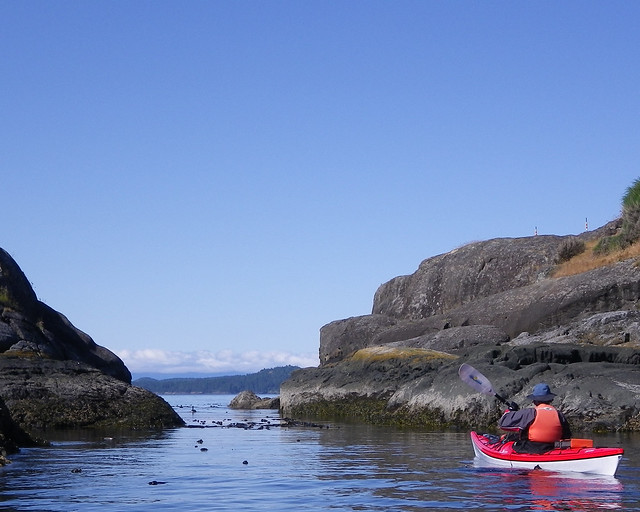
We reached the small short cut that we like to call "The Short Cut." Even with the lowering tide, we could still make it through the channel and cut a couple of minutes off the journey around the point of Albert Head.
2011-06-20 Albert Head_0372 copy

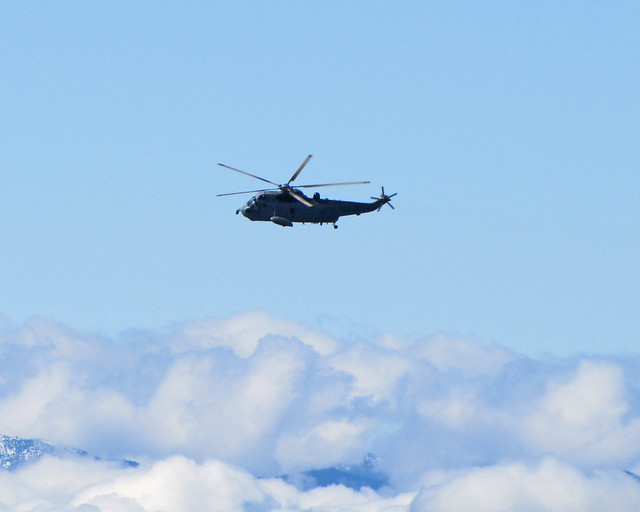
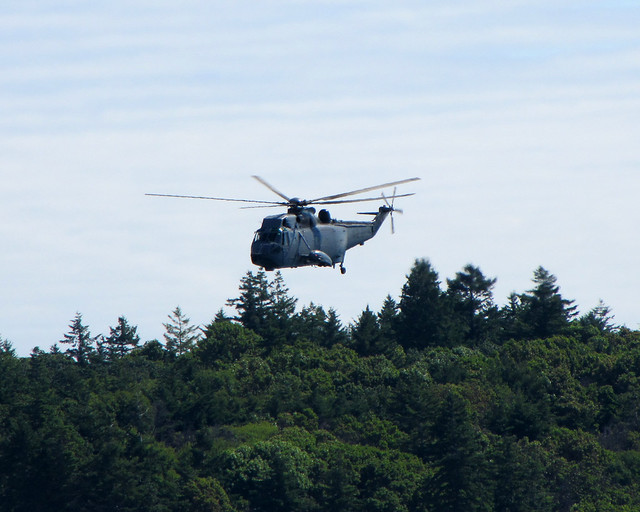
As we paddled along we could here the familiar whirring of a helicopter off in the distance. There is passenger helicopter service from Victoria's harbour, but this seemed to be closer than that. We assumed that there must a helicopter performing some manoeuvres at the nearby military base and moments later, we were proven correct as a chopper flew over us.
2011-06-20 Albert Head_0030 copy
I'm no expert, but I'm guessing this was one of the last of the SH-3 Sea Kings that's being phased out this year.
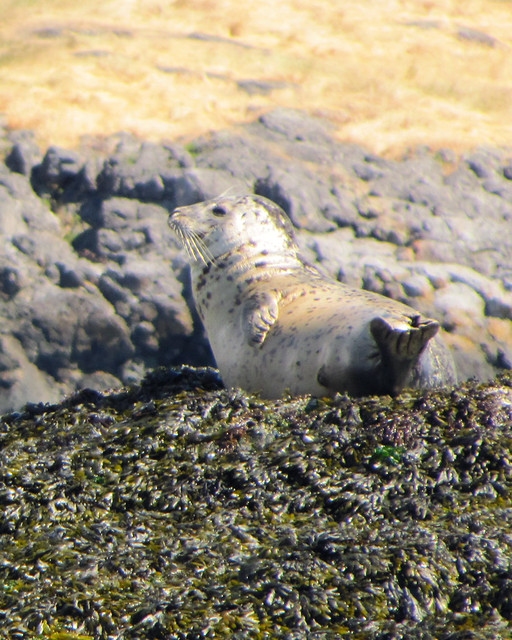
The seal didn't care what it was -- he just thought it was too noisy.
2011-06-20 Albert Head_0043 copy

A couple of minutes later it was back, and this time passed at tree-top height over the bathers at Witty's Lagoon.
2011-06-20 Albert Head_0036 copy

That seemed like more than enough excitement for us so we started back.
2011-06-20 Albert Head_0383 copy

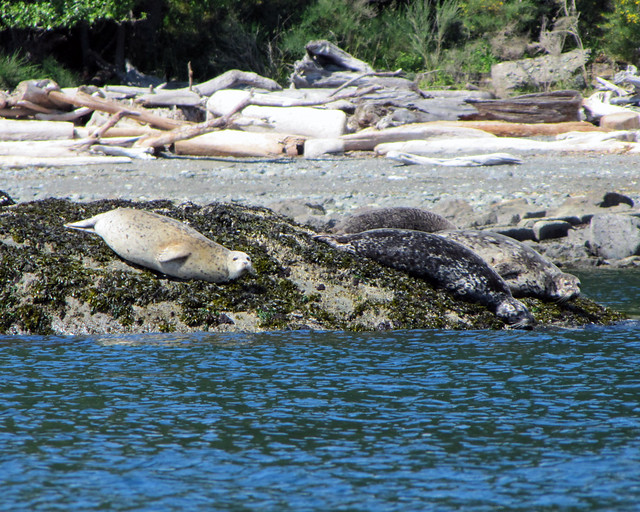
The seals didn't care one way or the other...as long as we were quiet about it.
2011-06-20 Albert Head_0045 copy

Trip Length: 10.08 km
YTD: 115.09 km
More pictures are here.
2011-06-20 Albert Head

Saturday, June 18, 2011

2011 MEC Paddlefest Victoria

IMGP0927
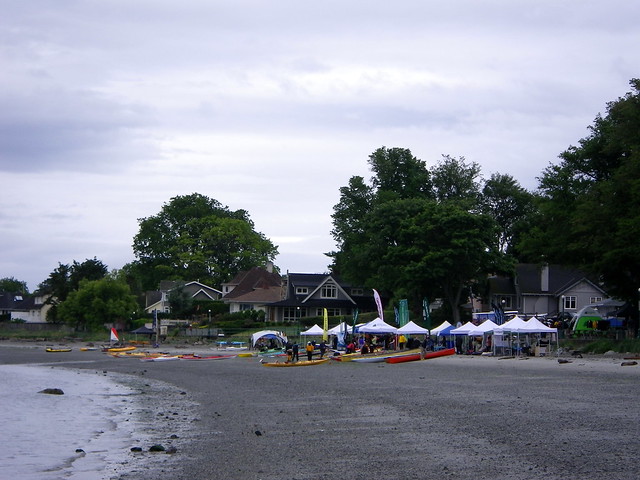
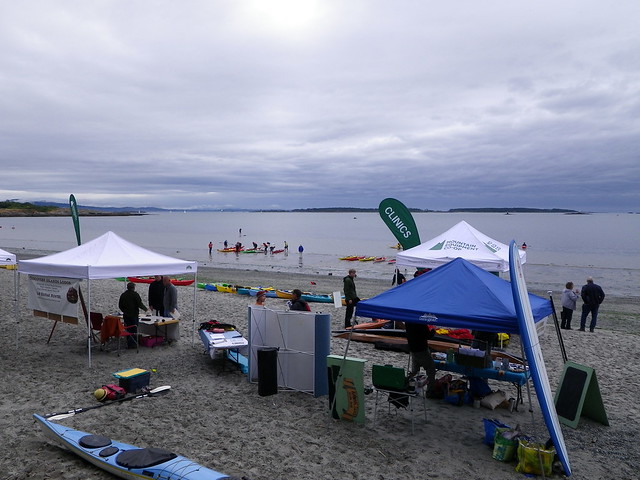
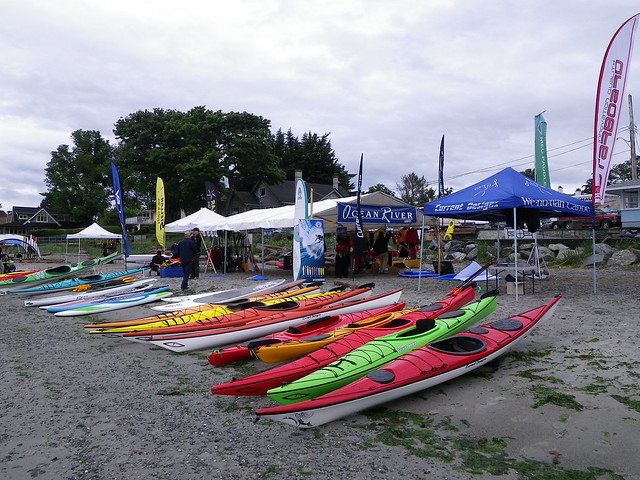
The rain let up just as Louise and I arrived at Willows Beach to enjoy the 2011 MEC Paddlefest Victoria. Overcast skies and a breeze greeted us as we began out tour of the information booths.

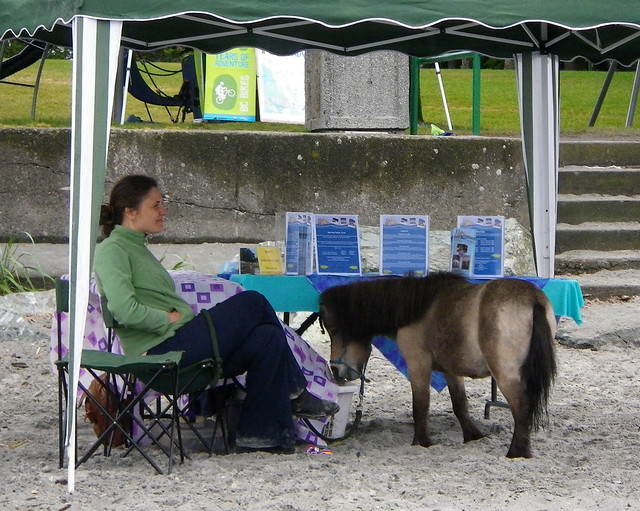
Nothing says kayaking like a donkey! Or did we miss a turn and somehow end up at a 4-H event?
IMGP0933

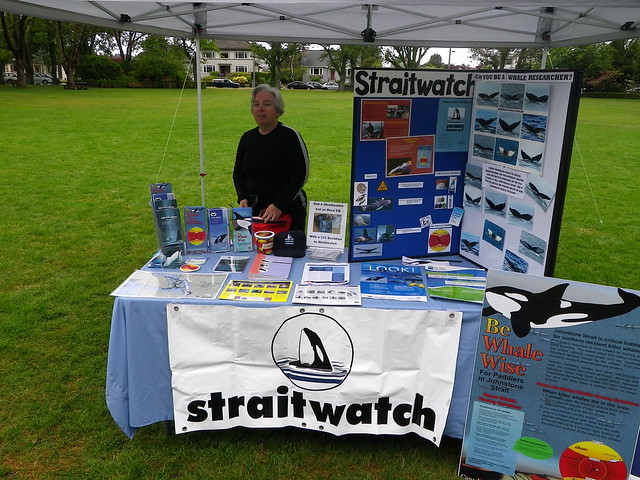
No, it's a paddlefest. We found Paula manning the Straitwatch table.
IMGP0938
Here we met a local shark researcher investigating the local waters for basking sharks. They are listed as endangered in BC waters as they were hunted to near extinction in these waters in the middle of the last century. In fact, extermination of the basking shark was official (and short-sighted) government policy in the 1950s.
It's not known how many basking sharks are left on the coast of BC -- there might not even be any -- but there has been a sighting or two in the last couple of years, giving hope that at the very least the occasional transiting basking shark might be paying regular visits.
If you've ever seen a basking shark in local waters, the Department of Fisheries and Oceans wants to hear from you.

After that we hit the beach....
IMGP0940
...and I took an Atlantis Titan for a spin. I also wanted to take out a Current Design Solstice GT Titan but the guy manning the Current Design booth didn't seem very interested in helping me.
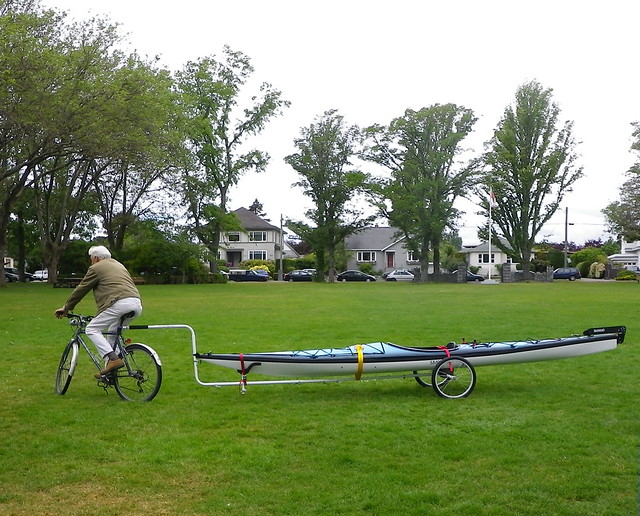
However, Tony from Tony's Trailers was keen to show off his kayak trailers for bicycles.
IMGP0947

The weather seemed to be keeping the crowds away, but those of us that showed up had a great time!
IMGP0943
IMGP0935

Trip Length: 1.27 km
YTD: 105.01 km
More pictures are here.

Thursday, June 16, 2011

Shark Music

Odds are it's not likely to happen, but let's say you're paddling along in your kayak and a shark swims by and starts showing more interest in you than you find comfortable. If you have a boombox with you, you might want to slip in an AC/DC cd.
According to this story, "a chartered boat operator in Southern Australia has been conducting research into how music affects the behaviour of great white sharks and discovered that they tended to behave in a much calmer manner when played AC/DC tracks, in particular 'You Shook Me All Night Long'."
He noted that the great white became less aggressive and more curious when exposed to AC/DC, and even began to rub their faces along the underwater speakers.
There was no word about how the sharks behaved when exposed to Barry Manilow.

Monday, June 13, 2011

Inner Habour

Project1
Yesterday, Louise and I met Paula for a quick paddle down in the Inner Harbour. We hadn't paddled here in a while, but if you don't use it, you'll lose it to developers who think it's their universe-given right to exploit public land to make a profit for themselves to the detriment of the people who actually live here. But I digress.

We put in on the western side of the harbour on a little beach in what is known as the Songhees area of town, but 150 years ago this was the hub of the Songhees nation.
IMG_3081
Two modern totems watched us as we prepared to launch.

Louise was very excited to practice the skills she learned at last week's tidal currents course. but the only skill she could remember was "the helicopter."
IMGP0903
Her father was a helicopter pilot. Like father, like daughter.

We start by passing under the Johnson Street Bridge, also known as The Blue Bridge, or Big Blue in these parts.
IMGP0906
Enjoy this view while you can, folks. The old bridge had seen better days, and it will be replaced over the next couple of years. In fact, demolition of the rail side of the bridge will begin in the fall.
Under the bridge...
IMGP0907
...and past the industrial working harbour...
IMGP0908
IMG_3087 copy
...and suddenly we're into modern urban housing and retail.
IMGP0911

This heron is enjoying a late Sunday brunch.
IMG_3097 copy
IMG_3098 copy

Clearly someone has an opinion on the Stanley Cup finals.
IMGP0913
Trip Length: 7.23 km
YTD: 103.74 km
More pictures are here.
2011-06-12 Inner Harbour

Thursday, June 09, 2011

Nanook of the North

89 years ago today, Nanook of the North, a film that is generally regarded as the first full-length documentary, was released. Here's the famous kayaking sequence:

Wednesday, June 08, 2011

Cackle TV Canada Day Sale

Justine Curgenven and Cackle TV have begun to offer many of her splendid kayaking films from the award-winning This Is The Sea DVD series as digital downloads. With Canada Day looming at the end of the month, Cackle TV has teamed up with Kayak Yak to offer something special to Kayak Yak readers.
From now through Canada Day on July 1, you can download any of Cackle TV's three kayaking films shot in Canada at a 20% discount. Go to Cackle's Download page, select any or all of the following three films, and enjoy them at a 20% savings. Use the code word KAYAKYAK when you check out!

You can choose from:
Skooks (from This is The Sea 2)
Bryan Smith (an award-winning film-maker in his own right) survives getting trashed multiple times at the famous Skookemchuck rapids in British Columbia. This surfing wave provides beautiful green waves to carve on which turn into angry white monsters on big spring tides. Bryan shows off his skills and survives multiple rolls.
Ottawa River (from This is the Sea 4)
World champion kayakers Ken Whiting and Brendan Mark take seakayaks down the grade 4 high volume Ottawa River. Justine has to survive the rapids to get in position to film the experts. It's a good thing she knows how to roll!
In this terrific film, these beautiful, remote islands off the west coast of Canada showcase an assortment of amazing wildlife, wilderness camping, intimidating swells and Haida culture. Shawna Franklin, Leon Somme and Justine paddle 500 miles around the archipelago encountering humpback whales and 200 year old totem poles. This is one of my favourite of the This is the Sea films.
And if that doesn't whet your appetite, check out this clip from the Haida Gwaii film:

Check out these films and others at Cackle TV, and don't forget to use the code KAYAKYAK when you checkout to save 20% when you download the three films featured above!

Tuesday, June 07, 2011

Cutting-Edge Fashion

*ahem*


I'm about to blow my own horn here. Turns out that I'm not quite the fashionless goob after all.

True, I have the fashion sense of an aging hippie outdoors freak, and the finely-honed body of a freelance writer. This combination of interests and anatomy has led to such outfits as the merino wool Icebreaker shirt worn with MEC's River Pants, Teva sandals with merino socks, a fleece vest made from recycled pop bottles, a bicyclist's wind shell, and frequently a bandana tied around my forehead to contain a migraine.

Migraines have been induced in my fashionistas at the sight. They have fallen into despair not because I assembled such an outfit, but because I have worn it an appalling number of times over the last few years. In public. Not just while kayaking, either, but to Olive Olio's coffee shop, the grocery store, the library, friends' homes and the movies.
Despair not, O my fashionistas! You know who you are. And for those who don't, look through the Kayak Yak website for photos of Marlene and my grown offspring, Lila and Ben. Their advice has always been reliable for me. If you can't trust a woman who is both taller and thinner than a Greenland kayak paddle, a professional photographer and model, and a man who hand-sewed his own shirt from army surplus camo and fishnet stockings, well, who ARE ya going to turn to for fashion advice? And all of them have been out paddling with us at various times, so we have photos of them in PFDs and merino wool and so on.


My fashionistas need not fret any further about my sartorial splendour, or lack thereof. I have photographic proof that in at least one instance, my fashion sense and personal grooming overlaps with no less a fashion giant than... Lady Gaga.

No fooling.

Look at the photos of Gaga at the CFDA Awards on June 6, 2011. I direct your particular attention to the turquoise-blue hair bobbed around her ears. Here's a pair of photos taken by Andrew Walker that ran on the New York Fashion website.


Now, look at the photos of me at the Ocean River Gear Grab on March 15, 2008. Here's one of the shots that John took, showing Louise and Richard unimpressed by something I'm yammering about with enthusiasm.


I humbly suggest that not only did I have the same colour hair as Lady Gaga, but that I sported the look some three years before she did. So there.
Don't anyone point out that it's ridiculous to compare myself with a fashion giant when I'm barely five-foot-one in my bare feet. I'll counter that jibe with the fact that so is Lady Gaga. It takes those odd heel-less platform boots to jack her up to Marlene's height. And hey, I wear black a lot, too.

Any comments about the round bottom showing in either series of photographs will not be dignified with a reply.

Monday, June 06, 2011

Tidal Currents Course

Ladies and gentlemen, it's been a long wait, but that wait may finally be over. May I present, in all its glory, summer!
Project2
Saturday may have been the first day I ventured outside without a jacket since last September. And Sunday promised to be sunny and warm, some might even say "hot." It would eventually hit 21 degrees in the afternoon, and it must have been the hottest day since last autumn.

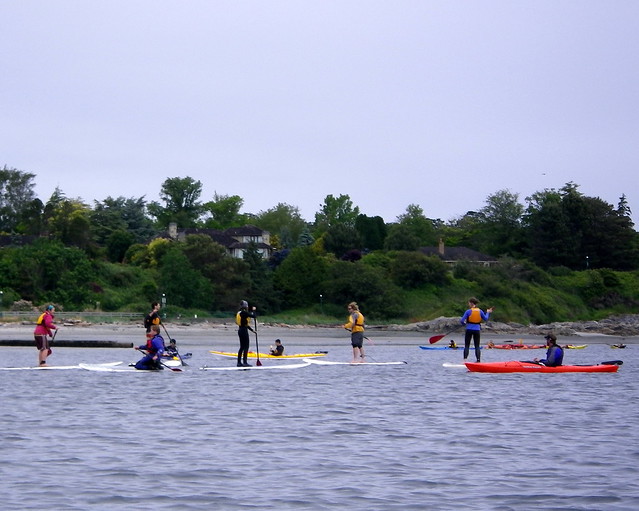
It was under these bright sunny skies that Louise and I participated in a Tidal Currents course put on by the fine folks at Ocean River Sports. Long-time readers of this blog may recall that we took the course last year under conditions that were less than ideal, and Ocean River gave everyone in the course a do-over. Out of the six people on the course today, four of them were from last year's adventure. Another person had a fair amount of experience, and as for the last student, he'd been in his kayak in a lake, but this was the first time he'd been out on the ocean. Talk about jumping in with both feet!

Louise looks thrilled at the prospect of being out in the currents again.
IMGP0874
This was also the first test of the new hip pads we installed in her kayak last week.

It really was a beautiful day. Thin clouds slowly drifted by on a light breeze. Discovery and Chatham Islands were calling us....
IMGP0892
...but we stuck close to shore and headed out to Ten Mile Point.
IMGP0883
We've paddled here lots of times, but today we were planning to be there at maximum current. Our instructor Gary estimated the current at about four knots. Max current was early today, so he wanted us on the water right away to take advantage of it. He would deal with the theory part later back on the beach.

We huddled together in an eddy while Gary quickly checked the lay of the land...um, I mean water.
IMGP0877
Ten Mile Point is a rocky area with many outcroppings and islets. Gary found three main currents runing through the rocks: a mild one near the shore, a second stronger one further out, and a third, stronger still, and futher out again.
Gary moved us to the mild current to demonstrate how to peel into a current, but as he hit the current and planted his low brace, a sea lion popped up from behind a nearby rock, possbily annoyed that he now had to share the ocean with us. Gary returned and demonstrated the maneuver again as clearly the class had been distracted.

From there, we moved to medium current, then to the fast current. Louise was feeling a little apprehensive and hung back at the medium wave with Janette, the co-instructor. She is still feeling a little unsure in her boat, and she dislikes being around large sealife and the sea lion had spooked her. What she didn't realize was that when she stayed back, the sea lion popped up right behind her without her noticing! But she quickly gathered her courage and joined us out in an eddy near the strong current.
IMGP0884

Gary demonstrated how to play in a small standing wave....
IMGP0887
...and the rest of us gave it a go, some more successfully than others.
IMGP0888
Of course, the most successful of us was the sea lion.
IMGP0891
He spent the morning riding the current over and over again like an amusement park ride, showing us stupid humans how it's really done.

Finally, we headed back to the beach for a snack and the theory, avoiding the traffic jam of geese as best we could.
IMGP0899

Trip Length: 8.15 km
YTD: 96.51 km
More pictures are here.
2011-06-06

Delta Fit Kit

Louise has been complaining for a while now that she hasn't felt as comfortable in her Delta 17 kayak as she has in the past. While we have investigated this problem, one thing we discovered is that her hips probably weren't in as much contact with the boat as they should be. This can be easily remedied with some padding, so we took a quick trip down to Ocean River Sports for some advice where we discovered that Delta Kayaks has just released a new kit especially designed to retro fit hip padding into their boats.
Called, naturally enough, the Delta Fit Kit, it consists of two pieces of plastic, some fasteners and pads. And instructions. Instructions are always good.

Before:
IMG_2781
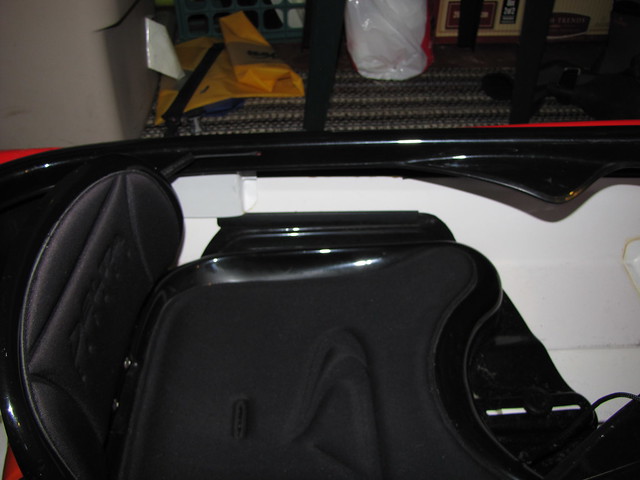
The cockpit of Louise's boat. You can see the white space between the seat and the underside of the coaming. This is, of course, the inside hull of the kayak. The plastic pieces of the Fit Kit attach to the seat and fit in on the underside of the coaming. When it's done, there should be a smaller inner wall of black plastic in front of the white hull.

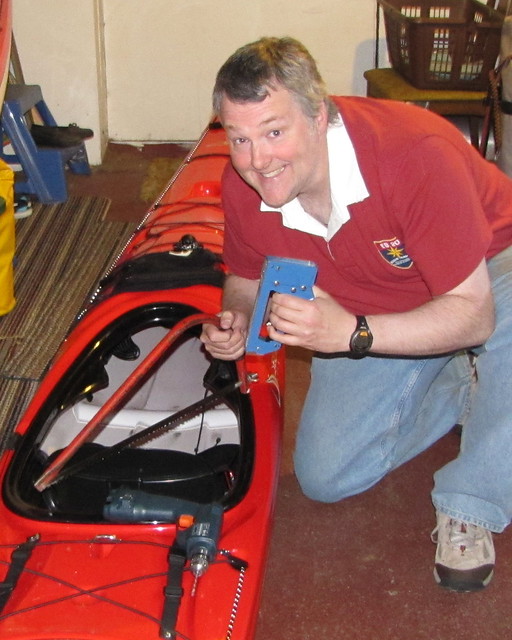
Of course, you shouldn't begin any job without having the proper tools ready to go. And nothing says "Let's work on a thin plastic kayak" more than a staple gun, drill and a rusty hack saw. Except for maybe a crowbar, sander and a welding torch. Bandages, a first aid book, a cell phone preprogrammed to call 9-1-1, and having the nearest trauma centre programmed as a waypoint into your GPS wouldn't hurt either
IMG_2782

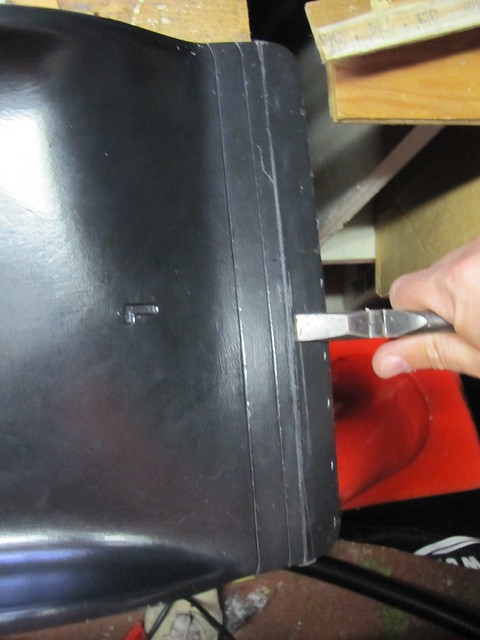
The first order of business is to trim your plastic pieces. Fortunately the instructions let you know just how much plastic to trim off for your particular kayak model. A little scoring with a box cutter...
IMG_2784
...and a little bending with pliers and we're done.
IMG_2785
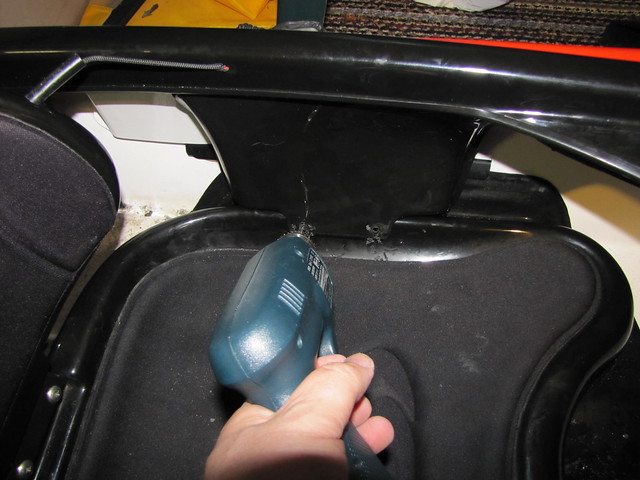
Now comes the fun part: drilling!

The new side pieces fit in tight under the coaming and snap onto the edge of the seat. Both the salesperson and the instructions warned that it might take a significant amount of force to make this work, but surprisingly not all that much was required.
With the pieces in place, they need to be attached to the seat, so holes must be drilled for the fasteners.
IMG_2786
And if you haven't had any adrenalin rushes lately, may I recommend using a drill pointing towards the bottom of a plastic boat's hull! It does get the juices flowing!

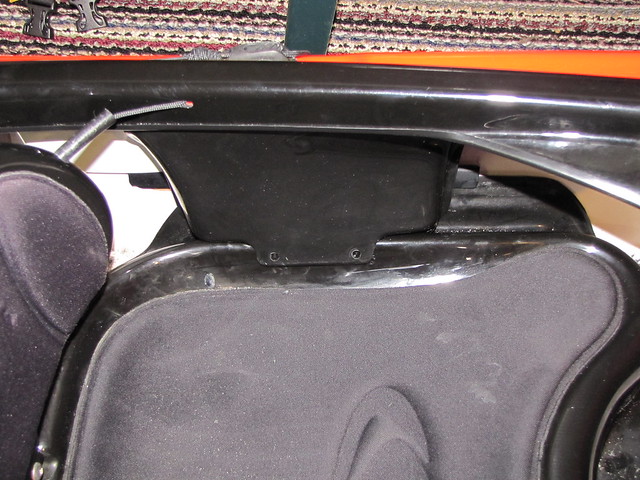
And here we are with the plastic sides installed with the fasteners about to go in. They just push in very easily.
IMG_2787

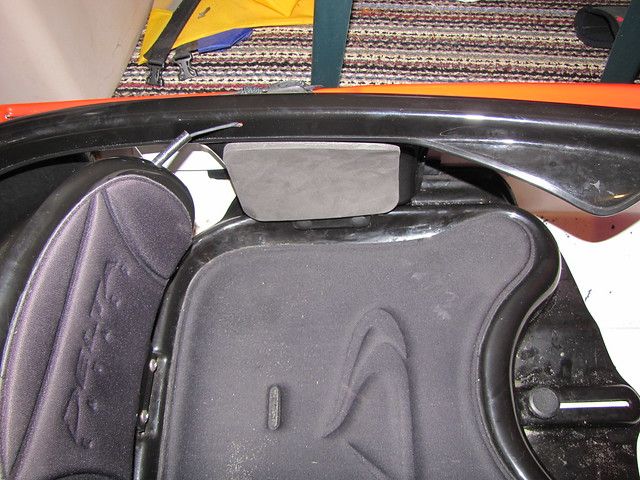
Louise hopped in and we tried to figure just how much padding she requires. The Kit comes with six pads, three for each side. We slid them in there for a test fit and two on each side seemed to be the magic number.
IMG_2789
But we decicded for the moment to try only one on each side and see how it went on her next paddle.

Sunday, June 05, 2011

Into The Deep Past

This year, I missed the first day of Paddlefest in Ladysmith, BC on a Saturday, May 14. After five years, it was a disappointment not to be there to see all the boats lined up along the shore, and talk with other kayakers. But I missed the first day of the kayaking festival for something really good instead -- something my paddling group has been looking for since we first paddled off Sidney, BC.
It was all for rocks.

One look shows how different the rocks are from one headland and island to another around Vancouver Island. There's something important to learn about geology here on the Saanich Peninsula. Look at some of our kayaking group's photos from Robert's Bay and Coal Island and the Little Group! But how to learn the local rocks? Hands-on is the best way to learn in the physical sciences. We needed a tour with a geologist. And I got one on that Saturday in May.

The Capital Regional District of greater Victoria set up the tour, finding a geologist from the Pacific Geoscience Centre on Patricia Bay near the airport. Dr Chris Yorath took two dozen of us volunteer naturalists off on a wild tour of several sites, from Island View Beach and Parker Park to Cattle Point, Finlayson Point, Goldstream River, Esquimalt Lagoon and then to Tower Point at Witty's Lagoon.

Most of these places I've been to lots of times as a child and an adult. Tower Point is a park that previously I've only seen from my kayak, when we're rounding Albert Head and going to Witty's Lagoon. You can see our blog posts on the website Kayak Yak about that area here. Parker Park is a beach access that I hadn't used before, but around Victoria there are beach accesses everywhere. The municipality of Saanich had to explain to a developer that property fronting onto Portage Inlet couldn't just cut off public access to the beach. I love it that the government is on our side on the issue of beach access!

Walking along the shoreline at place after place, Yorath spoke about the ancient origins of several kinds of rock in this part of the world. As the continent of North America drifted westward for millions of years, it ran into island chains (something like Hawaii today) that piled up along the West Coast. All of British Columbia is made up of these wrinkled ridges of rock, previously separate but now smushed together, called terrenes. Several of these terrenes can be found packed together here at the south end of Vancouver Island. Even easier to see were the most recent geological changes, caused by the glaciers of the most recent Ice Age. Yorath showed us basalt pillows that originated in undersea volcanoes a hundred million years ago, and that have been carved away by glaciers. The rock underfoot has veins of quartz, tilted layers of shale, sandstone, sandy bluffs, and conglomerate.

Yorath is exactly the geologist you want for a tour like this! He literally wrote the book on local geology -- Geology of Southern Vancouver Island, revised edition. While we were on the beach at Parker Park in Cordova Bay, we ran into students from Royal Roads University who carried copies of the book. Shyly, they asked for his autograph.

Yorath knows his earth science, and he has been walking over these local sites for decades. The man showed us his favourite basalt pillow. Any scientist with a favourite example of a rock formation is my kinda scholar! He spoke of how the scientists who studied mid-oceanic volcanic ridges were working locally, confirming not only the theory of continental drift but the reversals of the Earth's magnetic field. The places we walked over and examined were the ordinary parks we naturalists had visited for years, but with Yorath's commentary we understood them in new ways.

The rocks around us looked so permanent, but he showed us that we could see the changes and how one layer of rock overlay another. Fifty million year old rock actually looked newer than rock a hundred million years old. We could see the weathering and cracking in some places, and the big gouges from glaciers in others.

Yorath told us that the edge of the North American continent is colliding with and riding up over the Pacific Plate under the Pacific Ocean. Those mountains we could see across the Strait of Juan de Fuca, the Olympic Mountains in Washington State, were being forced higher and higher at an inch or a couple of centimetres a year. Wind and rain and gravity was wearing down those mountains too, at about the same rate, so the peaks wouldn't get much higher than they were now. John took this photo showing the Olympic Mountains.

We could see why, for example, the Gulf Islands are mostly made of harder shale, where the softer sandstone has been worn away by water and glaciers. John took this photo showing layers of shale along the west shore of Thetis Island. And now I understand why our beaches are a muddle of many kinds of stone -- it's because the glaciers scraped across this whole area time and again. Bits of stone and sand clung to the bottom of the moving ice and were carried for a short way or for many miles from one terrene to another before being left behind as the ice melted. During the latest Ice Age, sea level had been over a hundred feet lower than it is now. Ten thousand years after the great glaciers melted, the land here is still rebounding, springing up now that the great weight of ice is gone.

During Yorath's career, the rocks hadn't changed except for the most minimal of weathering, but the understanding of geology had changed profoundly. It made me dizzy, to see these stones the way he spoke about them. Time was suddenly something to think about differently than the speed of my own movements. Hot lava emerged from underwater volcanoes, cooling quickly to glass on the outside curves of slowly hardening billows and pillows. Grit and organic debris settled down so thickly and for so long that it compacted into rock under its own weight and under new lava. Mountains split and piled up like the snow I plowed from my driveway. Smooth, flat shale and slate bent like taffy, pushed by a continent colliding with volcanoes sprung from an ocean floor. There's a big bend in the layered rock visible on a cliff above Horne Lake, up-Island, and I could see it twisting in my mind's eye, an inch a year. Rigid bedrock was springing up underfoot as the weight of the glaciers melted away ten thousand years ago. The slump at the south end of James Island, making a sandy bluff and shallows, fluttered like my hair in the offshore breeze. The ocean water around our islands was as transparent as the air to my new vision.

I felt like a mayfly, or a daylily, fluttering in my short, twittering life while glaciers ran like the rivers where I paddle my kayak and the limestone and sandstone silted up and hardened like the mud on my kayak and my shoes. It was humbling.

You can understand that I kind of staggered around for the next couple of days. I was observing things! I was walking into the deep past, and watching how rock hardened and layered and bent. It all felt as familiar as cooking jam and watching it set, or stretching taffy, or baking an impossible pie that settles out its own crust and topping. It especially felt like shovelling snow off the frozen driveway -- the weight and the pressure and the texture changes. And of course, the rocks were familiar... they were the same ones I'd clambered over since I was a child.

Wednesday, June 01, 2011

The Wave

As kayakers, we seek them out, and we avoid them. We harness them and ride them. We even generate them. And in Susan Casey's latest book, she seeks out the the biggest waves she can find.
In The Wave, she follows the world's best extreme surfers as they travel the world in search of the elusive 100-foot ride. From Hawaii to Mexico to the Far East, she follows the elite of the sport as they push the barrier between remarkable and reckless. With eloquent language and in the manner of Vicki McAuley's Solo or Jon Krakauer's Into Thin Air, she explores the need of some people to push the edge almost to the point of falling over it. And a fall off waves like Mavericks or Jaws could be a life-altering or life-ending experience.
But she doesn't limit her search for the big waves to the surfing beaches. She consulted with physicists and oceanographers to learn the latest science on the creation of rogue waves, and the effects climate change is having on the oceans. She met with salvagers who take control of disabled tankers and cargo ships after their crews have been rescued. And she explored an inlet in Alaska that in 1958 suffered stunning damage from a 1,700 foot-tall tsunami. (Yes, 1,700 feet. That is not a typo.)
It's a rollicking good read and will take you as close as words can to sliding up a big one on a board as the foam splashes around you, and the thunder rattles up through your bones.